In 1865, according to Lewis Carroll, Alice followed the White Rabbit down a rabbit hole, and went deeper and deeper into a strange world. The Rabbit Hole is now a metaphor for an adventure that moves from one item to another, finding many tangents, and often taking hours to complete, usually ending far from where one began. I have often fallen into a Rabbit Hole searching for books. Sometimes that story is as unusual as the books themselves. My library continues to grow with what I feel are interesting books. Here is how the last few books were discovered.
I found the book “Am I—? Forty-Five Amusing Mental Tests” by J. George Frederick, published in 1928. It was a gift for some very close friends that just celebrated their forty-fifth wedding anniversary.
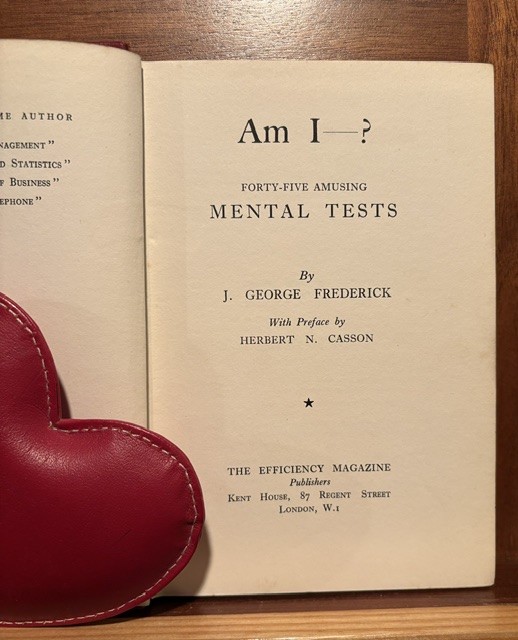
It was an interesting read (of course such a book I would read before I made it a present!) The forty-five quizzes were parlor games to be used in small group parties. (They could also be used individually for real insight to a person.) It had a preface by Herbert Casson, and was published by The Efficiency Magazine in London.
I found at the end of the book, that there were other books published by The Efficiency Magazine, and authored by Herbert Casson. I looked up a few on internet. First found was “(Twelve) Tips on Window Display” by Casson, published in 1928, in London. It was offered at a fair price, and was the ONLY one on the internet that had the original dust jacket. I bought it.
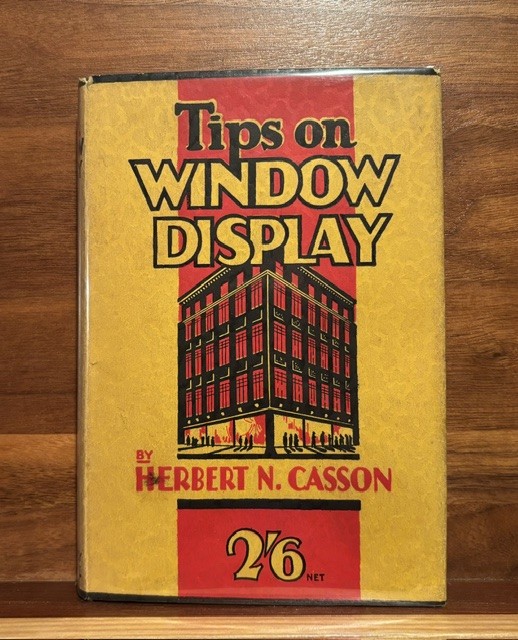
What a great find! First the yellow dust jacket. Eye catching. Then the discussion on window displays was wonderful. It brought me back to my early days of retail when I was put in charge of the window displays at Woolworth in Waukegan. Every week I would have to change seven sets of windows, then listen to the blistering critique from my manager Bill Elliott.
The tips and theories in this book brought those window dressing conversations back from dusty old memories. There is an interesting quote at the end of the book:
“As yet, Window Display is only in its dawn. No one can foresee all of its possibilities; and someone in this generation, perhaps, may yet do for Window Display what Watt did for Engineering, and what Darwin did for Science, and what Sheldon did for Salesmanship, and what Beethoven did for Music.”
(A sidenote, I wrote a article about Mundelein, Illinois, titled ” Bodéwadmi” to “Mechanics Grove” to “Holcomb” to “Rockefeller” to “AREA” to “Mundelein” (look it up on search). Arthur F. Sheldon played a big part of the development of that town. He built a business school there. I also have the complete set of his salesmanship books-twelve volumes, in my library.)
In this rabbit hole search, I found a second book by the author of “Tips on Window Display”. It is “Thirteen Tips on Luck” by Herbert Casson, published in 1929, also in its original dust jacket.
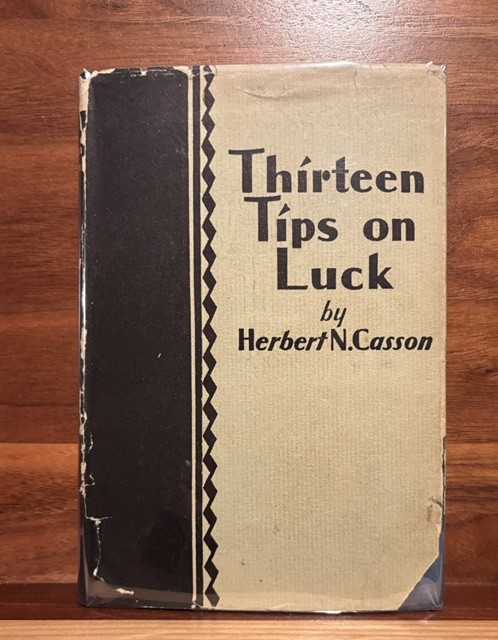
This same author explains,
“Yes-I believe in luck. But luck is made, not born. No man is born lucky. There are no lucky stars. There are no talismans. I wish there were. The man who is lucky has found out the secret for himself. I have found it out. In this book I make clear what luck means.”
This book is a fantastic self help book, written nearly 100 years ago. It is also a great read.
There was another interesting book by Casson and The Efficiency Magazine Press I saw advertised, but I felt it was too expensive-“The Story of Artificial Silk” from 1924. What is artificial silk? and in 1924? I could not let the question go. In typical rabbit hole fashion, I kept looking for other (cheaper) artificial silk books from the same era. I found one!
“Artificial Silk and Its Manufacture” by Joseph Foltzer, published by Sir Isaac Pitman & Sons, England, in 1924.
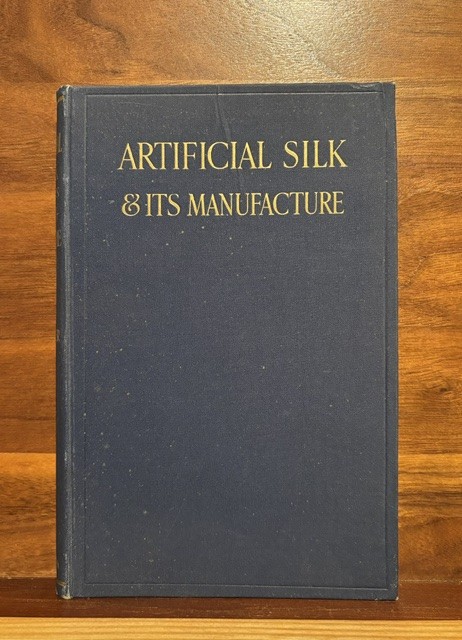
This is an interesting story. Artificial silk is Rayon; and other polyester or cellulose products. This book even goes into illustrations and descriptions of the manufacturing machines to make Rayon. It is quite a detailed book…and another great read.
I still wasn’t done crawling through the rabbit hole looking for books, and found another by the same publisher of Sir Isaac Pitman and Sons, “Silk. Its Production and Manufacture” by Luther Hooper, published in 1924. And with its dust jacket!
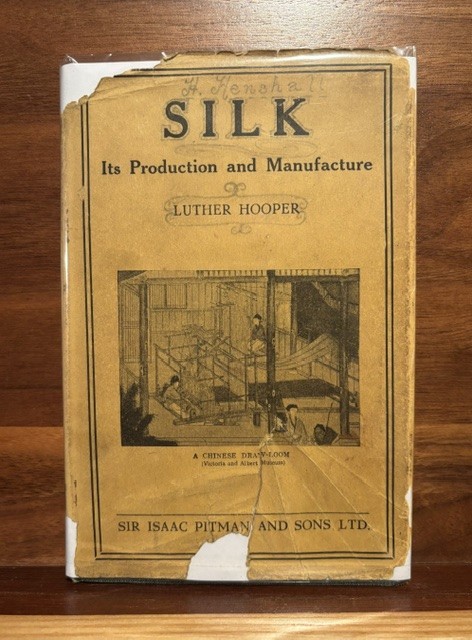
This is a marvelous book about silk. There is a detailed history of the silk worm, and weaving. Then how modern machinery helps with dyeing and weaving. It has interesting illustrations, many with foldout pages. I even read the appendix on Fire Hazards Incidental to Silk Mills and Factories. You just can’t find this type of information on modern Wikipedia. Such details in these older books.
So…four different books bought during a rabbit hole adventure, when finding an anniversary book gift for some friends. The search was rewarding, as were the readings afterwards. And I still can show the books to other unsuspecting friends that I lure into my library. Many are mind-numbed senseless almost as soon as they pass the threshold, but there are a few folk, that when they touch and hold these tomes, can feel the inner excitement that books possess. They are the lucky ones.
Thanks for reading.
“Oh, you can’t help that. We’re all mad here. I’m mad. You’re mad.” -Cheshire Cat from Alice’s Adventures in Wonderland

