December 12th is National Gingerbread House Day. Gingerbread Houses were made famous from an old German fairy tale. I have “Grimm’s Fairy Tales” by the brothers Grimm, published in 1926.
In the story, we find an evil stepmom who convinces her husband to allow her to lead his children into the woods, and leave them there forever. Lost, the children stumble upon a gingerbread house, and start munching on it. A witch catches them both, and locks the two up to fatten them, later to be eaten. Instead, Gretel pushes the witch in the oven, and kills her. The kids take jewels they find in the house, and eventually find their way back home. During the time that they were gone, the evil stepmom has died, so Hansel and Gretel, and their father live happily ever after.
I also have two other interesting books about Hansel and Gretel. They are both illustrated by dolls posed as the characters in the story. The first book is “Hansel and Gretel” “A Living Story Book” published in 1967. I would like to show the book, and then the kids eating pieces of the house.
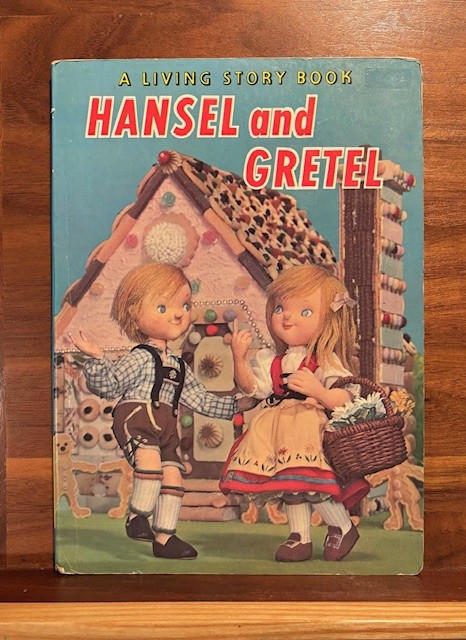
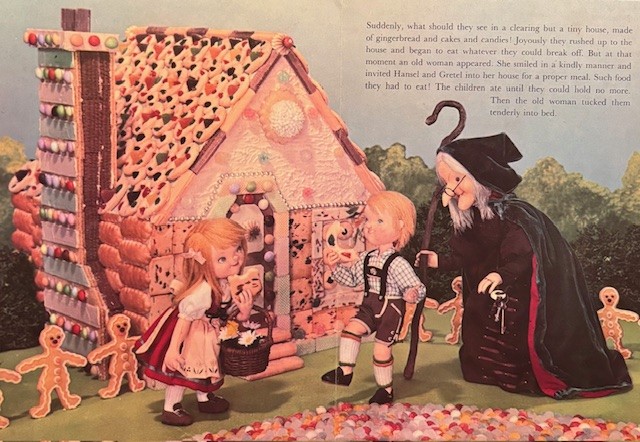
I also have “Hansel and Gretel” a “Giant 3-D Fairy Tale Book” published in 1984. It is the same type of book, with dolls posed for the story, just about twenty years later. Again, I will show the book, and then the page of children eating from the gingerbread house.


I bought this book, along with several other fairy tales in the series, to read to my children when they were little.
December 12th is also National Poinsettia Day. The poinsettia plant comes from Mexico, and is sometimes known as the ‘Flower of the Holy Night. The plant was brought to the United States by Joel Roberts Poinsett, the first Ambassador to Mexico. He was also a botanist, and brought plants to his greenhouse in 1828. Poinsett was enamored by the brilliant red bracts against the green leaves. The poinsetta was named after him, and Congress declared December 12 Poinsettia day after his death on that day, 1851.
Poinsett later was instrumental in getting the $508,000 ($15,000,000 today) estate that James Smithson bequeathed to the United States for an institution for the “increase and diffusion of knowledge.” While others wanted a library or a science lab, Poinsett promoted the idea of a museum. It became the Smithsonian Museum.
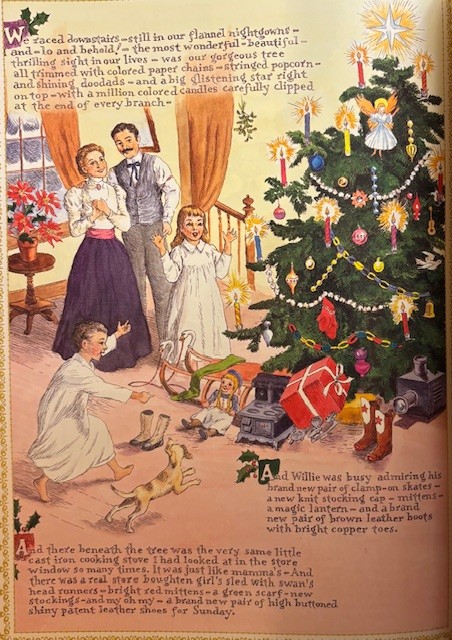
In the book “The Ideals Classic Chrismas Treasury” 1994, there are some wonderful Christmas stories and illustrations.

I would like to show a few of the illustrations in the book that display poinsettias.
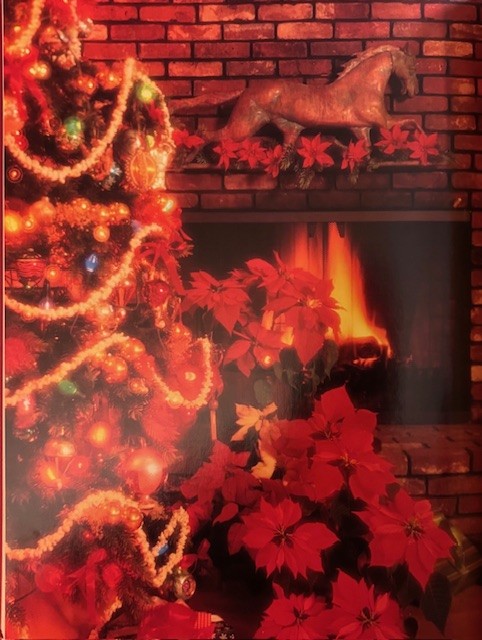
I also have “A Christmas Alphabet” by Robert Sabuda, published in 1996.


Sambuda has developed many popular pop-up books, some rather intricate. He also had made more than a few Christmas pop-up books. In his Christmas books, he likes to keep all the pop-ups white. He said that it is is more calming, and that one can see the shapes, and movements better when just in white.
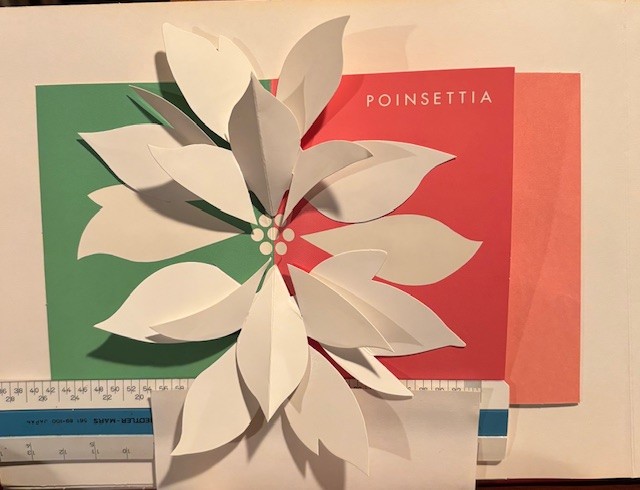
From St. Matthew Catholic Church in North Carolina, I found a version of the Mexican Legend of the Ponsettia.
“A legend is told of Pepita, a poor Mexican girl who had no gift to present the Christ Child at Christmas Eve Masses. As Pepita walked slowly to the chapel with her cousin Pedro, her heart was filled with sadness rather than joy. Pedro said consolingly, I am sure, Pepita, that even the most humble gift, if given in love, will be acceptable in His eyes.
Not knowing what else to do, Pepita knelt by the roadside and gathered a handful of common weeds, fashioning them into a small bouquet. Looking at the scraggly bunch of weeds, she felt more saddened and embarrassed than ever by the humbleness of her offering. She fought back a tear as she entered the small village chapel.
As she approached the altar, she remembered Pedro’s kind words: Even the most humble gift, if given in love, will be acceptable in His eyes. She felt her spirit lift as she knelt to lay the bouquet at the foot of the nativity scene. Suddenly, the bouquet of weeds burst into blooms of brilliant red, and all who saw them were certain that they had witnessed a Christmas miracle right before their eyes. From that day on, the bright red flowers were known as the Flores de Noche Buena, or Flowers of the Holy Night, for they bloomed each year during the Christmas season and thus, the legend of the poinsettia was born.”
My last poinsettia story is when my sister was born (on December 25), my grandfather called the local florist at home that Christmas Day. Grandpa convinced him to open, and sell the largest poinsettia he had, so it could be taken to the hospital. Because of that birthday beginning, my sister still gets poinsettias for her birthday every year.
Sometimes, I had wished that my sister would have eaten some poinsettia berries, or the stem and leaf sap. While I don’t feel that way today, there was a time growing up. Why??? You will have to wait until December 25th…
 Librarytomes
Scientific tests have shown that poinsettias are not poisonous. Poisindex, a primary information source for Poison Control Centers, says that a 50-pound child would need to eat more than 500 poinsettia bracts to experience any toxicity, and even then, they would likely only have a severe stomach ache.
LikeLike
I did know that. I had to prove to wife that it would be OK to own a dog for similar reasons. It is still one of the most common misconceptions about poinsettias. The white sap can cause skin rashes and burn sensations in the mouth-which would still prove point of story about my sister. Hope you will read ending on December 25th.
LikeLike