On November 14th, 1851, Moby Dick, by Herman Melville, was published in the United States. While I have talked about it in some detail on Whale Day February 18, I have an additional book that I did not use then (Go back and re-read. I have a touching story on both my mom and dad-miss them both.)
This book is a wonderful kids book “Moby Dick” adapted and illustrated by Allen Drummond, 1997. This book does a good job of showing the characters in the book, and a lot of whaling information.
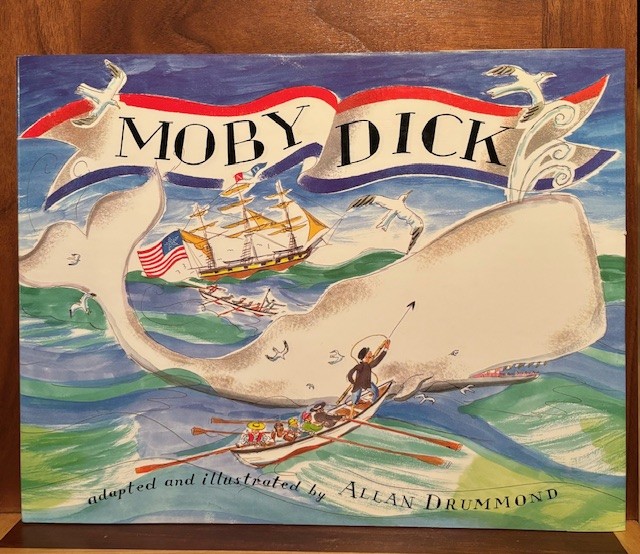
An interesting illustration is that of Captain Ahab, caught on his harpoon rope, was hooked to Moby Dick.

Moby Dick then submerged, and dragged Ahab under the waves. You could say that Captain Ahab was in quite a pickle…
November 14th is National Pickle Day. This is a day to celebrate both dill and sweet pickles, in fact any brined cucumbers qualify. My first book is “The Orange Judd Cook Book by Adeline O. Goessling, published 1914.

Orange Judd is famous for books on farming, for farmers. This is a farmer’s cookbook. I look up pickles and find five different recipes for Dill Pickles. I find another three recipes for Sweet Pickles. And then one for Olive Oil Pickles (using a 1/2 cup olive oil to gallon jar). But then there is more. There are two mixed pickle recipes,one with mangos (green and ripe), cucumbers, calliflower, onions, and celery; the other with green tomatos, cabbage, cucumbers, onions and added horseradish to the spices. The next eight pages are about different items being pickled.
I have a professional book “Pickle and Sauce Making” by Raymond H. Binsted, published 1939 in London.
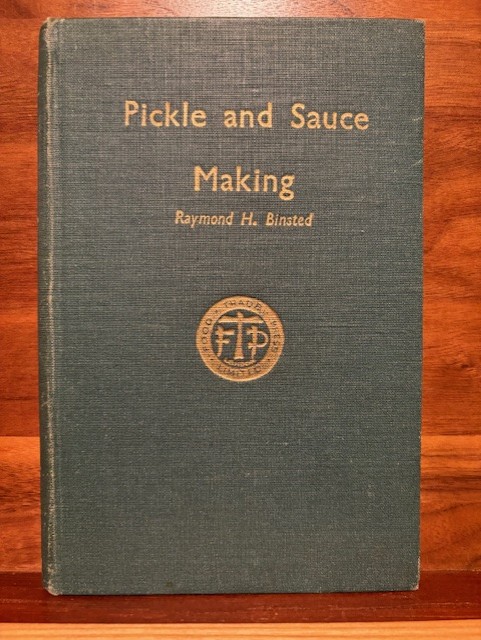
If you want to know how the British pickle and brine as a business, this is the book to read. It talks about proper brine, vinegars, coloring, spoilage, cloudiness, blackening, even blemishes on pickles.
Another book “Farm By-Products-267 Hidden Treasures” compiled by Farm and Fireside, published 1910, helps farmers. It shows tips on things to do on farm to make a little extra money.
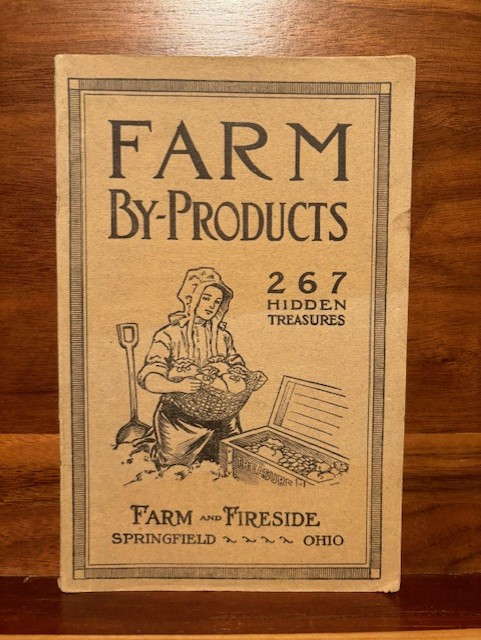
On the chapter on pickling, a good tasting quart of pickles can sell for about 30 cents. Ripe and almost too ripe cucumbers can be made into sweet pickle relish for about 20 cents a quart. We then read about corn, pickled onions, chow-chow and piccalilli. Those too could sell for about 20 cents a quart in 1910.
I then turn to “We Farm For A Hobby-And Make It pay” by Henry Tetlow, published 1940. When I turn to pickles, the author states that after trying Dill Pickle recipes, they would grow soft when storing. His answer was to use the state and federal agencies for farming help-they have bulletins for everything farming.
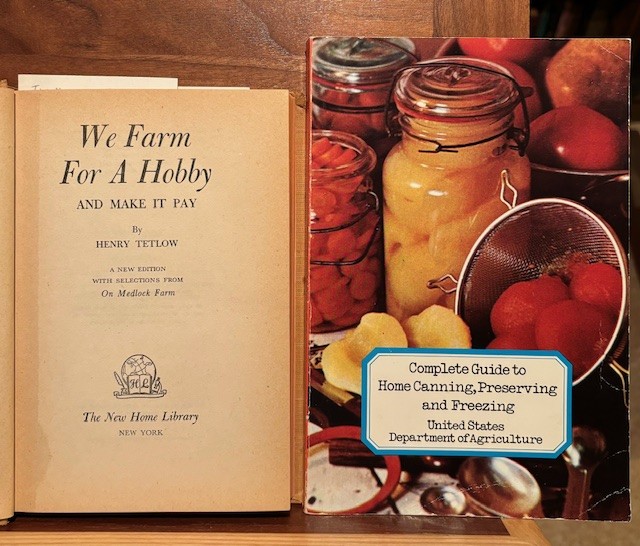
So I went to the United States Department of Agriculture, and have the government specifications on “Complete Guide to Home Canning, Preserving and Freezing” published in 1977. This book was published from seven pamphlets published from U.S. Department of Agriculture. I have reviewed this book on any home canning I have done.
Sometimes, it is not about the pickle.
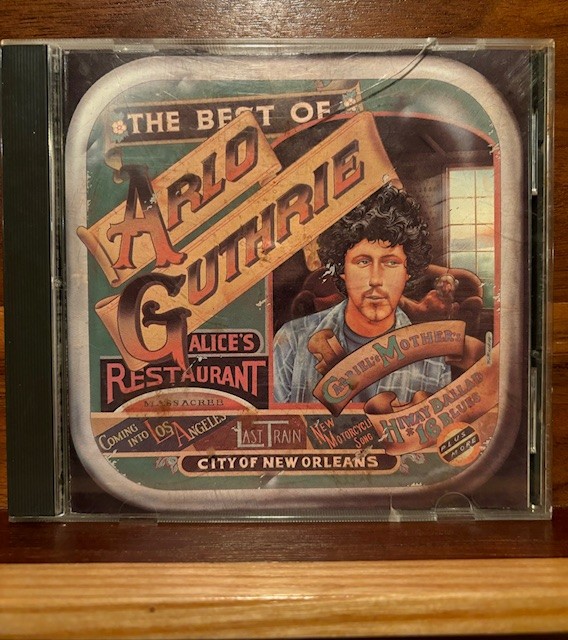
I have the “The Best of Arlo Guthrie” CD. There is a great tune “Motor (Significance of the Pickle) Song”:
“And I don’t want a pickle,
I’d rather ride on my motorsickle.
And I don’t wanna die,
I just wanna ride on my motorcy . . . cle.”
This would be my son and his uncle, humming that motorcycle song.

For them: “Live to Ride, Ride to Live.” They’re living their dreams.
For me, my dream might have to be from “The Music Man”…
“Marian, Madam Librarian
What can I do, my dear, to catch your ear
I love you madly, madly Madam Librarian, Marian“
Ahhh, I’m in a pickle, too. Thanks for reading.
 Librarytomes
My advice…. substitute Marylyn for Marion and you would have avoided being “in a pickle!”
LikeLike
I know, but Marian was Shirley Jones! I wanted her to date-stamp me in that River City Public Library. And that would be trouble…which starts with “T”, and rhymes with “P”, and that stands for Pickle.
LikeLike