“In this noble and Ancient place, once palace to our count-kings, I offer you all I have brought together in a life ruled by the passion of Art” – Frederic Marés
Museums. I love to visit museums. There is such excitement in seeing history, and what some other person has viewed as interesting. My parents began me on this passion by taking regular trips into downtown Chicago to visit the bounty of wonderful museums there. Field trips in grade school and junior high also had me bussed to Chicago-even once to Washington D.C.. I have also been lucky to do some traveling, and have seen wonderful museums in many countries. I have some books on various museums: some bought as souvenirs when visiting, and others in book hunting when back home. I would like to point out a few books and their unusual corresponding museums.
My first book is “Catàleg del Museu Frederic Marés” published in 1979 by the Barcelona museum. The book is a catalog of highlights from this amazing museum. While it is not in English, the photographs are a wonderful reminder of a dizzying collection. The book is in both Catalan and Spanish, each 145 pages in a flip-book way, with 185 photo pages of cataloged key items and photos of rooms, sandwiched between.

The Frederic Marés museum is in the Gothic Quarter of Barcelona. There is no huge sign, or pillars, or grand doors to announce this museum. Next to the Barcelona cathedral, is a small side street walkway, and the Museum is part of the old Palace (of Inquisition) complex. It is invisible from the street. One has to go downstairs for the entry (very inexpensive-and we even went on a free day!) We looked out a window on second floor, and could see the courtyard of Sala Tinell, a large hall where we were told that Columbus presented the first gifts from his travels to the New World to the Queen and King, Isabell I and Ferdinand II.
Frederic Marés was a Catalonian sculptor and collector. He lived from 1893 to 1991 in Barcelona, Spain. Not only are his works of art in this museum, but also his personal collections of just about everything. In the 1940’s, he donated his stuff to the city of Barcelona, and continued to collect. This can be an overwhelming museum to walk through. One begins in Medieval religious art. There are rooms of, crosses, crucifixes, sculptures and art from churches around the country, some very large, brought from alter walls of old churches.
Rooms appear one after another, and floors keep going up. It is quite a maze. Once one goes through several floors of this large art and sculpture, including Marés own sculpture work, one walks along his personal collections-his “Curiosity Cabinet.” Throughout these rooms, one sees immense collections, such as butterfly, feather, and human hair in artwork and clothing. Or pipes, cigarettes, cigars, and lighters. Or keys, watches, and door knobs. Or tools. Or fans, brooches, and pins. Or glasses and combs. There are collections of almost everything. On the fifth and last floor, after walking through so many rooms, one ends at the entertainment collections-toys. It is all wonderful.
Walking back can be daunting, and tiring. While one eagerly moved foreword, with expectations and thrills of what possibly could be next, when walking back one is now aware of how big each room is, and how far one has weaved through displays and floors. A charming lady near the stairs on that fifth floor, looked at my wife, and in a strong Catalonian accent, said “Please, this way. I can see that the museum charmed you too much. Do not take the stairs. Let me guide you to an elevator.” We then quickly dropped five stories, and made our way back out to the street, tired and speechless from what we experienced. Many museums have been wonderful, large and full of amazing art and history, but none have met the sheer volume of various curiosities, brought together by a single person.
My second book is “Bestecke” (The Egloffstein Cutlery Collection from the 15th to 18th centuries, at the Wartburg Castle) printed in 1994. It is a large coffee table book and well written in both German and English. The photos are spectacular. There is also a wonderful commentary about the dinner habits and practices from the Middle Ages to the 20th century.
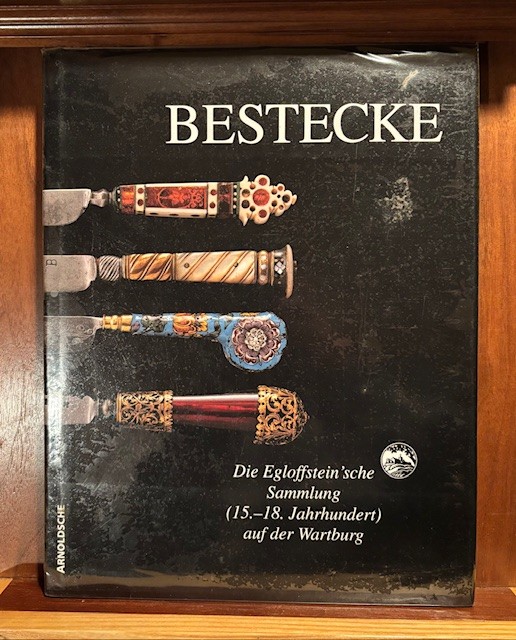
There is a small museum inside the Wartburg in Germany about cutlery, that is to say silverware, from medieval times. This large and detailed collection from Baron Egoffstein was purchased by the grand Duchess Maria Pawlowna, daughter of Tsar Paul II. She brought this to the court of Weimer, and it has now been at the Wartburg for over 180 years. The museum show the great diversity of elaborate knives and forks, along with some spoons through the ages. The designs of some cutlery, and workmanship of handles of amber, ivory, bone, along with inlays of gold, silver, marble are spectacular. There were folding cutlery, and even a set of knife and fork pistols.
The Wartburg is a place full of amazing life-changing religious history. It was a windy and snowy day when we visited. As we were not looking forward to the long winding road back down to the parking lot near the bottom of the mountain, we looked at any area we could still peruse, until they finally kicked us out to the cold. This hidden gem of a tiny museum tucked away in a corner set of rooms was a fantastic surprise. So much so, that when I later found this book online from a used bookstore in Germany, I bought it immediately. It was well worth the price.
My third book on unusual museums is “Amstelkring Museum-Our Lord in the Attic” by Marco Blokuis, 2007. This is a book about a house museum. There are many house museums around the world, and while there are objects in this museum, the museum is actually the house itself.
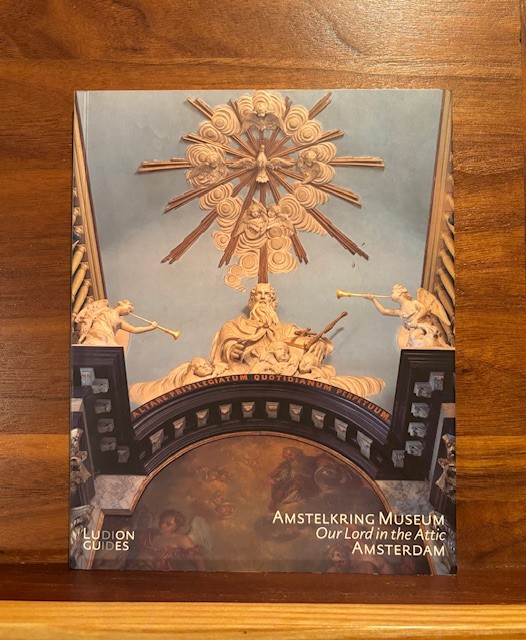
This house was built in Amsterdam in the 1630’s. In 1661, it was bought by Jan Hartman a wealthy Catholic. The house is connected to a row of houses along a canal. The town was currently then Protestant, and it was against the law then to publicly have Catholic services. All churches were Protestant-some remodeled Catholic churches. However, with Freedom of Religion and Freedom of Conscience in Amsterdam, anyone could worship as they wished behind closed doors. So Jan Hartman made a church behind those closed doors. He remodeled his home into an actual church.
Hartman re-supported the walls by connecting a few thin bars from one side wall to the other, and then cut out several floors, leaving only a balcony-width walking space on each side. Then on the back of the home he made an alter-three stories tall. On the front side he had a large two-story organ, complete with pipes put in. There was a lovely painted barrel-domed ceiling. In all, 150 people could attend a mass in this amazing church. Finally in 1887 (over two hundred years later!), Catholics were able to worship publicly in the newly built St Nicholas Cathedral. “Our Lord in the Attic” was then turned into a museum in 1888. It is the second oldest museum in Amsterdam.
Even currently, when one visits the museum, they are stunned when they walk through the front door. From the outside, it is just a single door to a home. The block is still just a row of houses, when you look down the street. But when one leaves the street to go inside, they are walking into an elaborate Catholic Church. It is amazing how an inconspicuous narrow home on a block, can be such a tall gilded secular church inside.
As I move efforts now to the United States, I will talk about another home, much, much smaller, and yet even more elaborate. I have the book “Colleen Moore’s Fairy Castle” printed in 1964 by The Museum of Science and Industry in Chicago.
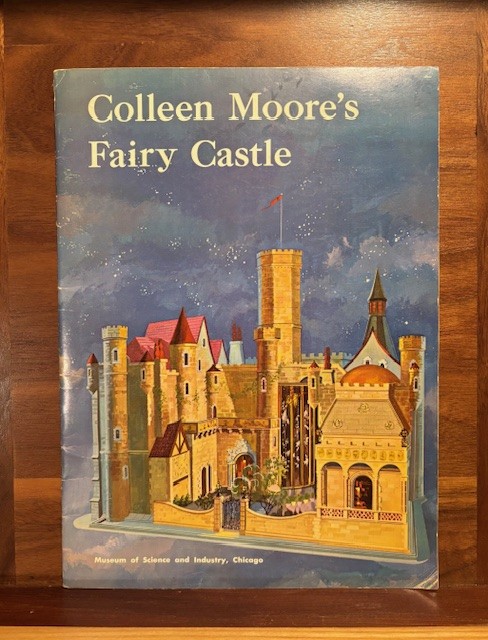
Colleen Moore was a famous and wealthy Hollywood actress during silent films, and she also made a few talking films before retiring. Her father made her a doll house when she was two. She loved it. He kept building or buying her larger ones. He also bought her a miniature book-a dictionary, that sparked her desire to build a miniature book collection. Finally her father, after she became a wealthy movie star, recommended she hire an architect and make the doll house of her dreams.
Moore did. Along with the detailed building of the fairy castle doll house at 1:12 scale-1 inch equals 1 foot, she also spent vast sums of money for the treasures inside. From this book, I will describe a few. The library has many real miniature books. There are others made with the covers of actual books, and then sent to the corresponding authors to hand-write portions of their book, or put in poems with their own hand. Some of the authors that contributed were: A. Conon Doyle, William Randolph Hearst, Sinclair Louis, F. Scott Fitzgerald, Booth Tarkington, John Steinbeck, Charles Norris, Willa Cather, and Edgar Rice Burroughs.
Two small vases by a doorway are actual real tiny jars: one from The Tomb of the Kings in the Valley of the Nile, and another a 1,000 year old urn from Thailand. There is another 500 year old miniature amber vase that belonged to The Dowager Empress of China.
There are almost 2,000 items in this 9 foot by 9 foot palace. It is 12 feet tall. It is electrified, and has running water for bathrooms and fountains. Real marble for miniature tiles and pillars were used. Gold and silver are everywhere. Jewelers and many craftsmen spend months, actually years making individual items. Imagine blown glass Cinderella slippers only 1/2 inch long.
In the chapel are two tiny bibles-the smallest in the world. There is also a glass vial holding a miniature ivory crucifix, a quarter inch wide, carved in Italy over 500 years ago. On a small ivory stand is a bust of Pope Pius IX. It is said to be the most valuable item in the miniature castle. Originally the statuette was the actual personal seal of Pius IX with the Vatican seal on the bottom of the bust.
One must see this Fairy Tale Miniature Castle. Words do not do justice; Just spend time peering at each room. Colleen Moore spent almost $500,000 to have it built and furnished, when completed in 1935. It took seven years. It is estimated that the value now is about $7,000,000.
Two other honorable mention books on miniatures in museums that I have visited are: “Three Ringling Circus” by Sandra Gurvis from 2024; and “The Crabtree Collection of Miniature Ships” 1969.
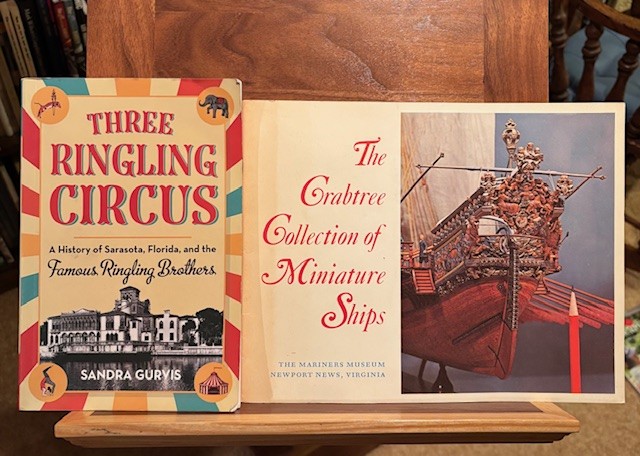
The Three Ringling Circus book talks of Ringling Brother’s circus museum in Sarasota, Florida. At the heart of the museum is a 3,800 square foot replica of the outdoor circus. There are 44.000 pieces individually carved, everything at 1:16 scale-3/4 of an inch to a foot scale. The artist Howard Tibbles spent 50 years to complete it. This circus is the Greatest Miniature Show on Earth.
The miniature ships carved by August F. Crabtree (1905-1994) are the most detailed of any miniature ships ever made. This 16 ship exhibit is in The Mariners Museum in Newport News, Virginia. As the artist described that “this group of models depicts the evolution of water transport.” They were hand carved, and actually fully rigged ships and boats, complete with sailors, and accessories. They were carved at 1/48 scale-1/4 inch to a foot. It took the artist and his wife 30 years to complete them. They are simply incomparable.
Another book that further whetted my collecting habits, along with my thirst for museums is “Gems and Gemstones” by Lance Grand and Allison Augustyn 2009. This coffee sized book is actually one of my favorite books in the library.
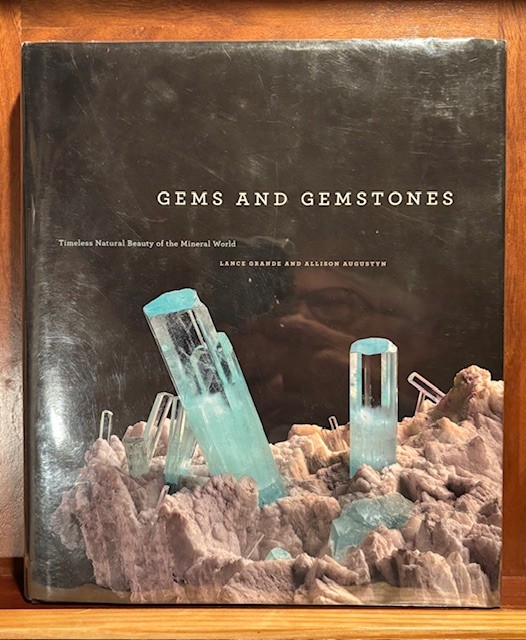
The book was printed in coordination with a new hall opening at The Field Museum in Chicago. In a corner tucked away by the back staircase is The Grainger Hall of Gems. This, while small, is a wonderful set of two rooms. There are all types of jewels, minerals, and crystals. What is wild is that there are remarkable and famous pieces of jewelry (some are the largest stones in any museum), and along side each piece is a corresponding jewel in its natural state out of the ground. So to see what items look like when found or mined from the ground, and then when cut and polished to perfection, is an incredible side by side view. The worth in dollars of the jewels in these two small rooms is incalculable. Makes me collect, and help my grandchildren search and collect rocks and fossils all the more.
I have another interesting book, “Religion in Museums, Global and Multidisciplinary Perspectives” published in 2017. One of the editors is Gretchen Buggeln. She received her doctorate at Yale, and holds the Phyllis and Richard Duesenberg Chair in Christianity and the Arts at Valparaiso University.

I mention her name, because not long ago, I was visiting The Art Institute in Chicago with my granddaughter, along with a friend and his daughter, we ran into Gretchen and another professor in the members breakroom-we shared a table. Gretchen was gracious and told us hints about areas in the museum. She addressed the kids in our group directly-still “teaching” even while on break. She was there with a class of students from the university.
After our lunch, we thanked her and began walking out. Gretchen ran up to us, and said, as we neared a window next to the exit, “If you have time after the museum, go to that building out there.” She pointed to a tall building facing Lake Michigan. It was the Chicago Athletic Association Hotel, a Victorian Gothic building built in 1893. She then added “You can take an elevator for free to the top, and look outside at Millennium Park and the lake. It is a beautiful building and view” It was a great second adventure after the Art Institute. Because of her kindness, and my curiosity, I have tracked down more of her written books for my library.
I have several other museum books worth noting on teaching: “Where’s the ME in Museum” by Milde Waterfall and Sarah Grusin. printed in 1989; and “Teaching History with Museums” by Alan S. Marcus, Jeremy D. Stoddard, and Walter W. Woodward, published in 2012.
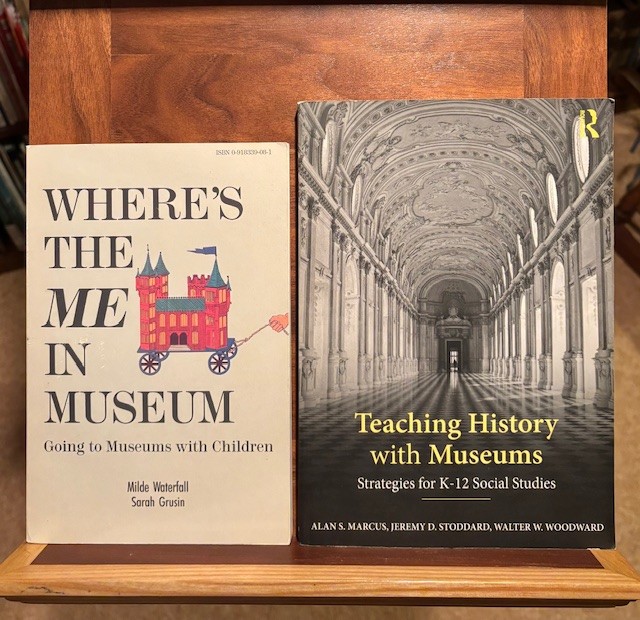
These are both interesting books on leveraging the best of for teaching kids, and having them get the most out of museum trips.
One of the best museums to go to, would be the closest one to where you live. I am lucky to have The Peoria Riverfront Museum nearby. I have been using this museum for 32 years-when it was first Lakeview Museum. My first interaction was when I moved to Peoria to open a Target store. As operations manager, I had to make everything run smooth with freight, people, and all opening tasks. Target headquarters wanted to make a donation to a community program to help make awareness of Target in the community. We gave a large donation to the Lakeview Museum to sponsor an exhibit on Dick and Jane illustrations.

I represented Target at the private Grand Opening. I brought my mother along. As a retired teacher, she used Dick and Jane books for quite a few years. She and several illustrators for the books struck up a wonderful conversation for a good part of the evening. I also met the museum’s head of marketing. He was very gracious with introducing us to the community.
As I raised my kids, and now grandkids going to the Peoria Museum, he has moved up to become President and CEO of the (now) Peoria Riverfront Museum – “The only multidisciplinary museum of art, science, history and achievement in the nation.” I have luckily seen first hand what an immense impact John Morris has done for Peoria and the Riverfront Museum. I am always happy to run into him several times a year, indebted for what I am able to share with my family.
A display wing the museum had when first opened, and kept on display for many years was a representation of sports in the Peoria area, high school and college. There was a pin machine there-a perhaps 4 by 6 foot board filled with thousands of plastic pins. It was interactive. You could press your hand in the pins, and see a “pin hand” on the other side. Kids would make designs and faces with it. A pillow was there to reset the pins. I started taking pictures of the pins every time my granddaughter would make a design. She started really looking forward to what she was going to do. She tackled Starry, Starry Night, The Scream, The Thinker, Bob Ross, as well as just having fun.


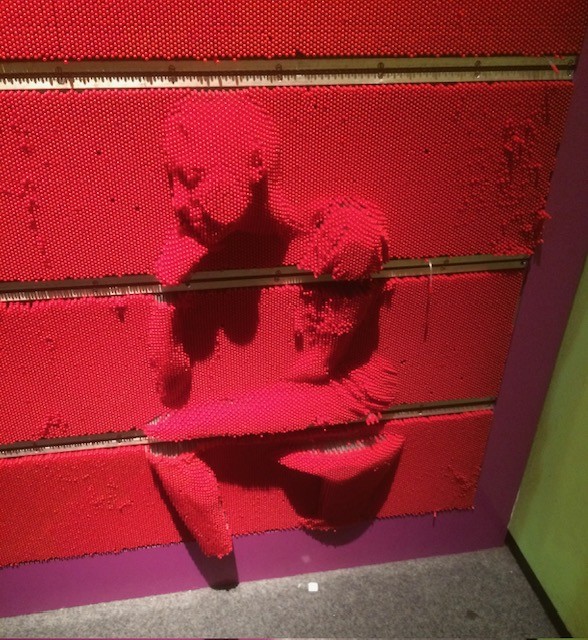

While that pin machine is now hidden in the museum’s vast storage of items to come back out at a later time, there is still much more to do at the Peoria museum. One program is watching movies on the museum theater with the largest screen in Illinois. Every week there are science movies, new movies, and often classic movies with “the Art of Movies” program. Those classic movies are hosted by various people that offer insights about the movie to watch.
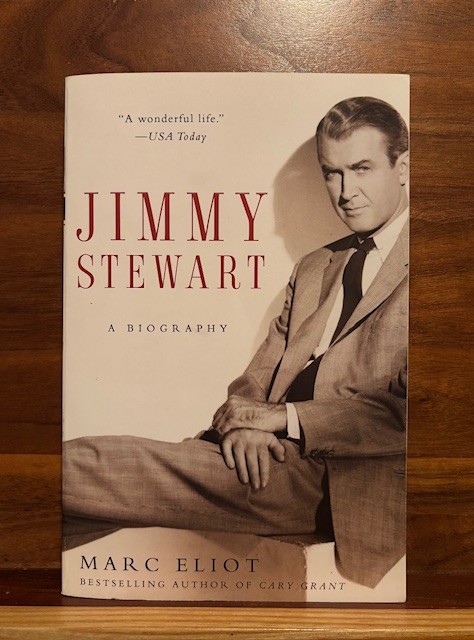
I have the book “Jimmy Stewart” by Marc Eliot, published in 2006. He has spoken at some of those classic movies, and we met him during an Alfred Hitchcock series. He signed the book to “Super Grampa and Nat”. (I have that moniker with all of my grandkids.) She answered his questions about parts she liked about “North by Northwest”, “The Man Who Knew Too Much”, and “Rear Window”. He was impressed with the caliber of discussion from a 14 year old girl. She spoke with conviction of what she liked. See what happens when you take kids to the museum!
When I take my grandkids to the Peoria museum, we always go through the rocks, minerals and fossils that they have on display. Afterwards, we go through my rock collection, while much smaller, still gets them to focus on what they have seen, and they remember much more. For example I have a tiny Amethyst crystal grouping, and the museum has a 10 foot, 2000 pound Amethyst tower that is the third largest display piece in the world. The kids hold my crystal, and then discuss then how huge the other one was. The same goes for various fossils that I have. For example, the museum has a complete giant clam fossil over two feet long, and I have only the center third (the spinish ridge part) of a clam about the same size. The kids also know much more about fossilized coral from seeing some behind glass displays, and then handling more from my collection.
To simplify and distill everything about museums, just go…and take your kids. Permit them have fun, teach them a little, and let them lead sometimes. If they are intrigued, they will stay a long time. If tired, they’ll want to go home. You can then try again later (it really helps if you have a membership!) Don’t forget to reinforce what they like. And then keep taking them. They, and you, will continue to learn.
Thanks for reading.
P.S.
Just several days ago, I took grandkids to see the Cathedral of St. Mary of the Immaculate Conception, in Peoria. We then went to the Fulton Sheen Museum in Peoria. We were given a few souvenirs.
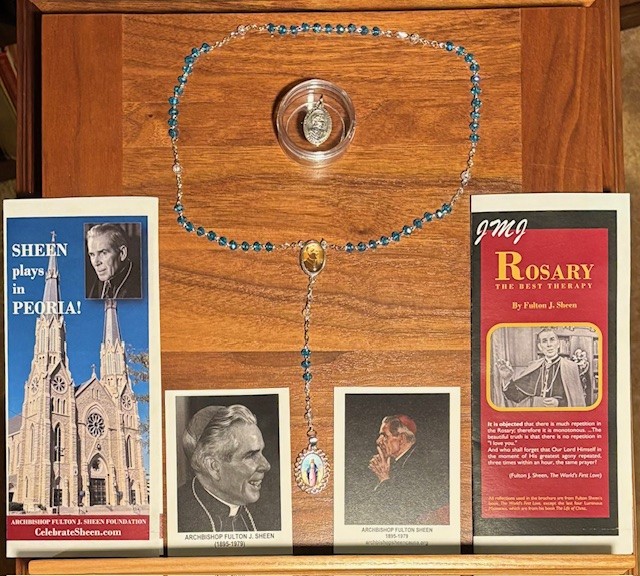
The museum is for Archbishop Fulton Sheen. He grew up here, was ordained in this church, and is buried at this church. Fulton did much for the Catholic faith, especially through media: radio and television. He also is a Servant of God in the canonization process to become a Saint. Sister Anne gave us a tour. While much of what we reviewed was a little dry for the young girls I was with, they were vary patient, and tried to discover what was interesting to them. Finally we got to displays of various vestments, robes and miters he wore while “at work”. They were stunning, and the girls really enjoyed them. Also exciting, was a beautiful large gold cross decorated with amethysts and emeralds. We then went home and looked at a small collection I have of rosaries and some medallions similar to what they had seen at the museum.
I love museums, and continue to pass along that enthusiasm.
 Librarytomes