It is said that Emperor Augustus found Rome “As a city of bricks and left it a city of marble.”
Steve Jobs said “Sometimes life hits you in the head with a brick. Don’t lose faith.”
Zig Zigler said “Big things are built one brick at a time.”
I have a few books and a few stories about bricks. First, is the book “Practical Bricklaying Self Taught” by Fred T. Hodgson, published 1907:

The subtitle is “Being a series of exhaustive instructions in all kinds of bricklayer’s work, including laying foundations, bonding, arching, gauged work, construction of damp courses, coping, building bridges, piers, chimneys, flues, fireplaces, corbeling, plain and fancy cornices, brick paneling, pilasters, plinths, and other brickwork, plain and ornamental.”
This volume also has over 200 illustrations, and is a great old book about understanding brickwork, and building tips.
The next book is “Bricks and Tiles” by Edward Dobson and Alfred B. Searle, published in 1936.
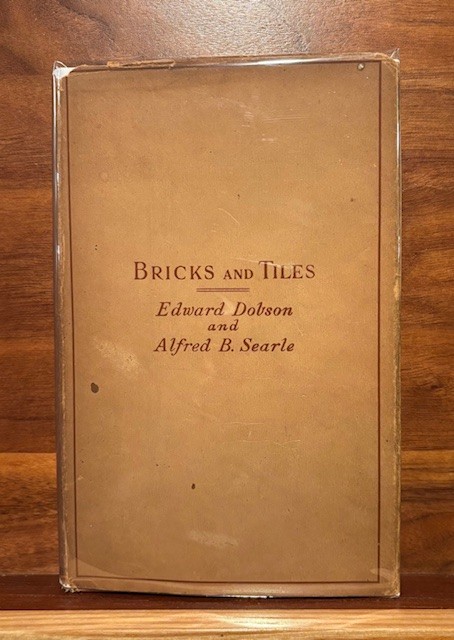
This is another beautiful book, published in England about bricks. It mainly discusses brick-making, with illustrations of machinery for the many various types of bricks, concrete blocks, and roofing tiles. It is a detailed book on the processes of manufacturing bricks.
Thinking about brick making, I have the book “When the Jewish People Was Young” by Mordecai I. Soloff, published in 1934. One story in the book tells of the Jews and the cruel Pharaoh. All strangers in Egypt (including the Jews) became slaves and were forced to make bricks for building up the city, palaces, and protective walls. The Egyptians knew how to make bricks, more than the strangers that came to Egypt (they were mostly nomads). but slaves did not have to be paid.

The book was printed by the Department of Synagogue and School Extension by funds from the National Federation of Temple Sisterhood, for the publication of Jewish religious school literature. It is one of several books of stories, traditions, and histories for teaching children of Jewish faith that I have in my collection.
The author used the term “Jews” throughout the book even when “Hebrew” or “Israelite” may be more historically correct. When this book was printed, the author stated “that while our environment (of the time) tends to give children a more favorable attitude toward Hebrews and Israelites than toward Jews, it is hoped by using the term Jew throughout the text, help to overcome this prejudice in some slight degree.” There is that prejudice sadly still. These stories, and these kids’ books, have wonderful tales for everyone. Several are also beautifully illustrated.
A second book continues the tale. “How the Early Hebrews Lived and Learned” by Edna M. Bonser, published in 1941 (first published in 1925). In this book, Moses goes to the Pharoah, and asked him if the Jews can go into the wilderness for three days journey to offer sacrifices to their God.
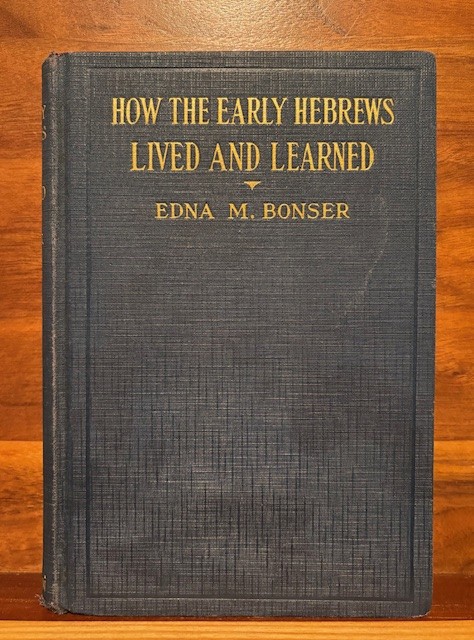
The Pharoah laughed, and said “Are our gods not enough for you? Is this a ruse on thy part to escape work for three days? My task-masters must be pampering you. Now you will make the same measure of bricks from mud and straw, but you will not be given straw. Find it on your own in your spare time.” This crisis led to the beginning of the ten plagues.
I have several actual bricks in my library correlating some significance to books, (and also to collecting memories and stories). The first is a brick from the John Alexander Dowie home and current Zion Historical Society Museum. They were reworking a corner of foundation, when I got this brick. Behind it is a full shelf of books about Zion and John Alexander Dowie.

This next brick is from Baltimore, and the grave of Edgar Allen Poe, at the Westminster Presbyterian Cemetery. There were workers replacing the path around the site of the marker.
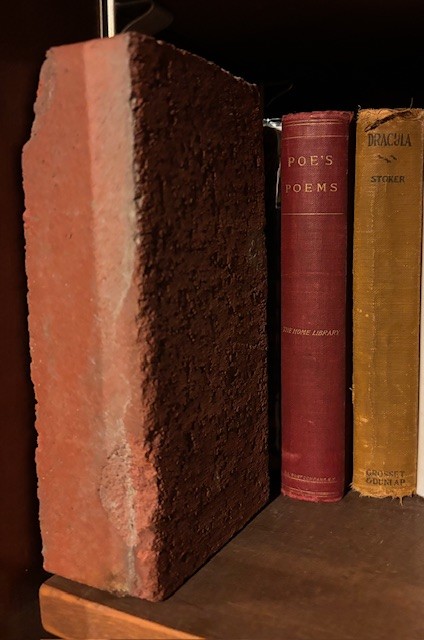
This third brick is from Our Lady for the Lake Seminary. They were reworking the space where the handball courts were. This brick was made by the Belding Brick Company that began in 1885. This brick is also resting on a religious bookshelf. I have found, but not yet received, an old miniature brick from Beldon Brick Co. that was used as a salesman’s sample. I will display it with the full size one.

This next brick is a paver from Purington Brick Company in East Galesburg, Illinois. Their first paver was fired in a kiln in 1849 by Henry Grosscup, a German stone maker. His factory was bought out by the Purington brothers in 1890. The paver stands in front of several books I have about Galesburg.

According to the Purington Brick Company website (along with stories from my mom who grew up in Galesburg), they were the largest paver-making company in the world. Purington paved Panama City when the US was making the Panama Canal. Freighters full of bricks were sent.
Also, “the largest order ever filled came at the start of World War II when Dupont Co. needed 22,000,000 building bricks for a munitions plant in southern Indiana. Purington worked at full production capacity for 146 days to complete the order, filling seven or eight freight cars each day. The daily shipment traveled through night and arrived next morning at the building site, still warm from the kiln.”
My latest brick is a partial brick. It came from The Hermitage in Nashville, Tennessee. The Hermitage was Andrew Jackson’s home. Next to the home, is a very old large landscaped walking garden, with the walkways lined and edged with upright bricks. In the corner of the garden are the gravesites of Andrew Jackson and his family. Deteriorating bricks are being replaced with a newer style brick. I was able to get this old partial brick.
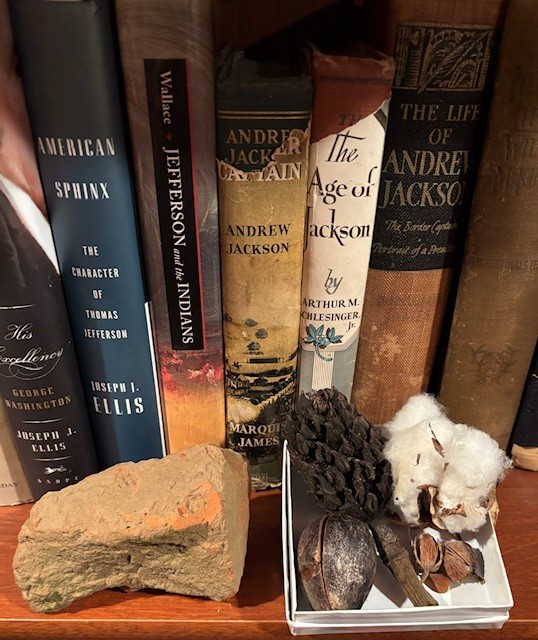
I also found at the Hermitage farm some other nature flora items. These are now in my collection cabinet, while the brick stays by my Jackson books. They are: a Magnolia seed pod, a cotton boll, a hickory nut (for “Ol’ Hickory”) and some Beech nuts.
This is what I call a brick-tacular story…if I were on the level.
I’m wall-king on sunshine with these stories.
Perhaps there’s mortar than meets the eye. It’s un-brick-gettable.
Thanks for reading (and perhaps listening to the artists below).
“All in all, it’s just another brick in the wall (and in the library!)” – Roger Waters.

 Librarytomes