The Potawatomi Indians lived throughout the Great Lakes area for several centuries. They called themselves Neshnabek, meaning “Original People.” They called their land Bodéwadmi. Others later began calling the Neshnabek by that name (now Potawatomi), which stood for “Keeper of the Flame”. One area they lived in was around the Fox and Des Plaines Rivers in Illinois. While they trapped along the waters, later trading with the French, they also raised crops to the east of the rivers, having camps around the modern name of Diamond Lake.
I have a great book about their story: “The Potawatomi Indians” by Otho Winger, published in 1939.

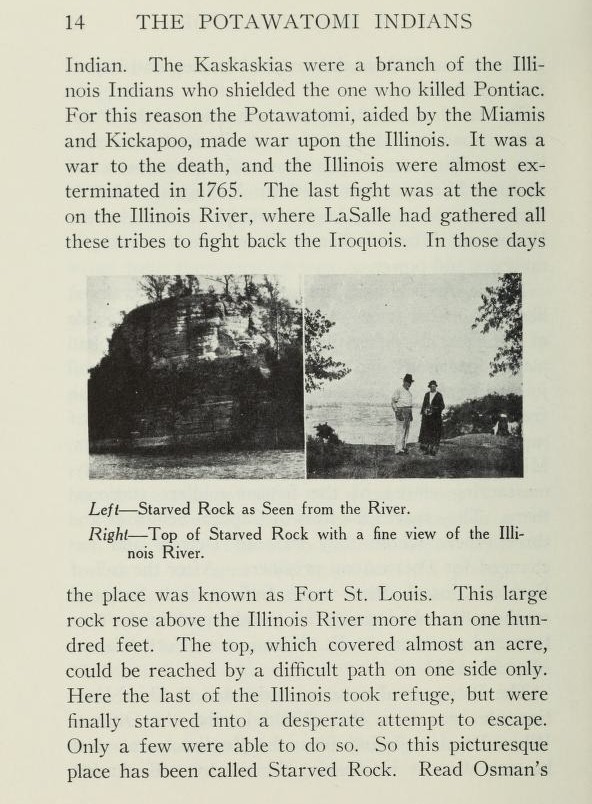
They were part of the killing of Kaskaskia Indians. It was for revenge when a Kaskaskia Indian killed their friend, Chief Pontiac. The battle site is where the name Starved Rock came from.
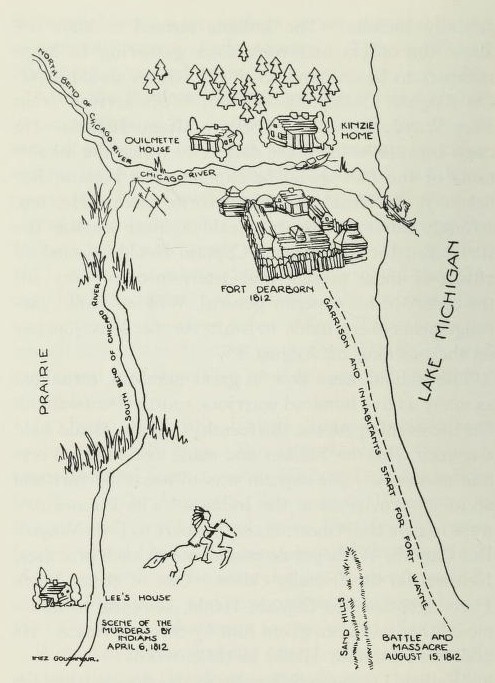
The Potawatomi were also part of the Ft Dearborn Massacre in 1812-early Chicago history.
In 1833, after signing the Second Treaty of Chicago with the US Government, the Potawatomi Indians ceded all their lands east of the Mississippi for some land in Nebraska, and some monies. Settlers soon moved in.
To this specific area in 1835, Peter Shaddle built a log cabin. He was the first white person to do so. Soon others followed. A lot of English millwrights settled in and became farmers. In 1836, these millwrights, wheelwrights, and ships’ carpenters called the settlement Mechanics Grove. Their first school-Mechanic Grove School was built in 1837.
One of the books I used for research of this town is “Images of America – Mundelein” by Shawn P. Killackey, published by Arcadia Publishing 2009. It is a signed book, and is part of the Arcadia History program. These publishers help towns all over the country publish books with stories and photos of their local history. I will be using several such books today. The Mundelein website also has a good timetable of history-it is just a little difficult to navigate and find the pages.

In 1847, John Holcomb bought 240 acres in Mechanics Grove. Holcomb wanted to grow the town, and he spent time in politics to help make that happen. The town’s name was then changed to Holcomb in 1850. When there was news that a train would be coming through the area, he donated the land for a train station. In 1885, when the train station was completed, the town changed the name (again) to now Rockefeller, for the largest shareholder of the line, William Rockefeller. William was the younger brother of John G Rockefeller.
By giving Rockefeller the name of the town, hopefully he would invest money in the town. However, tradition has it that William Rockefeller only once stopped into the station and town named for him, looked around for several minutes, and then went on his way. The town was incorporated as Rockefeller in February of 1909. The town did not keep that name for long.
The year before (in 1908), Arthur Sheldon bought 600 acres of land in Rockefeller, including Holcomb’s homestead, to build a school to train men for business and sales. This was for both on campus studies and mail correspondence. The Sheldon School was a big nationwide success, training over 10,000 students in ten years. Sheldon also hired many local residents, mainly women, to help with secretarial duties. He also helped build a large post office to keep up with the business he provided.
To thank Sheldon for the recognition and growth he brought into the community, in July of 1909, the towns people changed their village name (again) to Area. Area stood for the motto of Sheldon’s school: Ability, Reliability, Endurance, and Action.
I have a wonderful complete set of Sheldon’s Correspondence books. This is a later set printed in 1939. The original was printed in 1902. The company eventually moved from Mundelein to Chicago. These books are still in the original boxes, ready to be mailed to customers.
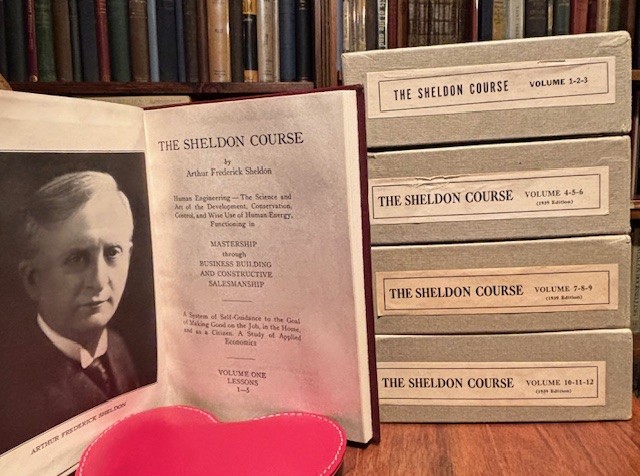
There are twelve volumes that include 109 lessons. Each lesson has a series of questions that the student was to write out the answers to and mail back to the Sheldon School.

These are a very interesting set of books. The first chapter teaches the science of learning about one’s self, drive, and the teamwork of “A Sound Head-A Sound Heart-A Sound Physical Body-A Sound Will-(and thus) Harmony.”
As well as detailed self-improvement, the study guides also taught different aspects of business and sales. Once one understands the why’s of business, then they can focus on being the best person to manage people or manipulate for sales. It was quite a program that still reads well today. World War One did not help Sheldon’s business. He consolidated to just mail correspondence and moved his business back to Chicago.
In 1915, Sheldon sold all his properties in Area, to the Chicago Catholic Church. The Archbishop, George Mundelein was looking for land. Mundelein wanted to take a struggling seminary in Chicago and make a new world-class seminary for priests. Building began in 1920 and was completed in 1924. Also in 1924, Pope Pius XI promoted Archbishop Mundelein to Cardinal Mundelein.
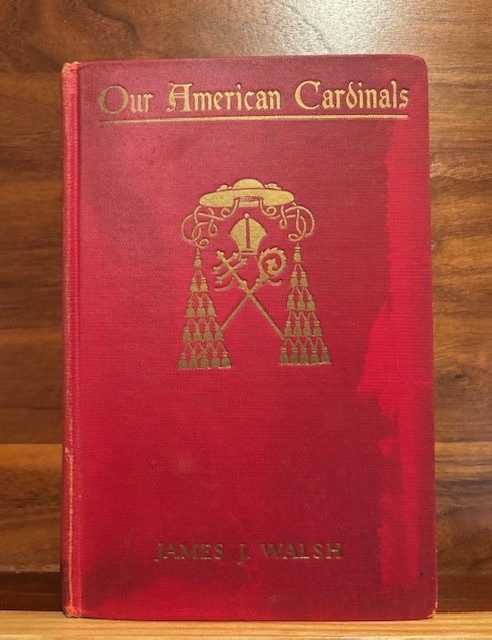
I have a wonderful book, “Our American Cardinals” by James J. Walsh, published in 1926. It includes stories about the recently Promoted Cardinal George Mundelein.
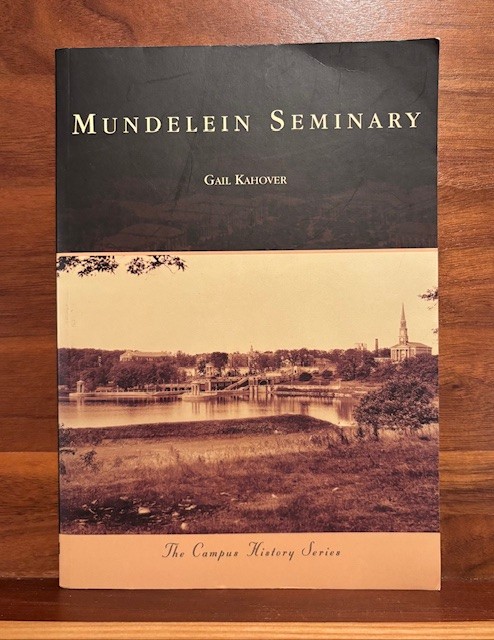
I also have another book by Arcadia publishing, Mundelein Seminary” by Gail Kahover, 2014. Interestingly, I bought this book at a book sale at the Mundelein Seminary’s (Saint Mary of the Lake Seminary) library. In the book are some wonderful old pictures and history of the seminary.
I also have the book “Rules and Prayers: Saint Mary of the Lake Seminary” written in 1951, and published at the Seminary’s own press. It gives wonderful guidelines and rules for priests to follow while training at the seminary.

The people of Area felt very indebted to Cardinal Mundelein, for his contributions to their town, so once more, they changed the name, now calling it Mundelein. Cardinal Mundelein was then promoting even bigger things that included the town. He petitioned Pope Pius XI to allow a Eucharistic Congress event to be brought to Chicago. It would be the first time this gathering was held in the United States. The Pope approved.
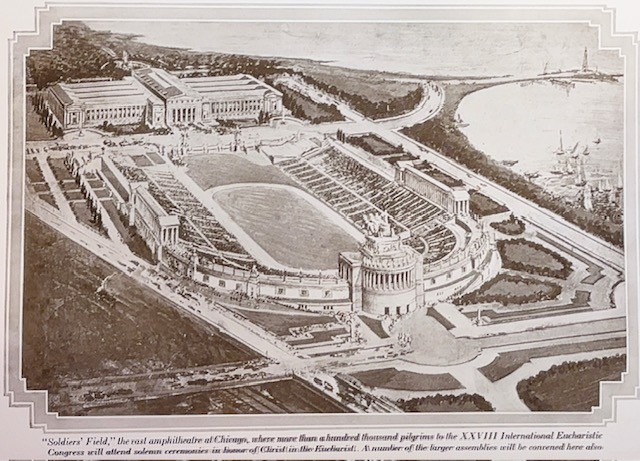
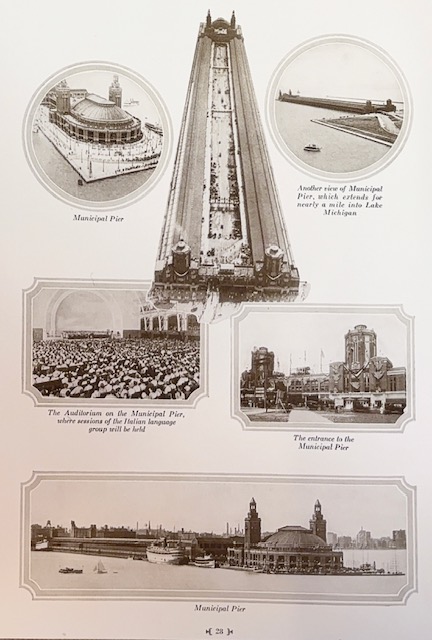
This would be a very big event for the Church, for Chicago, and for the town of Mundelein. The first several days had conventions and masses at Soldier Field, Navy Pier, and other Chicago venues. The last day parade and mass was held in Mundelein, at Saint Mary of the Lake Seminary. Almost 1,000,000 million people visited Mundelein June 24th, 1926. An extra temporary train station was built to handle the crowds. Trains arrived almost every five minutes during that day.
I have a souvenir book from the event: “XXVIII (28th) International Eucharistic Congress-June 20-24 1926” printed in Chicago 1926. It opens with a prayer from the Pope to the people (witnessing and visiting), the great Seminary in Mundelein, and all the work for the Eucharistic Congress to be a success.

The book has many pictures of various places in Chicago that held services, including Soldier Field and Navy Pier, along with other sightseeing ideas. People came from all over the United States, and even the world for this event.
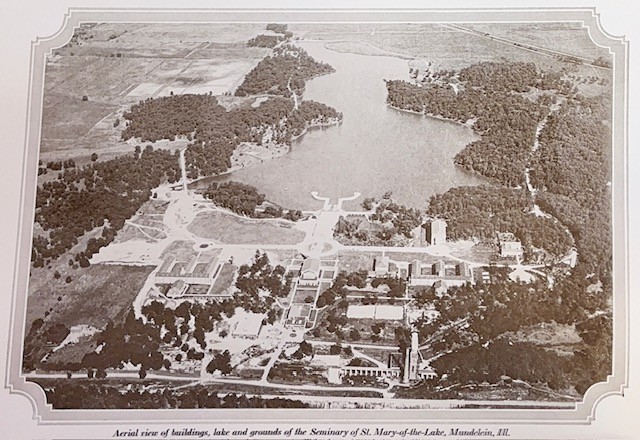
This would be an aerial photograph of the Seminary in Mundelein, from the book.
I have several other souvenirs from the XXVII Eucharistic Congress in 1926. They were given to me from my Mother-in-Law. She had saved them from when her grandparents participated in both Chicago and Mundelein. This would be my wife’s Great Grandmother, who was deeply religious. There is a small silk banner, a medal that would have had a ribbon to pin it with, and another medal that would be attached to a necklace or rosery.

I also have a wonderful picture given to me from a dear friend. This would be a photo of his grandfather, John F. Morrison. This picture was taken probably in 1926-the same year as the Eucharistic Congress. John Morrison was security for the Seminary, in uniform and with his motorcycle. This picture is taken by his home. The row of trees at the back of this photograph is the end of the Seminary property. Morrison raised his family at a house on the right.
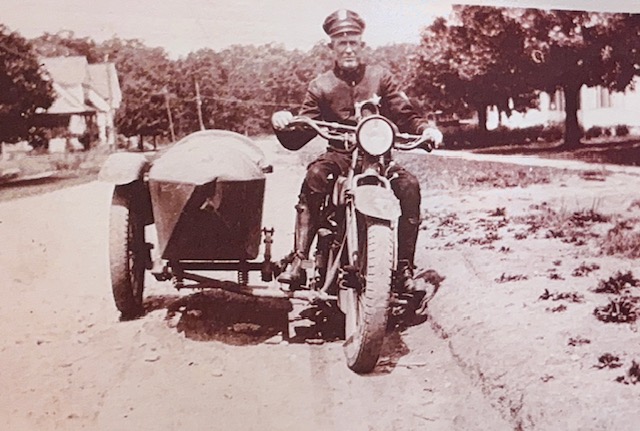
My friend years later bought the home on the left in the background of this picture, so he is now living across the street from where his dad grew up. Generations of this family have lived on this street, and in Mundelein. Both of those homes were utilized by the some of the 800,000 people who visited the Eucharistic Congress of 1926. There was a massive rainstorm after the last mass, and visitors huddled on the front porches of many homes, waiting to connect to trains going back to Chicago. Story had it that John Morrison’s wife was worried that their porch would collapse because of the weight of so many people standing there because of the rain.
Whenever I talk to my friend, he is filled with pride of living in Mundelein, especially with family businesses, and connections still with the Seminary. I hope in this story, I exhibit with my library and history, a little of the enthusiasm he feels about his town. Thanks for reading.
P.S.
And… there is Bill’s Pizza and Pub. It is the second oldest continuously run, family-owned business in Mundelein. They have a pretty good pizza, along with more Mundelein atmosphere.
 Librarytomes