I have a full bookcase of religious books, perhaps 250 volumes. It is a very interesting section of the library. There are several specific sub-collections in that religious bookcase. For example, I grew up in Zion Illinois. It was founded by a religious man-John Alexander Dowie. He was a Pentecostal preacher, faith healer, and self proclaimed prophet. I have a bunch of books and pamphlets just about Zion and Dowie.
A few examples are “John Alexander Dowie” by Gordan Lindsay, published 1986. I also have “Zion City, Illinois. Twentieth-Century Utopia” by Philip L. Cook, published 1996.
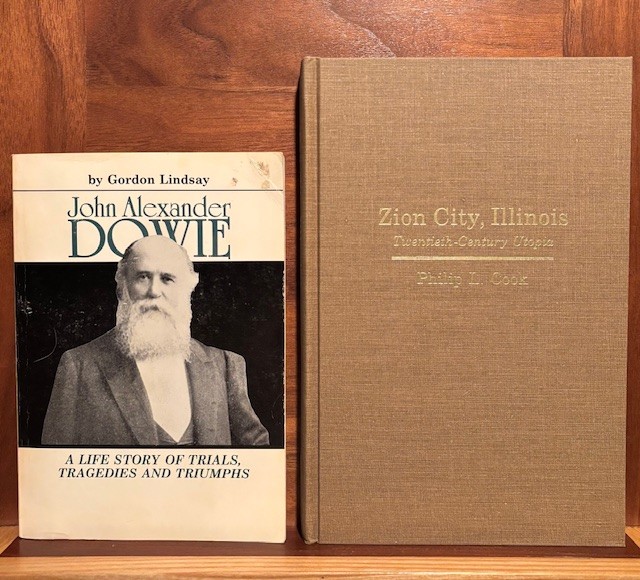
I also have works printed by the Zion press, and also from Century Magazine from 1902, as well as various other works. Zion has an amazing history. I wrote in detail about Dowie on May 25th, 2024. My grandfather’s family was very much involved with the church in Zion when it began. Dowie built the town to be a religious oasis, with plans of making more Zions around the country.
My grandmother was born in Farner, Tennessee near the the border of North Carolina in a very poor area in the Appalachian Mountains. Her grandfather, and great-uncle were two of the founders of the Church of God in the late 1890’s. She told me of religious tent revivals growing up. Because of her, I have a collection of books about the Church of God.
One of the books is “Like a Mighty Army, Moves the Church of God” by Charles W. Conn, published in 1955. I also have a study guide written by W. Perdue Stanley based on the book to be used in church studies.

My cousin lives in San Jose, California, about a block from The Rosicrucian’s headquarters. They’re a religious cult that some say go further back from Christ, to the Egyptians. They have a school for higher education, and I have a bunch of their works. I wrote about them in detail on March 19th, 2024.
There is also a large collection of books by published by The Sunday School Union in England. These books were about famous missionaries, other famous leaders to look up to, and religious morality stories. Most of these books were written around 1890 to 1920, but they published as early as 1800. Many of these books were given to children for good attendance at Sunday School, or for memorizing Bible quotes. A lot of these books have beautiful plates in the inside front cover or flyleaf, with the student’s name, and why it was given to the student. I wrote more about these books on March 5th, 2024.
I also have a collection of books from The American Sunday-School Union. These books were morality stories written for children, very popular in the mid 1800’s.
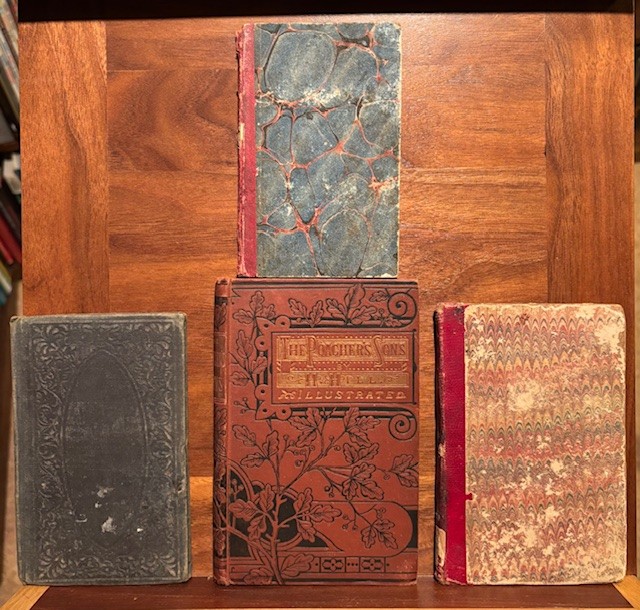
These few are “Winafred, the Willful Girl” 1850; “Amy, the Glass Blower’s Daughter” 1847; “The Poacher’s Sons” 1850 (?); “The Folly of Procrastination, or the story of Charles and Edward Martin” 1848. They all teach how one should act, and what happens if they stray. I have a bunch of these pocket-sized books for children.
Of course, I also have a Bible collection. Family members have given me Bibles from both sides of my parents. There are great stories tied to many of them. Some are in German, some are in Swedish, others in English. The oldest is from Maude Shawalla Blanch Brown, my great, great grandmother, printed in 1816. Her father preached with that Bible. I wrote a story about Bibles on January 28, 2024.
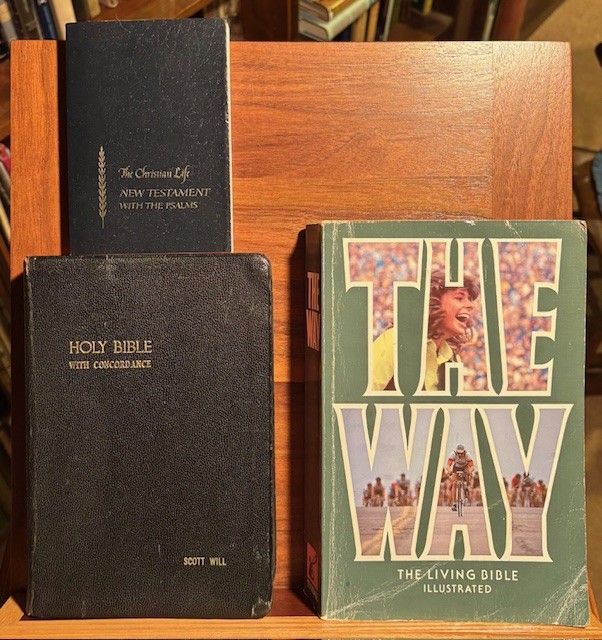
I would like to show several Bibles. First is the Bible given to me in third grade. I still go to and read from it. The next is “The Way” a Bible rewritten in the 1970’s, in a more contemporary language. I read it a lot in high school. The last is a New Testament that my Uncle Ed signed, dated, and gave to me right after my father died. He pulled me aside in church, and asked me to please use it. Uncle Ed (along with everyone) was so shook up that my father died at a young age (41), that he worried about me and spiritual guidance.
I also have a lot of books about the bible, and its stories. One collection is from Jewish printers, The Union of American Hebrew Congregation. A few of these interesting books in my collection are “The Story of Bible Translations” by Max L. Margolis, re-published in 1948. It is a great history of how the bible was written, and stories of translations throughout the years. There is also “When the Jewish People Was Young” published in 1934. (A friend of mine, Marsha, turned 90 in 2024. For her birthday, I bought her another copy of this book, as they both were born in 1934.)

And then, “Bible Tales for Very Young Children-book One and Two” by Lenore Cohen. These two volumes were first published in 1934 and 1936.
Another wonderful section in the library is a collection of bible study books and how to teach Sunday School. These two from my library are “The Notebook: A Collection of Anecdotes and Illustrations, for the Use of Teachers” by Sunday School Union, published 1871. The other is “Children’s Meetings and How to Conduct Them” by Lucy J. Rider and Nellie M. Carman, published 1884.

I then have a couple more, very interesting Sunday School books. First is “Picturesque Interviews with Jesus” by Rollin H. Walker, published 1926. Walker wrote of Jesus tales taken from the book of John, analyzing them, then explaining them to the youth; and having them be able to discuss the stories back.

Then I have “Talks With My Students” by Frederick Griggs, published 1903. Griggs was a teacher at South Lancaster Academy in Massachusetts. It was a theology college. He would start the day with stories such as these to the class. This book is current and relevant in today’s world, as well as meaningful over 120 years ago. Both of these books have great stories and tips for teaching the bible to the youth.
A favorite Sunday School book is also one of the oldest. I have “The Teacher’s Manual” by W.F. Lloyd, published in 1827.
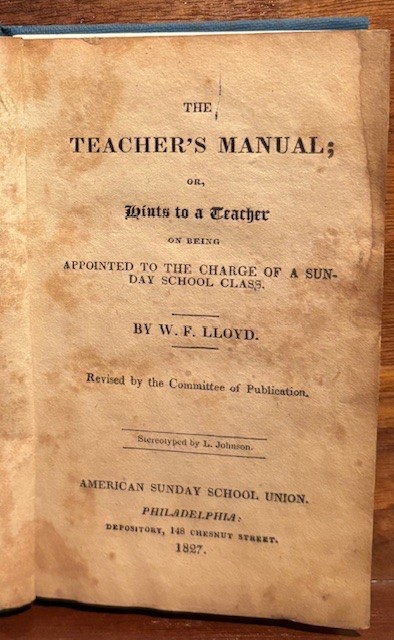
The author states that one should have children read out loud, and be able to speak on the subject. The main reason being is to have children “Think for themselves“. I fully believe his philosophy that if you talk like an adult to children and explain things to them, and then get them to answer back-and talk of the subject (really any subject at all), they will be able to succeed better in the world.
Children not only need to be taught things, but must practice to be able to repeat those ideas, and communicate well to others. That ability to discuss and talk to adults, is cornerstone to a well rounded child. I encourage all of my grandchildren to talk to me. When they are young, it is up to me to be able to ask the right questions-leading questions, so they can practice talking to an adult. This book is very small print on faded paper, but is a very detailed and such a thoughtful book to read.
I also have various books on helping to understand the bible. The next two books are rather interesting. First is “Curiosities of the Bible” by “A New York Sunday School Superintendent” published in 1900. This is a very detailed book about the Scriptures, and persons, places, and things within. There are many illustrations and maps, along with daily readings.

The next book is “Archaeology and the Bible” by George A. Barton, published in 1916. I have the seventh edition. This book is in two parts. The first part is titled “The Bible Lands, Their Exploration, and the Resultant Light on the Bible and History”. The second part is “Translations of Ancient Documents Which Confirm or Illuminate the Bible”. This book is thorough, with over 600 pages of writing, 137 plates of illustrations and black and white photographs, and is well indexed and cross-referenced to different books and verses in the Bible.
The last book I would like to show is “The Mine Explored: or Help to the Reading of The Bible”, by Benjamin Elliot Nicholls, published in 1853. It is an extremely detailed book about the history of books in the Bible, both Old and New Testaments, as well as explaining meanings. There is much cross-referencing, and a general index, and a Scripture index. There are also several detailed maps tipped in, that fold out.
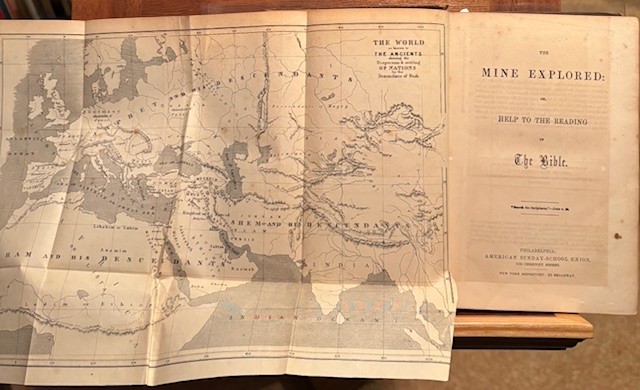
On the title page is a quote “Search the Scriptures.-John v. 39.”
I thought, as did the the Jews that Jesus was talking to (reading from my Revised Standard Version of the Bible), that in John 5:39, “You search the scriptures, because you think that in them you have eternal life; and it is they that bear witness to me.” Wow. perhaps I can get to heaven because using my collections, and my reading and studying about the bible.
But in reality, if you read the next verse, John 5:40, “Yet you refuse to come to me that you may have life“, it puts the comments in another, completely different light. As I now understand the meaning of “searching the scriptures, they all point to me” is that everything points to Jesus’ arrival. Once you understand that, you as a Christian, still have to make the active decision to believe in Jesus as savior. That is the choice which gets you into Heaven, not just searching Bible history.
All other scripture reading and studying, is just for fun, or curiosity, or to help one cope during daily struggles. For many, John 3:16 is the most important verse in the Bible. It is succinct, but I like the way that I came around to that view, using John 5:39.
Thanks for reading.
 Librarytomes