Thomas Becket was murdered on December 29th 1170. Becket was the Archbishop of Canterbury, but fell into conflict with King Henry II. The king had Becket murdered. One year later, the Pope Canonized Becket as a Martyr for the Church-standing up to the King. He was buried at Canterbury Cathedral. For hundreds of years, Pilgrims (religious people) have stopped to visit his tomb. Many would start there, and continue through Europe all the way to Jerusalem, stopping at holy sites.
His tomb, and bones (relics venerated by the Church and pilgrims to the tombs) are discussed in many books. I have a small book collection about pilgrims, relics, and sites to visit. For relics in England (both discussing Becket) I start with “In the Steps of the Pilgrims” by Sidney Heath, re-published in 1953.
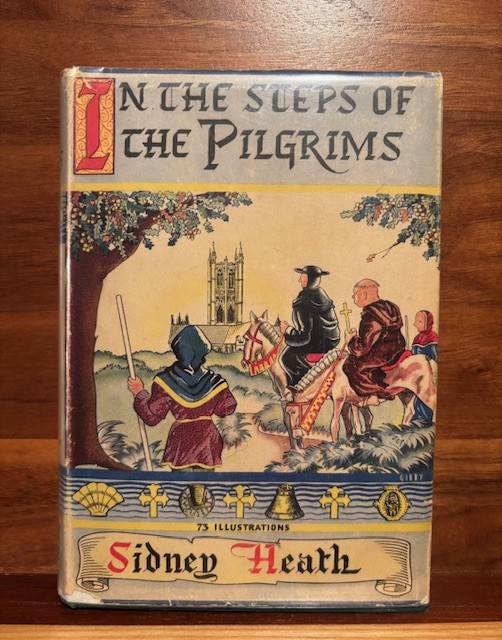
This book explains many of the shrines in England. Henry the II did pentance to seek forgiveness and absolution for his share of the murder. Henry VIII also visited the shrine.
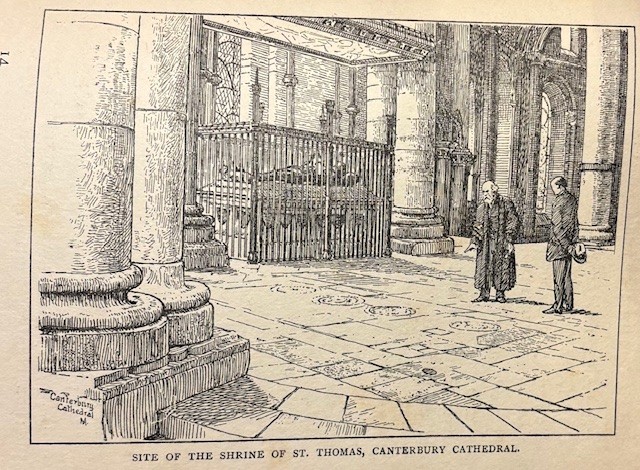
I also have “The Pilgrims’ Way from Winchester to Canterbury” by Julia Cartwright published 1911. The author have given much detail of St Thomas Becket.

This illustration shows the new shrine. The old one was below the ground (the old man in picture is pointing to it). There were several holes that pilgrims could stick their head through and kiss the tomb.
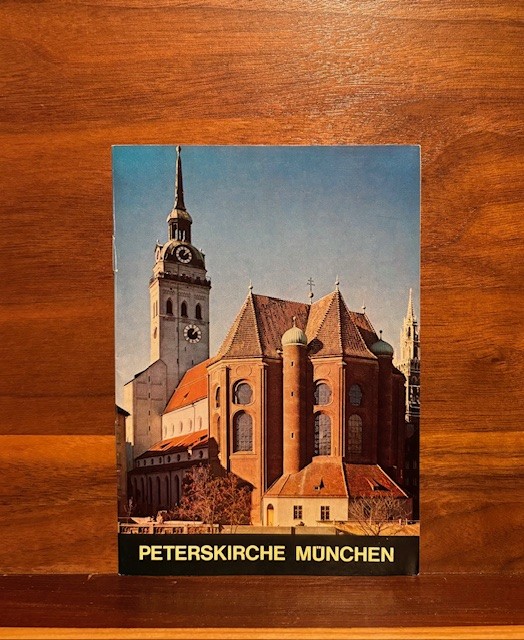
I began my fascination with relics when I first visited Munich in 1975. Downtown Munich, right across from the Marienplatz is Peterskirche, St. Peter’s Church. It is the oldest church in Munich. I have a booklet from when I visited “Peterskirche München.”
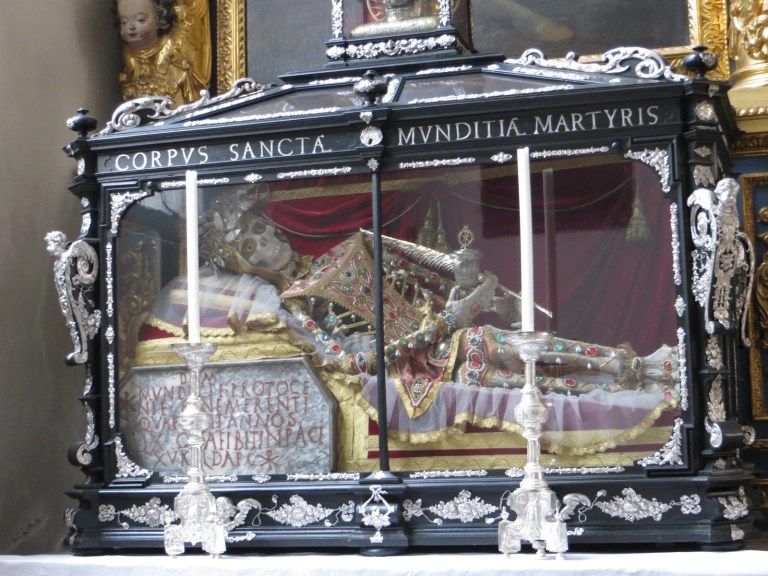
In the church is a hallway with many relics behind metal bars and glass cases. The wildest is the skeleton of Saint Munditia. She is the Patron Saint of Munich, along with unmarried women and spinsters. She was beheaded in the year 320. The skeleton is covered with jewels, and there are two glass eyes looking forward. it was the first time I saw real skeletons.
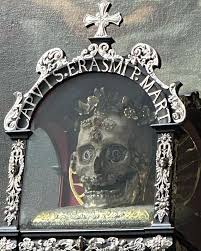
On the top of her glass coffin is another skull. It is Saint Erasmus of Formia. He is the Patron Saint of Mariners and Protector of Intestinal Ailments.
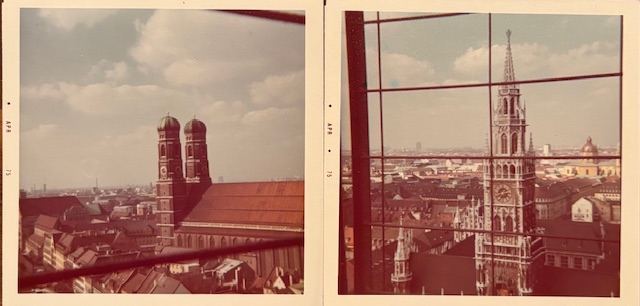
The church also has stairs you can climb to the top of the bell tower, 300 steps. Once on top, you can look down and watch the Glockenspiel clock with animations. I did. You can also see the Frauenkirche, only a block away. I still have a few pictures from that trip at the top of the belltower.
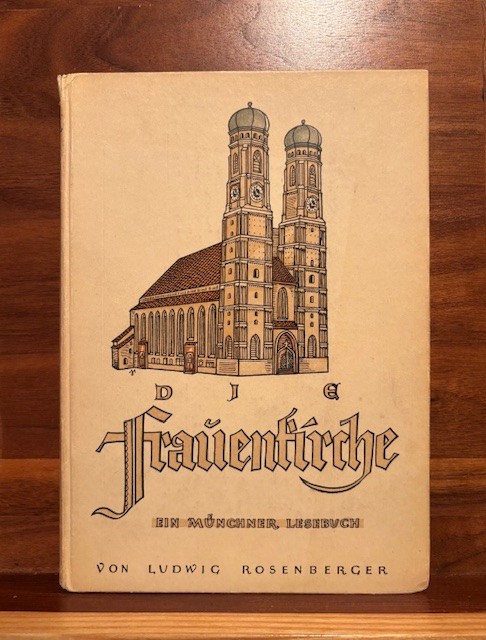
I have the book Die Frauenkircher” by Von Ludwig Rowenberger, published in 1947. This was an interesting church as well.
While I did not see any relics there, I did see Der Teufelstritt – The Devil’s Footprint, near the front of the church. Supposedly, the architect of the church in 1468 made a deal with the devil to pay for the church as long as there were no windows. When the devil first walked in, though there was light, it looked like no windows.
He was happy and about to leave, but then took another step forward. He saw that there were windows that were blocked a step earlier by pillers, and that the front alter was built higher than the front window. The devil was so mad he stamped his foot and left the mark on the floor. He called forth a windstorm to tear the church down, but it held strong.

We do not have the same reverance for relics in America, we are much younger. But there is kind-of one nearby in Springfield, Illinois. and it begins with Texas.
On December 29th 1945, Texas became the 28th state in the Union. It caused a lot of unrest in Mexico, and we had the Mexican – American War. In 1847, the Illinois 4th volunteer Infantry intercepted Santa Anna’s army, when they were resting. While Santa Anna escaped, his artificial leg, a chest of gold, and his lunch roast chicken was captured.
It has been displayed in a life-size diarama at the Illinois State Military Museum in Springfield.

I took my mom to see this ‘relic’ in Springfield about fifteen years ago. She enjoyed the visit. We talked about relics, and she said there was one in Galesburg. “What!” She then told me that growing up, they (her girlfriends and her) would go to church at the Lutheran Church, and then sneak over to Corpus Cristi Church and look at the small boy relic behind a glass box.
Several days later, my mom and I were pilgrims to the Galesburg Corpus Cristi Church built in 1884.

We saw St Cresent, a nine year old wax doll with a gash on his arm and one on his forehead. In the open wounds are actual bones from the boy. He died in Rome about the year 280, killed by Roman boys while smuggling alter supplies from one underground house to another. He dropped them when surrounded by the boys.
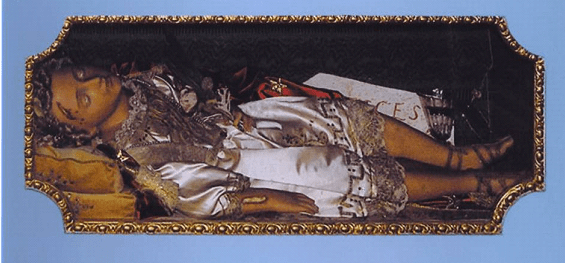
The Pope gave the relic to Galesburg when the church was completed. It is one of ten such relics in the United States. It is said that the relic protects Galesburg from Tornado harm, and has done so for almost 140 years.
To quote “In the Steps of the Pilgrims”, Sidney Heath said “The old-time pilgrimage was touring and sight-seeing at its best.“
I agree. The above stories are just a few shrines. I can add some Paris, Rome, and Barcalona churches and shrines to my memories. I would love to go back to Rome for two weeks, just to visit more shrines, churches, and relics.
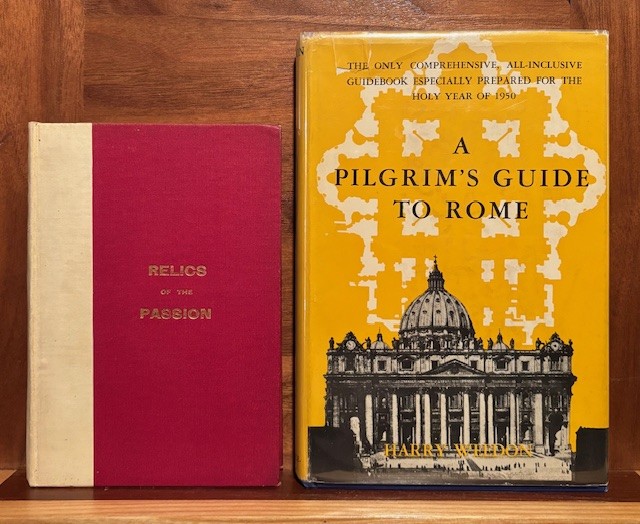
I already have my guide books: “Relics of the Passion” by J. Charles Wall, published 1910; and “A Pilgrim’s Guide to Rome” by Harry Weedon, published 1950.
Thanks for reading.
 Librarytomes