The Festival of Winter Walks, is from the third Saturday of December to the first Sunday of January. This annual celebration is held in England, to embrace winter and the outdoors. We are right in the middle of this festival season, so dress warm and take a hike.
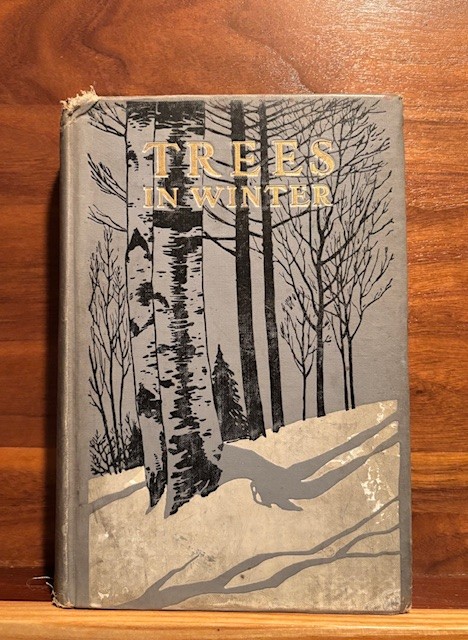
To help identify trees in the cold season, I have the book “Trees in Winter” by Albert Francis Blakeslee and Chester Deacon Jarvis, published in 1913. This is an interesting book that not only discusses how a tree works and grows, but what it does during the winter months. The authors have also given us comparative photographs for summer and winter.
December 27th is Visit a Zoo Day. As well as walking in the woods, one can hike in zoos during the winter. Many animals are more active this time of year.
My first book is “Zoo, A Behind-the-Scenes Look at the Animals and the People Who Care for Them” by Don Gold, published in 1988. This is an intriguing look at what the day-to-day routines are at a zoo. We learn how far in advance one has to plan for new animals, seasons, etc. It also happens to be what really happens at the Lincoln Park Zoo, from which this book is about.

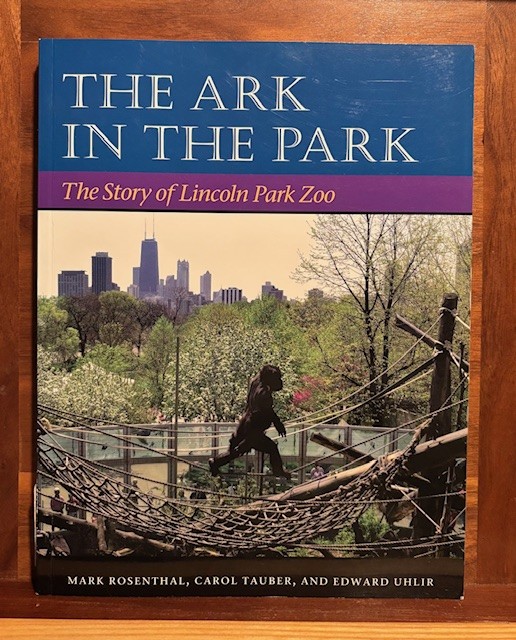
I also have the book “The Ark in the Park – the Story of Lincoln Park Zoo”, by Mark Rosenthal, Carol Tauber, and Edward Uhlir, published in 2003. This book gives us the history of the Lincoln Park Zoo. It has been around since 1868, and is the second oldest zoo in the United States. When I lived in Chicago, I would take my son, perhaps every other weekend to the zoo. It is a wonderful place to visit, especially in the winter.
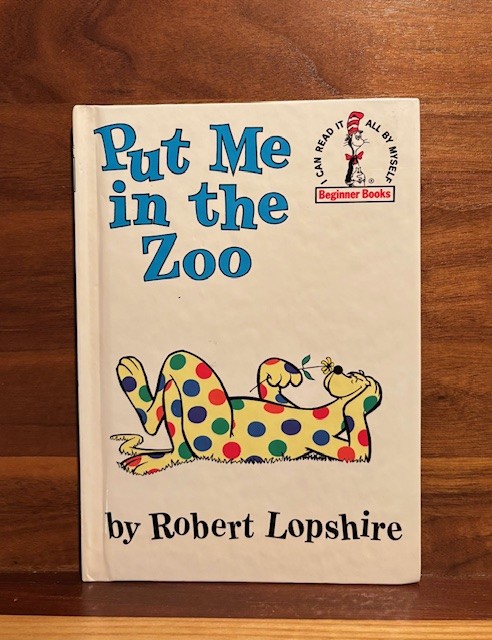
There are several other zoo books to add to today’s story. First is “Put Me in the Zoo” by Robert Lopshire. I used to read this book to my kids, and then later to my grandkids. When anyone of them sees the book, they always remark “I remember you reading this book to me…”
And I have “If I Ran the Zoo” in my book “A Hatful of Seuss-Five Favorite Dr. Seuss Stories.” This is another wonderfully imaginative book about if a young kid ran the zoo, what he would put in there. Unfortunately, this book is no longer published by the Dr. Seuss Foundation, as being insensitive to some people.

My next two books come from my Peter Pauper Press bookcase. One of my oldest, and most fond of collections, are books printed by Peter Beilenson, and his private company Peter Pauper Press. For decades, he published unusual and interesting books with limited runs, usually between 750 and 1000 copies. While I still am looking for some missing volumes, I have several hundred books, the oldest PPP book is from 1928.
The first PPP book today is “My Sentimental Zoo” by Claire Goll, published by Peter Pauper Press in 1942. It is in great condition, along with the cardboard bookcover. This is a heart wrenching book of animal stories. Each chapter is of a different animal. While there may be some sad moments in each story, I am very glad to have read the book.
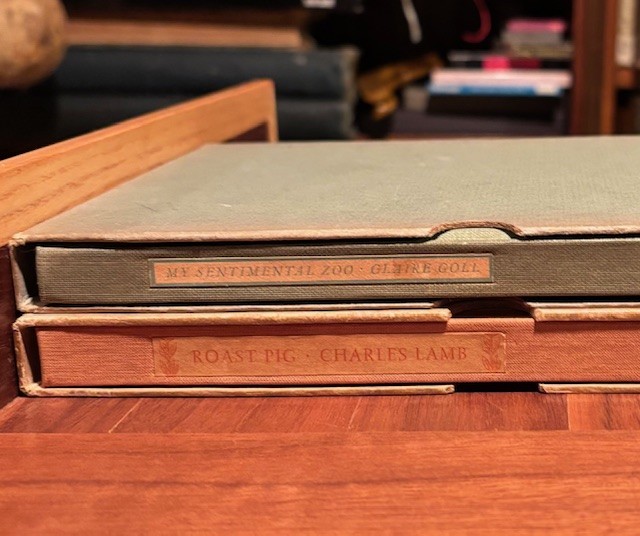
The second book is “Roast Pig, and other Essays” by Charles Lamb, published by the Peter Pauper Press in 1934. Not only is it a Peter Pauper Press book, today on December 27th, 1834, Charles Lamb died. This is an interesting story about Bo-Bo, a swine-herd’s son who burned down his father’s house and barn by accident, many centuries ago in China. While his father was upset, Bo-Bo discovered (and then taught the world about), the great taste of Roast Pig, as nine small pigs were burned in the fire. They were delicious.
I also have a set of books for kids, called the Junior Deluxe Edition.
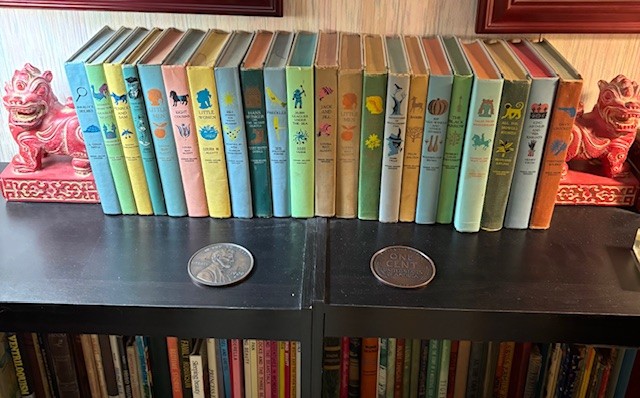
One is called “Tales of Shakespeare” (re-written for children) by Charles and Mary Lamb, published 1955. This is the same Charles Lamb that wrote about the Roast Pig.
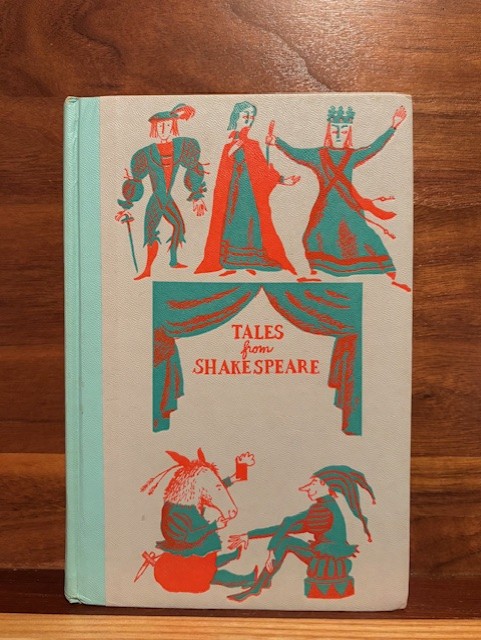
To bring my dissertation around full circle to the beginning…of Winter Walks…one story in this book is “The Winter’s Tale”. This is a feel-good story, whether you read it by Shakespeare, or by Charles Lamb. The story may be confusing (and sad) at first, but then as Shakespeare (and later again, Charles Lamb) said “All’s Well that Ends Well”.
“Thou hast been Bard from making Shakespeare puns.”
 Librarytomes