In the early morning of December 7th, 1941, the Japanese made an attack on the military base at Pearl Harbor, in Honolulu, Hawaii. Over 2400 Americans were killed, with another 1200 Americans injured. The next day, President Roosevelt spoke to the American public. Soon after that speech, Congress approved the United States going to war against Japan.
I am offering several unusual and poignant books about that day in 1941. The first is “Honolulu Prepares for War” by Rodney West, MD. When I visited Pearl Harbor some years back, I visited the USS Arizona. At the museum, this author was there, and I was able to listen to first-hand stories (and get his book signed).
He told of civilian defense preparation starting a little over a year before the actual attack on Dec. 7. Many people were anticipating some sort of attack due to the location of Hawaii in the pacific. The author was an active service MD, and at home that Sunday morning. He was called to to the base about 15 minutes after the attack began. It took him another 10 minutes to get there, and he immediately began assisting six other doctors. He gave a very interesting talk.
The second book is “The Children of Battleship Row” by Joan Zuber Earle. This was the story of an eight year old girl, whose father was the Commanding Officer at Pearl Harbor in 1941. Their home was several hundred yards from where the Arizona was docked. She remembers how they had to run to a bomb shelter after the explosion from that ship sent a piece of the hull, the size of a refrigerator, through their kitchen. They gave up their robes to use as bandages to wounded sailers swimming ashore.
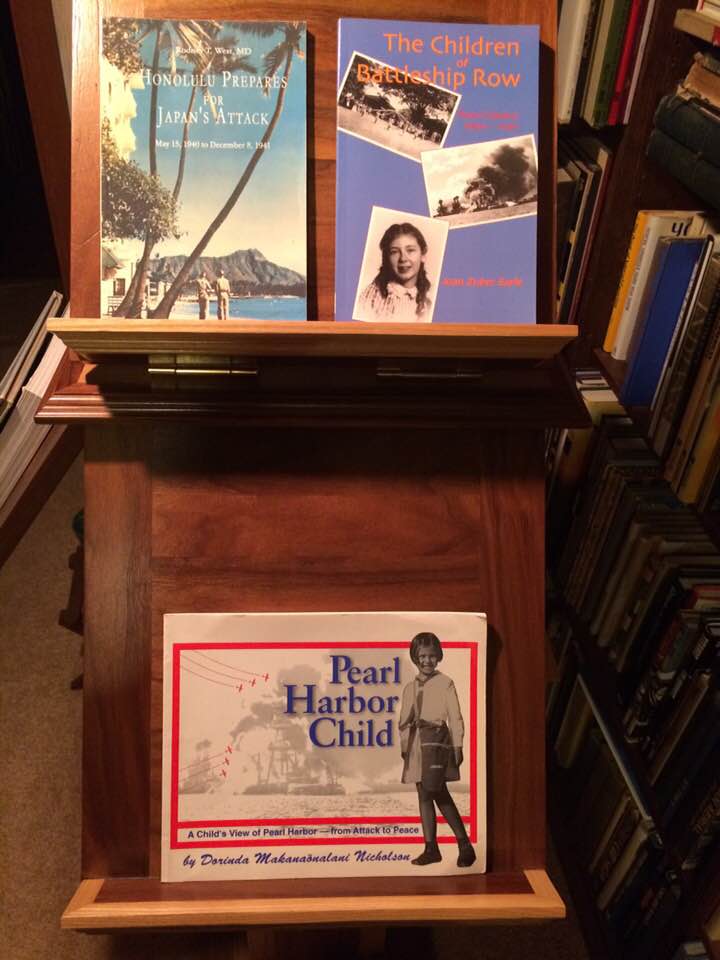
The third story is equally unusual, “Pearl Harbor Child” by Dorinda Makananalani Nicholson. It was another child’s point of view of the attack. Her mother, Hawaiian, worked for Pan American Airlines. If someone flew into Hawaii in 1941, they would land by sea plane in Pearl Harbor. They also lived near the harbor. When bombing started, her parents took her and her sister away, up in hills nearby.
After watching the bombing from that view, they tried to go home. The military would not allow them back to the area where their house was for several days because they were Hawaiian, so they stayed in sugar cane fields. When finally allowed to return, the girl and her sister had a contest of who could collect the most shrapnel and bullets from the walls of their home. Then she related stories of the days and months after the attack: black outs, food rationing, barbed wire on beaches, and distrust of islanders.
I am proud to have these three personal accounts: one from a doctor, and two from children witnesses; and their perspectives of “the date that will live in infamy.” These three books certainly bring different and unique viewpoints to the story of December 7th, 1941.
 Librarytomes