My parents were a mix of city folk and country folk. Dad grew up in Zion, just north of Chicago, and Mom on a Wataga farm near Galesburg (She had a 4-H scholorship for U of I, where they met). I got the best of both worlds, spending time in the summer, and during some holidays on the farm.
I found out that many small farmers were pretty smart. I also discovered that many farmers were good readers. Back in the day, agriculture news came in detailed and specialized farming books. One such publisher was Orange Judd farming books. I have discussed many of their books, because I have a large selection of their library of farming knowledge. That will help with today’s special day.
December 5th is World Soil Day, a U.N. designated day to help the world understand the importance of good soil, and how to properly manage it. I have several very old books that are still quite accurate for soil care in today’s world.
The first is “Irrigation Farming” by Lucius M. Wilcox, published by Orange Judd Co, 1902.

The subtitle is “A Handbook for the Proper Application of Water in the Production of Crops”. This highly illustrated book had diagrams and photos to help the audience in training them to possible solutions to get water to cropland. The first edition of this book came out in 1895, and the author followed with updates as new equipment or ideas came along.
There are chapters on building canals, reservoirs and ponds, flumes (bridges of water over areas), piping, pumps, and best ways to apply water (devices, appliances, and contrivances). There are then detailed irrigation advice for orchards, vineyards, small fruits, alfalfa, and general field crops. This is a detailed ‘how to get water to crops’ book.

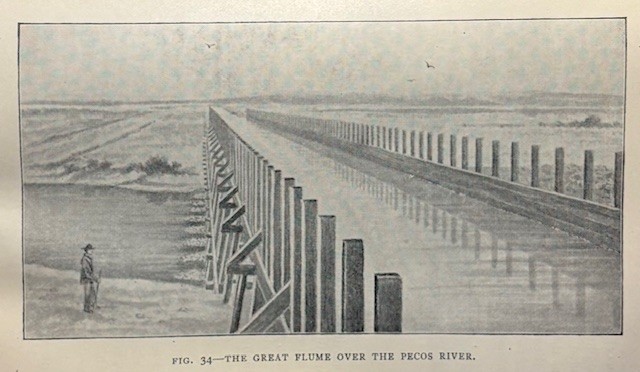
But what if you owned land that had too much water, from flooding or swamps and such. I have the book “Draining for Profit and Draining for Health” by George E. Waring, Jr. published by Orange Judd and Co., in 1867. This is much more than an old ditch digging manual.

The author was the engineer of drainage of Central Park in New York. He gives us details on how to make more land profitable for farming. This book is also very illustrated with many detailed drawings. Much of the book is how to put drainage tiles in farm land so water can drain enough for successful planting.
The process of drainage tiles or piping on farmland in those days were by hand. Imagine digging a trench three, usually four foot deep, and the trench only 12 inches wide on top, and only 5 or 6 inches wide at the bottom, using special shovels. When you are digging several miles worth of a draining pattern, you want to remove as little soil as possible, so the trenches were extremely narrow. They then had to be scraped smooth to ensure a slight grading to have water drain properly out of the pipes.
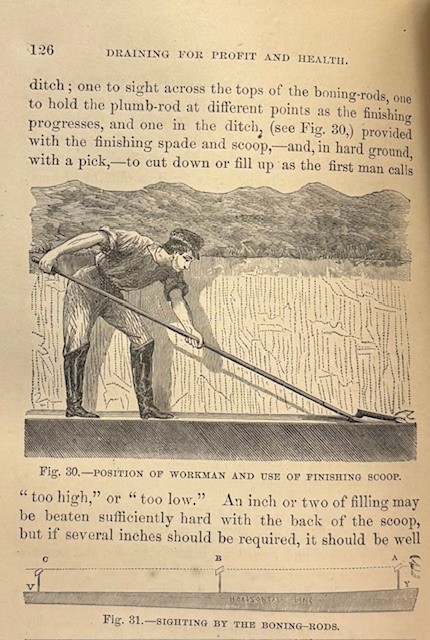
Acres of farmland would have to be propery drained with piping, with the runoffs going to wells to hold water. This book would even breakdown cost per foot of drainage. I enjoyed reading this book, and trying to just imagine the man-hours it took to properly drain a field.
And then there is the soil itself. I have “A Muck Manual for Farmers: a Treatise on the Physical and Chemical Properties of Soils; The Chemistry of Manures; Including also the Subjects of Composts, Artificial Manures and Irrigation.” by Samuel L. Dana, published in 1855 by Orange Judd Co.

This book has been a cornerstone of my library for almost forty years. When I first spotted it at a used bookstore, the owner eyed me rather curiously. She was hesitant at first to sell it, because her books were her babies, and she wanted to see first if it was going to a good owner. As we talked about books, she began to relax. I learned that day that really, we are only adopting books, and are just their current parents.
Even though 168 years old, this book is incredibly detailed on the discussion and study of different soils, fertilizers, and manures. Everything was broken down to parts per 100 for iron, magnesium, phosporus, nitrogen, salts, and other organic matter. Interestingly, there is a study in the book about how much food and water a cow eats in a week, and then the breakdown of what comes out the other end. They measured, weighed, and analyzed the urea and manure.
An interesting way they measured, was “a cord of green cowdung, pure as dropped, would be formed daily by 108 cows. A cord of dung weighs 9289 lbs. (86 lbs per cow). One cow produces (in that dung) enough salts of lime sufficient for 4 1/2 bushels of corn.”
The science that these farmers used for helping re-generate the soil that long ago, was scary.
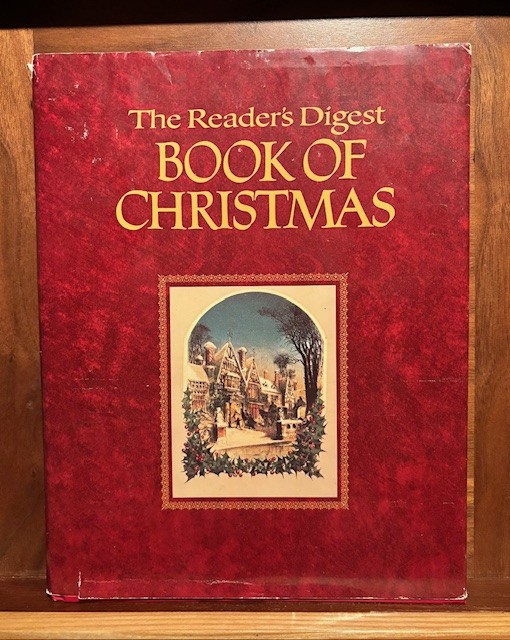
Speaking of scary, as we’re getting near to Christmas, I was reading this book, “The Reader’s Digest Book of Christmas” published in 1973. It has a myriad of Christmas stories and legends.
When it came to a section of German Christmas legends, it got scary. There are some dark traditions and stories from the Vaterland. Buttenmandln, wrapped up in straw, and wearing scary masks, catch and squeeze young kids. Monsters-Krampus who traveled with Saint Nicholas use switches on naughty kids, while the good kids get presents. Evil spirits roam the streets the last Thursday before Christmas and mummers dressed in scary outfits go from house to house rattling cow bells and cracking whips to scare the spirits away.
In fact, December 5th is Krampusnacht in Germany. St. Nicholas rewards good children by secretly leaving them presents. Krampus-devil like monsters with long horns and sharp teeth beats those children who are naughty, with branches or sticks. On December 6th, St Nicholas Day, children wake up with presents, or scratches and bruises. There are multiple parades on December 5th with these horned devil monsters-Krampus, running through the crowds scaring children.

My great-grandparents were from Germany, and brought their customs to Zion. I have a several St Nicholas photos. They are when I was one, and then my brother and I when I was two. This German St. Nicholas was not fat and jolly like Santa Claus. The face is painted cloth.
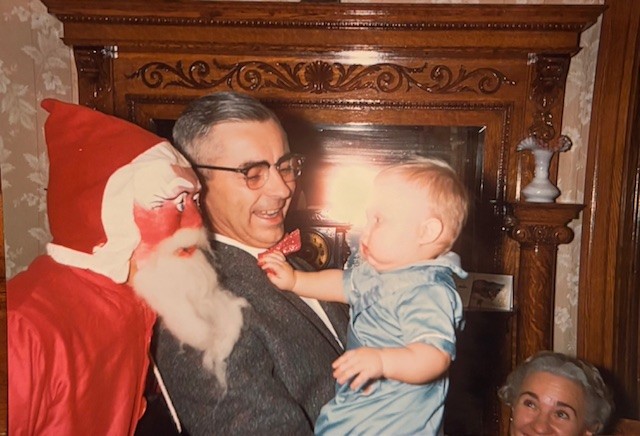
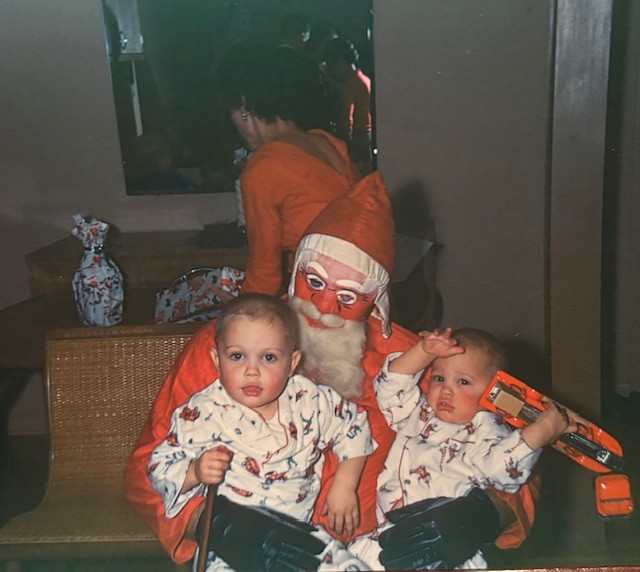
Some people are scared of clowns. For me, it was that man in the red costume…..There was not a “Ho, ho, ho”, there was me crying “No, no, no!”
Tonight, I will have dreams of Krampus beating me with sticks. It is still less scary than the nightmares of that St. Nicholas.
Pleasant dreams.
 Librarytomes