November 24th in history is rather interesting. I have a couple of books to display, and few stories to tell. The history will be chronological only to my age in the stories. I hope it is not too much for such a little space.
November 24, 1932 the FBI Crime Lab (Scientific Crime Detection Laboratory) opened. I have an interesting book, “The FBI” by Quentin Reynolds, 1954. It is the only Landmark Books volume I have without the colorful dustjacket.
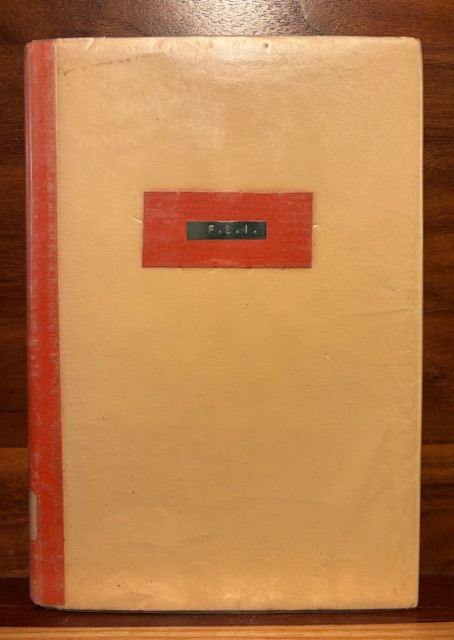

This book is a history of the FBI. It is a very well written book for the junior high crowd. Not only did I read this book in junior high, at Westfield school, I was able to visit the FBI-State Identification building in Joliet, Illinois. My father was able to get us a visit when I was in Boy Scouts. To get our Fingerprinting Merit Badge, one requirement was to take a legible set of fingerprints. We took ours at the FBI building, and they were submitted and approved. So long before any of my college escapades, my fingerprints were already filed with the FBI.
My father also helped us get a tour of the facilities. We saw bullets shot into water, and a gelatin substance to resemble going in a human. There were lots of crime scene studies. Dad also had a subscription to FBI Law Enforcement Bulletin, a monthy journal for police and other badge carrying officials. He always let my brother and I read it. The last page always had some unusual device that criminals had made. I remember one that was a lighter that could also shoot one round of a 22 caliber bullet.
November 24th, 1874, mechanically made Barbed Wire was patented by Joseph Glidden in DeKalb, Illinois. I have a great book “The Wire That Fenced The West” by Henry D. and Frances T. McCallum, published 1965.

This book is a history of barbed wire. And if you follow barbed wire, you knew it began in DeKalb, Illinois. The book explains the story of three men (Joseph Glidden, Isaac Ellwood, and Jacob Haish) that met at the 1873 DeKalb county fair, when they saw some armored fencing-wood with nails sticking out, attached to wire fence. They each designed and patented barbed wire fences-wire points that are attached to the actual fence wire.
Glidden’s was the first, and for many years, the easiest to make. It was named ‘the Winner’. Ellwood joined up with him (later Glidden sold his shares out to Ellwood), and Haish began his own company. In the next few years, there were hundreds of different designs.
Before barbed wire, it was hard in the West to keep the huge herds of cattle contained, along with keeping other rancher’s out. As the West developed, barbed wire became more and more important. It changed the way of farming cattle – and owning property. For example, in the year 1874– 10,000 lbs of barbed wire was made. Four years later, in 1878– 26,655,000 lbs were made. In 1879–50,377,000 lbs, and in 1880–80,500,000 lbs. Those three men made a lot of money back then. It is said that more than anything, barbed wire changed the West.
This is the Glidden barn in DeKalb, where he first made barbed wire. It is right next to the Burger King on Lincoln Highway, next to the University. His home is next door behind Glidden Florist. I passed this barn and his house, almost every day at school there, not paying attention. Across the street is The Junction Eating Place, that has barbed wire collections hanging on the walls. Next to that is Pizza Villa. In college, one had to know where to eat. (like Tom and Jerry’s-open all night; and where I worked-Pagliais Pizza-best in DeKalb).

Nearby, closer to downtown, is the Ellwood estate, now a museum. I never took a tour of the building when I was going to college in Dekalb. One day a few years back, I just called my mom, and asked her if she wanted to take a road trip to look around. She was game, and we had a wonderful tour.
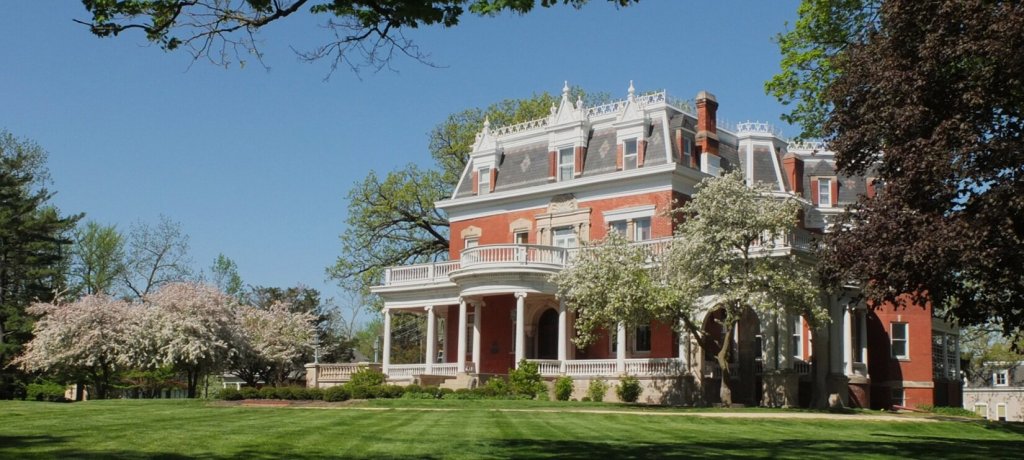
Interesting on the property, is a playhouse for his kids. It is a two story playhouse.

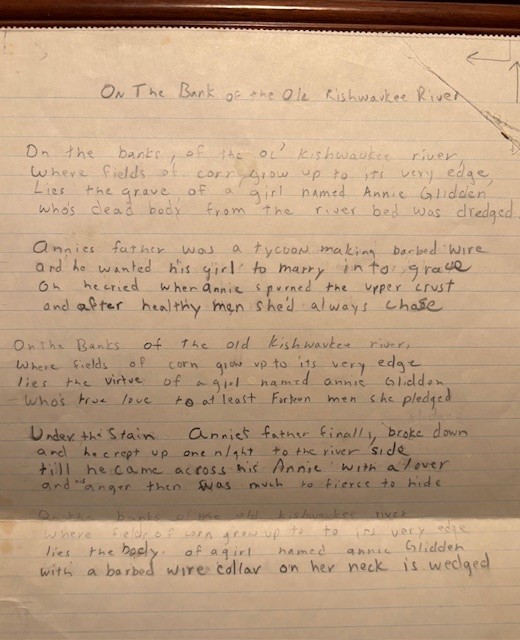
I was a journalism major at NIU. In one class, I had to write a professional interview for radio class (along with studio directions), then have have the people to record it. It would later be played in front of large class. I wrote a song about the Glidden family (Joseph Glidden had actually donated the first land, and gave much money to have a college come to DeKalb. Annie Glidden road was named after Glidden’s daughter.) The song “On the Banks of the Ol’ Kishwaukee River” was about Glidden’s man-chasing daughter meeting suiters at night along the riverbank. Her father, in a rage, killed her and a lover by strangling them with barbed wire.
I sang the song, recorded it on a tape with my girlfriend (now my wife) playing the guitar. In the interview, I had a classmate be the interviewer, and I the interviewee. My teacher was a little worried, when I stated on tape that this was extensively researched, and tragic. At the end of the interview, I added that it may or may not have happened. My teacher liked my directions on producing a radio interview, along with the professionalism of the sound people, director, and interviewer. However, he was not impressed with the fake song made out to be true. The rest of class loved it when it had to be played for them. At that presentation, there were many of the other Journalism professors watching, who has heard through the grapevine of the Glidden bashing song.
I still have the original sheet of paper with the words to the song.
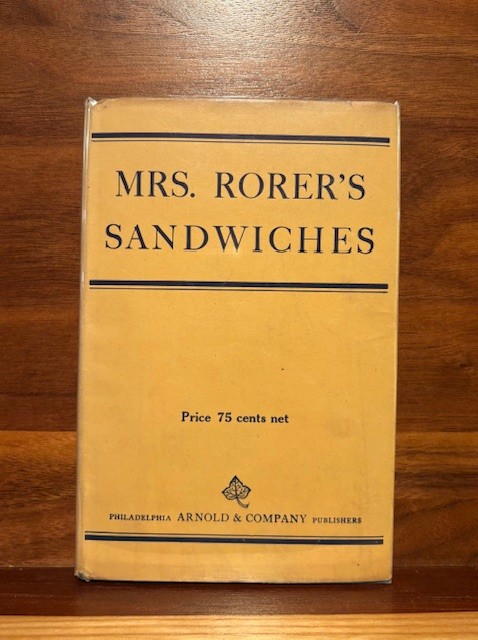
Moving along, November 24 is National Sardine Day. It is to make people aware of the health benefits of eating sardines, and to try them. I have the book “Mrs. Rorer’s Sandwiches” published in 1912. There are two sardine sandwiches. One is making a Sardine Salad, (like tunafish salad), and the other is to use whole sardines, laying them on toast, adding finely chopped capers and olives, and a sprinkle of lemon juice.
I also have two books on the Iron Chef. One in Japanese that reads backwards. The only English is “The Battle of Iron Chef” of the title. A friend from Japan gave it to me. The other book is “Iron Chef, The Official Book” by the Fuji Television Co in Japan, and translated by Kaoru Hoketsu, 2000.
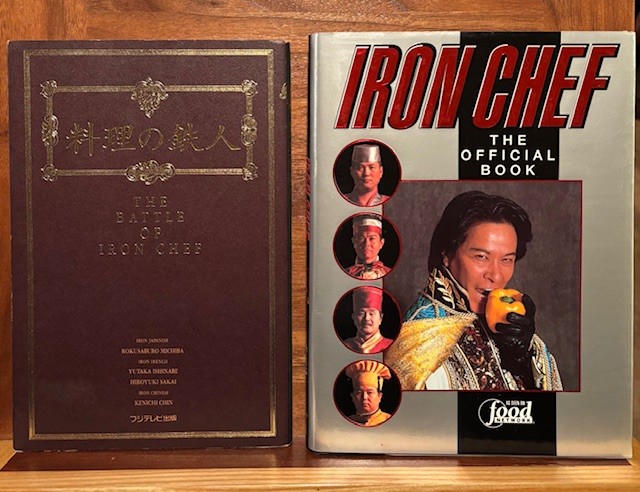
I really enjoyed the show, being in Japanese, and dubbed into English. I found out that episode 85 was a Sardine Battle. It was with Iron Chef Chen Kenichi, and Yukihiro Noda, who worked for The famous Don Sabitini Italian Restaurant in Tokyo (with others around the world). Chen won with Sardine Ice Cream, Sardine Sashimi, Stir Fry Sardine, and Sardine and Shark Fin Stew. (I have had Shark Fin Soup without Sardines in Japan, and it was crazy good.)
Don Sabitini was not happy with the loss, and there was a rematch three years later with another Sabitini chef-Hideki Marayama. The ingredient was again Sardines, and Chen again won. The meal cooked was Sardine Hor d’oeuvres, Sardine Mousse, Smoked Sardines, Steamed Sardine and Mango Stir Fry, Hot and Spicy Sardine and Banana, and Sardine Soup with Risotta Rice.
I also have my Steinbeck novels stacked up like sardines in a can. These are published by Library of America, and are quality bound. In the third book is the novel “Cannery Row” about sardine canneries in in Monterey.

I visited Cannery Row a few years back. Here is the Steinbeck Memorial there on the bay.

In Cannery Row, is the Monterey Aquarium. This is a wonderful aquarium. There is a huge 1.2 million gallon tank with an equally huge school of sardines. It was mesmorizing to watch them swim.
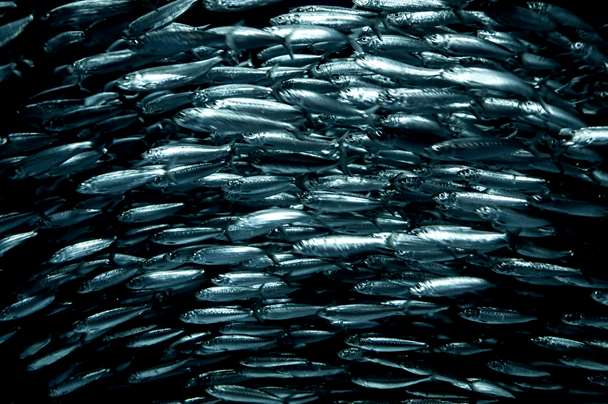
That aquarium was fin-tastic.

When good friend of mine, and I traveled to Japan, we rode the Bullet train (the Shinkansen) several times. We wanted to travel once during the rush hour, where they had ‘pushers” – conductors that would decide of you could fit in or not. They would then push or pull before the door closed. We wanted to experience human sardines in a can. During rush hour, the capacity of people in cars would be 160%, sometimes actually up to 200%!
For us, the rush hour time was when we were going back to the airport. With my back pack and his suitcase taking the space of at least three or four Japanese, it was the only time we got yelled at by a japanese person.
Knock knock! Who’s there? Pack. Pack who? Pack-ed like a sardine, but still having fun!
Nothing fishy about this story. Thanks for reading.
 Librarytomes