On November 16th, 1822, William Bechnell arrived in Sante Fe New Mexico, along a soon to be named Santa Fe Trail. He was the first to use a specific route for trading, along with leading wagons. I have a good book that give history around Santa Fe, why there were people there, and what happened before and after Bechnell began regular trips from Missouri.
This would be ANOTHER Landmark Book, from my childhood, “The Santa Fe Trail” by Samuel Hopkins Adams, published 1951.
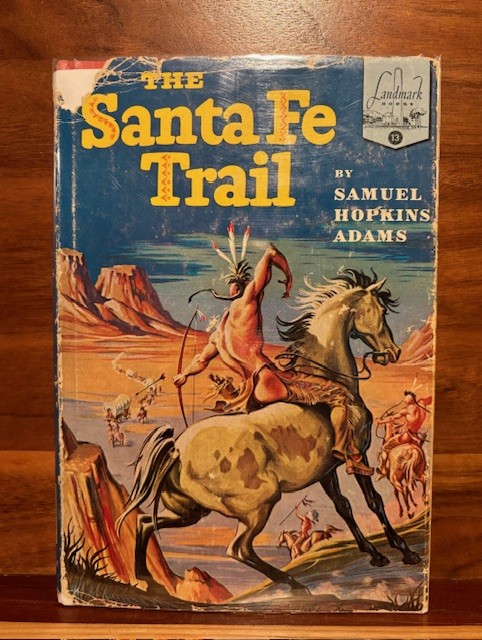
According to the author, there is a legend around the Sante Fe area. About twelve hundred years ago, an ancient Bishop of Lisbon landed in the Pacific coast of North America and led his men across the mountains of the Southwest. Then they found this fertile country inhabited by savage Indians. After conquering the tribes, he found a nation called Cibola, with seven great cities. Each city had treasures of gold and silver.
The early Spanish conquerers took over Mexico and began looking for these fabled seven cities. For centuries, there was a quest for these lost cities of gold. American pioneers began making their way southwest looking to trade in Sante Fe, some for gold, others for trade with Mexicans, some to settle somewhere new. James Percell in 1805 was found in Sante Fe with a pack of gold. No one ever found out where he mined that gold.
A few years later a Zebulon M. Pike brought some surveyers and soldiers, and was arrested by the Mexican army in Sante Fe. He claimed he was trying to work trade between Mexico and America. When finally let free, he continued to explore the Rocky Mountains. On November 15 (yesterday), 1806, he spotted a mountain. It was later named after him-Pikes Peak.
In 1822, Captain William Becknell, an explorer, who was an honest trader with Indians (a quality that allowed him to pass safely where many traders were not), talked with some Mexican adventures, and decided to make the trek to Sante Fe for trading. He led the first wagon train. Their trip from Franklin, Missouri to Santa Fe was successful. He made several journeys, and began the Sante Fe Trail route.
This is all just in the first 25 pages of the book. The Sante Fe trail from Missouri to Sante Fe (and Mexico to Sante Fe) then became a major trading route. The rest of the book explains the traders and settlers that used the route, along with the damaging power of the Comanche Indians living there. At their worst, they would be attacking you. Sometimes just stealing and demanding tolls. Even buffalo were part of the trail story. The war between Mexico and America involved the Sante Fe Trail.
There are great stories of adventure about this strategic location. It became a major road for commerce, until the building of train tracks slowly took the business west to California. This book well tells the story of not just people, but people that were part of a place-the Sante Fe Trail. This is an interesting book on a specific land-area in history.
I also wanted to button up a few notes. Today is National Button Day. I wrote a good amount on buttons for the beginning of National Button Week on March 11 (“I’m the Boss, Applesauce”). Just to commemorate today, I refer you back to the other post.
I will however, show a small selection of specific buttons from my button box.

I have also since March, found a few shells that have had button blanks drilled out of them to then be polished and made into pearl buttons.
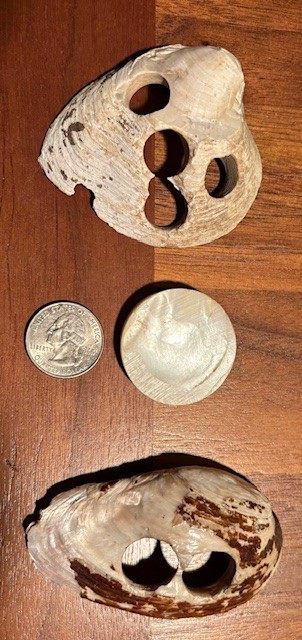
I have also found online, a book about Muscatine, Iowa, “the pearl button capital of the world”. I have of course ordered it, and will later review more button history.
This goes to show you, I can’t stop looking for interesting books. I hope you find them compelling, as well.
Thanks for reading.
 Librarytomes