September 27th is American Indian Day, the fourth Friday in September. My dad was an avid reader and student of Indian history and art. He spent a summer in his youth living in at a reservation in New Mexico. When we traveled, if there were Indian artifacts in a museum, or buildings and mounds, we would stop. I have a full shelf of the history about Indians, and would like to display a few from various collections inside that collection.
First is a three book set of interesting aspects of Native Amerians. These are a good start into history and traditions written by Colin F. Taylor, 1996.

I have some new and old children’s books about American Indians. These two are both illustrated by Susan Jeffers, and are autographed by her. My mom took a seminar with Jeffers as a guest speaker, when studying for her masters.

Here I have a few more childrens books. I really like “Horned Snake Medicine” by William H. Bunce, published in 1945. It is about mound builders in Western United States. I also have enjoyed reading “Wigwam Evenings, By Charles A. Eastman and Elaine Goodale Eastman, 1937. This is a collection of Sioux folk tales.

I also have books about indian places I have visited. Several times my dad took us to visit Dickson Mounds. This is “The Prehistory of Dickson Mounds: the Dickson Exavation” by Alan D. Harn. 1991, reprinted from 1971. This is a written study, with many illustrations, and one photo of the excavation story and site.
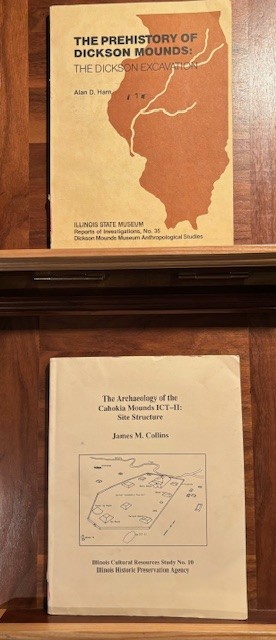
This is “The Archaeology of the Cahokia Mounds ICT-II: Site Structure” by James M. Collins, 1990. I first went here with my mom, when traveling from St. Louis book hunting. There is a wonderful museum and many mounds. The largest is Monks Mound, over 100 feet high. From the top, one can see the St Louis arch. This was supposedly one of the largest cities of the world around the year 1100, with a population of 15,000 to 20,000 people. During the same time, Paris and London were each smaller in population.
I have visited the site several times again, once where spent some time talking to the people actually excavating an area looking for artifacts, while they were digging.
The next two books are about Indian Petroglyphs: The Jeffers Petroglyphs by Kevein L. Callahan, and “Wisconsin Rock Art” published by Wisconson Archeological Society, 1987. We were camping and Dad took us to visit petroglyphs in Wisconsin. While we went to Roche-A-Cri state park, he also had connections to go on a farmers land and see a privately owned place. I believe that was called Twin Bluffs.

Another place we have gone as a family is Mesa Verda. Here are a few books on that site.

The Newberry Library in Chicago has perhaps the countries largest collection of American Indian books and printed matter. They have printed bibliographies on specific Indian tribes and subjects. As well as listing the printed matter, they have recaps of that specific tribe or subject that have been wonderful reading. There are perhaps twenty three volumes, that I know of. I have twelve so far. These were printed by Indiana University for the Newberry library.

Here are a few of the older printed stuff I have on American Indians. The top two books upright are: “Childhood and Youth in Jicarilla Apache Society” by Morris Edward Opler, published 1946; and “Culture of the Ancient Pueblos of the Upper Gila River Region, New Mexico and Arizona” by Walter Hough, 1914.
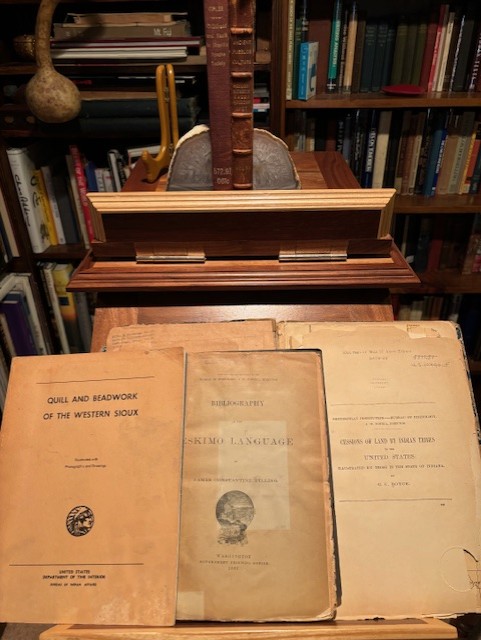
These three pamphlets are “Quill and Hemp Beadwork of the Western Sioux” by United States Dept of Interior, 1940; “Bibliography of the Eskimo Language” by James Constantine Pilling, Washington Government Printing Office, 1887; And “Cession of Land by Indian Tribes to the United States: Illustrated by those in the State of Indiana”, published 1881. This has a torn map that I would like to archively repair.
This would be the first American Indian book I have owned. It was a Christmas present from my Aunt Dee, back in the 1960’s.

She gave my brother and I each a book that year. I received a book on Indians, and my brother received a book on Birds. At the time I was a little jealous because his book had a small record in a back cover sleeve that had different bird sounds to help identify them. We also received that year, tie tacks. One was an Indian head, and the other an owl.
When Dad would take us to museums like the Field Museum, I would want to see the Granger Hall of gemstones, or the mummies, or stuffed animals like the Tsavo lions. He would take us first to the Americas displays of Indian Art and Artifacts. Those first visits, I would cringe at how long he would take reading every sign and display marker. I hated it.
I have officially turned into my father. He would be happy to know of the interest I have in American Indian history. Just the books I have shown today, would have thrilled him to read.
Thanks for following along on this adventure.
“Amazing the things you find when you bother to search for them.” – Sacagawea
 Librarytomes