September 24th is National Punctuation Day. This is an important day. As a graduate of NIU from the College of Journalism, I appreciate knowing the rules, regardless (not irregardless) if I use them. My biggest loophole is that writers (not that I am one-just impersonating) can disregard proper punctuation, when journalists must follow proper AP style. That brings me to my first two books from my college days: “Grammer for Journalists” by E.L. Callihan 1979; and “The Associated Press Stylebook and Libel Manual” by the Associated Press, 1978.

“Grammer for Journalists” was first a quick rehash of grammer, then proper usage and choices in nouns, verbs, adjective and adverbs, and then finally punctuation. It was advanced English-journalism style. Every chapter had a quiz in the book, and every chapter was reviewed in class for another quiz.
The “AP Stylebook” was the Journalism writing bible-still is. There are updates, of course (texting has now forced us to use only one space now between sentences) to keep abreast of (and I use too many parentheses).
The next book reminds me I am part of a lending library. Family borrows my books, and I then borrow others. My book ‘Eats, Shoots & Leaves” by Lynne Truss, 2006 is in a classroom. So I borrowed the book “Eats, Shoots & Leaves” by Lynne Truss (for kids) from my daughter-the teacher. I won’t be able to keep it because she put her name in it.
Both the adult and the children’s editions are great examples of proper use of punctuation. The kids book is just about the comma.

One good example in that book would be whether to use commas in this sentence. The student said the teacher is crazy. The student, said the teacher, is crazy.
September 24th is National Gorilla Day. I have a good book on that, “The Ark in the Park-The Story of Lincoln Park Zoo” by Mark Rosenthal, Caroltauber, and Edward Uhlir published in 2003. In the book, one reads about the history of getting primates to the zoo. It also talks about the Lester Fisher Great Ape House that opened in 1976. It was at the time a state of the art enclosure for gorillas in the country.
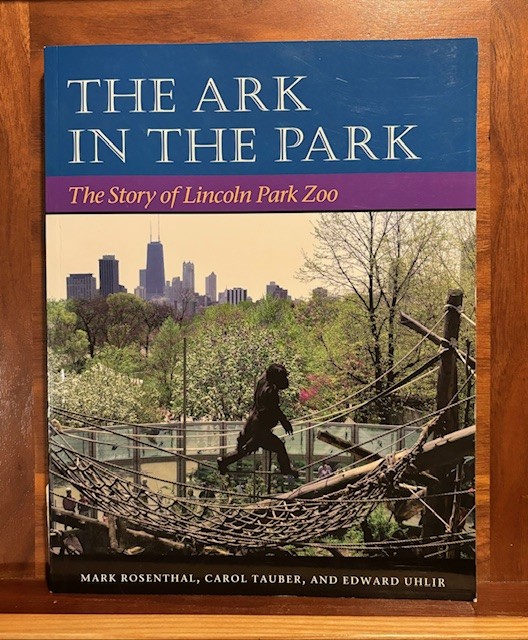
We went to see it that year. Many scientists also went there to study gorillas. The Lincoln Park Zoo was a leader in learning about gorillas. Now there is another even more elaborate system for studying gorillas-Regenstein Center for African Apes. It is considered the most innovative habitat for gorillas in the world. All the more reason to visit the Lincoln Park Zoo. I will admit, I also liked going to the Milwaukee Zoo when growing up, to see Samson the gorilla. He died in 1981.
I have another interesting gorilla book, “The Gorilla Hunters” by R.M. Ballantyne, published circa 1900 by the Sunday School Union, London.

This is a wonderful novel of hunting and studying Gorillas in Africa. The book was published for building character in young boys, and books such as these would be given as prizes for proper Sunday School reading and behaviour. I have a collection of these books, with a smaller collection of books that have a prize plate pasted inside the front cover, the the name of the winner on the printed plate.
From punctuation schooling to gorillas…I just have a few more comments:
What is the first thing that gorillas learn at kindergarten? Their Apey Cees.
What is most gorillas favourite book to study in English class at high school? The Apes Of Wrath.
Why did the Gorilla fail its exam? He didn’t have the ape-titude.
Why did the girl-illa win the beauty contest? She was beast of show.
Why do educated gorillas like the numbers 1, 3, 5, 7, 11 and 13? Because they’re prime apes.
Thanks for a little monkeying around. As Magilla would say “We’ll try again next week.”
 Librarytomes