On the first Saturday of September, we honor several birds-one of the largest, and one of the smallest.
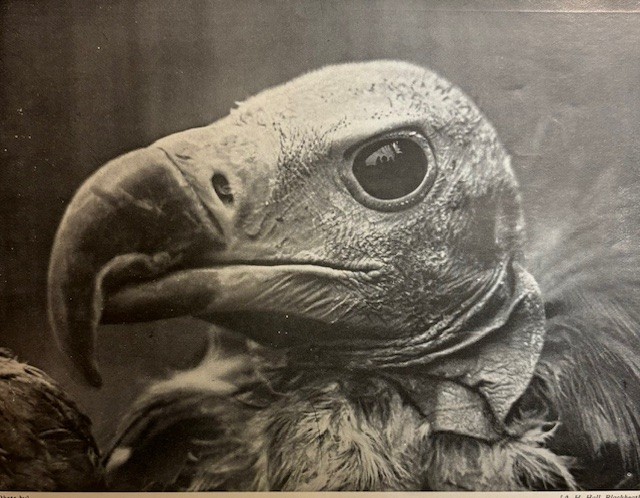
September 7th is International Vulture Awareness Day. Vultures can be beautiful birds when they are floating high in the sky on air currents. When you see one up close, they can be rather spooky, with their bald head and large black eyes. My granddaughter and I were once taking photos in a Florida wildlife preserve. We saw a turkey vulture land in the top of a tree about 30 yards away. She zoomed in to take a picture, and as she did, it turned its head right at her. She screamed, saying that it was looking at her so that it could swoop in and peck out her eyes. It gave her serious creepy vibes.
I have the four volume set of books “Hutchinson’s Animals of all Countries” published in 1920. There is much discussion about vultures, and a few pictures. Vultures can use their smelling abilities to locate their food. Their wingspan can be five to six feet.


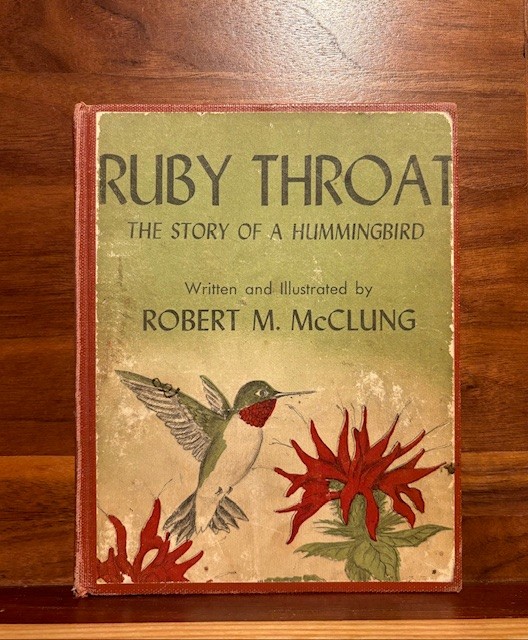
September 7th is National Hummingbird Day. Hummingbirds are more apt to be loved by humans. Everyone loves to watch them hover over flowers in the garden. My first book is “Ruby Throat, the Story of a Hummingbird” by Robert M. McClung, published 1950. It was a cancelled book from the Peoria Library-only checked out nine times. It is a nice children’s book explaining the life of a hummingbird.
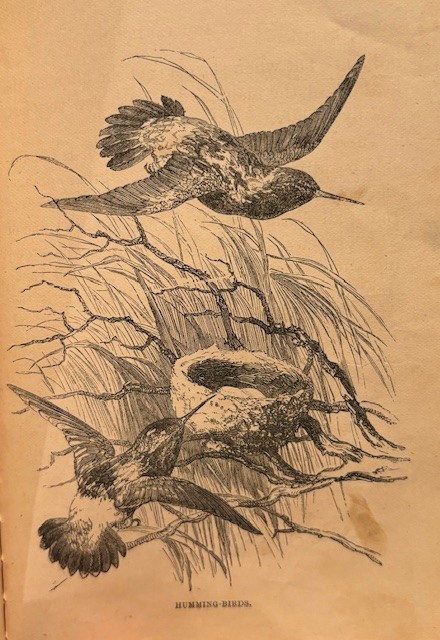
My next book is a little older, “Little Nellie’s Bird Cage” by Mrs. R. Lee, published in 1860. This wonderful old book has a picture and a little description of fourteen birds. To quote the author, “All that is elegant and graceful in shape, all that is brilliant and beautiful in plumage, is exemplified in the tiny humming-bird.”

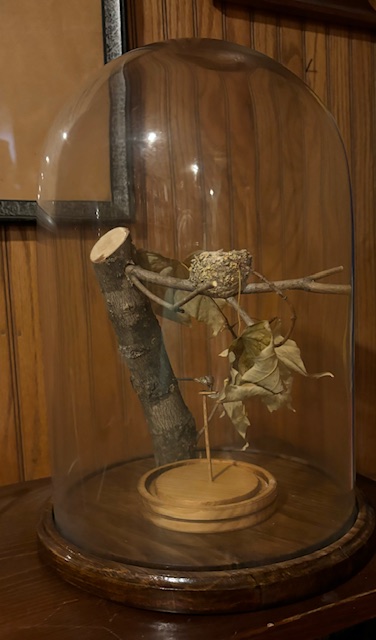
The book describes the humming-bird’s eggs to be pea sized. Today one might say that they are Jelly Belly jelly bean sized. When trimming a tree down about 20 years ago, I found a hummingbird nest in the cut down branches. I mounted it in a glass dome for the library.
I also have a collection of feathers. There is a book on that, and of course, I have it. The book is “Bird Feathers: a Guide to North American Species” by S. David Scott and Casey McFarland, 2010.
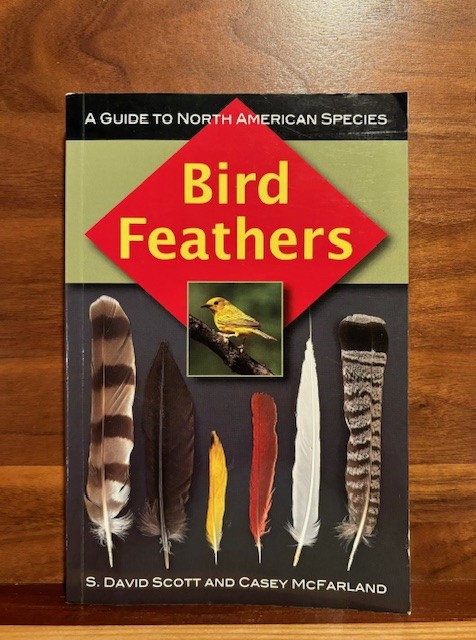
I have found feathers often when walking the dog in the woods, hiking, and in my tree filled yard. Also, when my brother-in-law and I were hiking in another Florida preserve a few years ago, we stumbled upon a committee of turkey vultures. (If there is group of vultures in the air, they are called a kettle. If a group of vultures are resting on the ground or in a tree, they are called a committee. If they are found together feeding, they are called a wake.) I found and kept a primary wing feather.

From my album of feathers, one can compare the size of a wing feather of a turkey vulture to the wing feather of a hummingbird. Once again, you see that in my library, I have a collection of collections.
Thanks for exploring with me.
Q: What do you get when you cross a hummingbird and a doorbell?
A: A hum-dinger.
A vulture decides to take commercial flight instead of flying himself South for the winter. He’s heard about airline food, so he brings along a dead raccoon for a snack.
As he gets his ticket, the agent looks at the raccoon and says “would you like to check that?”
“No, thank you” he replies. “It’s carrion.”
 Librarytomes