August 21st, 1858, was the first of seven Lincoln-Douglas Debates in Illinois. Steven Douglas was the United States Senate incumbent, for the Democratic party. Abraham Lincoln was running on the newly formed Republican Party. Their first debate was in Ottawa.
I have ANOTHER(!) Landmark Books entry today, “Lincoln and Douglas-The Years of Decision” by Rigina Z. Kelly, 1954. Kelly does a great job in explaining the individual roles of Lincoln and Douglas, and the political and social climate of the day. She explains the Missouri Compromise and how Douglas had it repealed, and then his involvement in getting the Kannsas-Nebraska Bill passed. Their speeches and debates together were mainly about slavery.
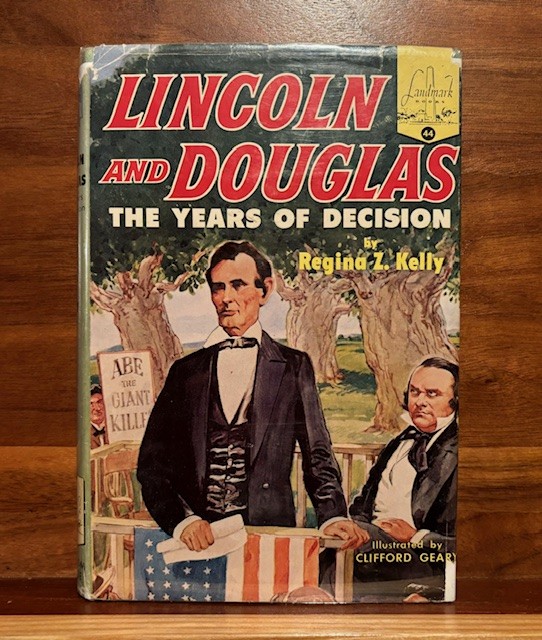
Both Douglas and Lincoln were running for the United States Senate. Douglas was the incumbent. Douglas was a great speaker, with the nickname, ‘the Little Giant”. Lincoln also spoke passionately, soon getting his nickname ‘Abe the Giant killer’. Each candidate had given speeches one day apart in two of the nine congressional districts. Lincoln asked if they could do the remaining seven together: the leadoff speaker had 60 minute, the next had 90 minutes, and the first then could have a 30 minute rebuttal.
They would rotate from one district to the next to as who would speak first. Lincoln lost the election to Douglas, but was now seen as a well spoken candidate for further considerations. As for his thoughts on the loss, he said that he felt “like the boy that stumped his toe,—‘it hurt too bad to laugh, and he was too big to cry.’”
I also have several Lincoln books from The Library of America. One is an anthology of Authors writing about Lincoln. The other two are his complete speeches and writings. Lincoln was good at giving many of his notes to be published, some the very next day in the newspapers.
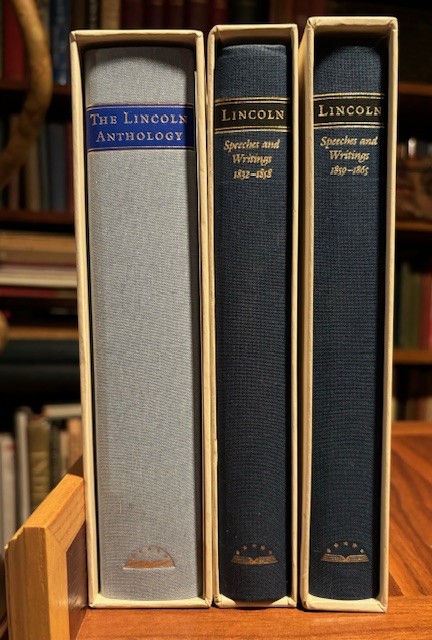
In these books one can read Lincoln’s speeches of the first two debates where they spoke a day apart. There is also the Ottawa debate, fragments of another in Edwardsville, and his last speech in Springfield. That speech was notable, for it included:
“A house divided against itself cannot stand.“
“I believe this government cannot endure, permanently half slave and half free.”
“I do not expect the Union to be dissolved – I do not expect the house to fall – but I do expect it will cease to be divided.”
“It will become all one thing, or all the other.“
I also have in my Lincoln collection, the book “Abraham Lincoln: Plowboy, Statesman, Patriot.” by W.G. Rutherford circa 1900. I found a few tidbits of knowledge. Lincoln’s grandfather was also named Abraham Lincoln. He married Anna Boone, a first cousin of Daniel Boone.
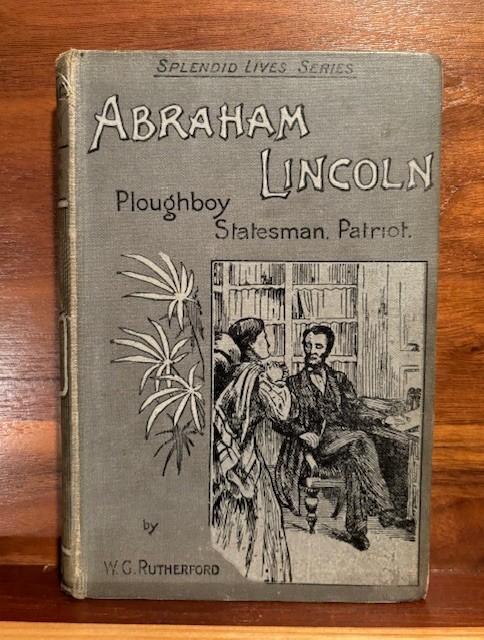
All three books tell of Lincoln’s Farewell address in Springfield, Illinois, as he was going to Washington DC to become President:
“My friends, no one, not in my situation, can appreciate my feeling of sadness at this parting. To this place, and the kindness of these people, I owe everything. Here I have lived a quarter of a century, and have passed from a young to an old man. Here my children have been born, and one is buried. I now leave, not knowing when, or whether ever, I may return, with a task before me greater than that which rested upon Washington. Without the assistance of the Divine Being who ever attended him, I cannot succeed. With that assistance I cannot fail. Trusting in Him who can go with me, and remain with you, and be everywhere for good, let us confidently hope that all will yet be well. To His care commending you, as I hope in your prayers you will commend me, I bid you an affectionate farewell.“
He never saw Springfield again.
 Librarytomes