On August 17, 1807, Robert Fulton’s steamship, the Clermont, left from New York to Albany. Fulton had now begun the first commercial voyage of a steamboat. It moved at about five miles per hour. While that does not seem like a speedy trip, it revolutionized moving products in the US, and even later in and to Europe.
All of that story, and other events of Robert Fulton, are in my Landmark Books tome “Robert Fulton and the Steamboat” by Ralph Nading Hill, 1954.

Robert Fulton had a busy life. He easily met people of importance, and was involved in many projects. He was a good portrait painter and inventor, as well as an engineer. He moved from Philidelphia to live in France because of tuberculosis. Later Fulton was commissioned to invent a submarine for Napoleon. He did complete one, and it was called the Nautilus. Fulton then later moved to England, and worked on building torpedoes for their government. It was during his time in France, and then later back in New York, when Fulton worked with Robert R. Livingston to develop a steamboat that could be profitable on rivers, and his attention of making canals. It was unusual at the time to be able to move products upstream. More and more steamboats were made, some for moving goods, and others for military might.
On August 17th, 1740, Prospero Lambertini became Pope Benedict XIV. He was elected on the 255th ballot, after not receiving a single vote on the first 254. It took six months of balloting in the conclave. It was just before that 255th vote, that he spoke up and said “if you want an honest man, vote for me.” I started my research on him with the book “Chambers Biographical Dictionary” edited by Magnus Magnusson, 1996.
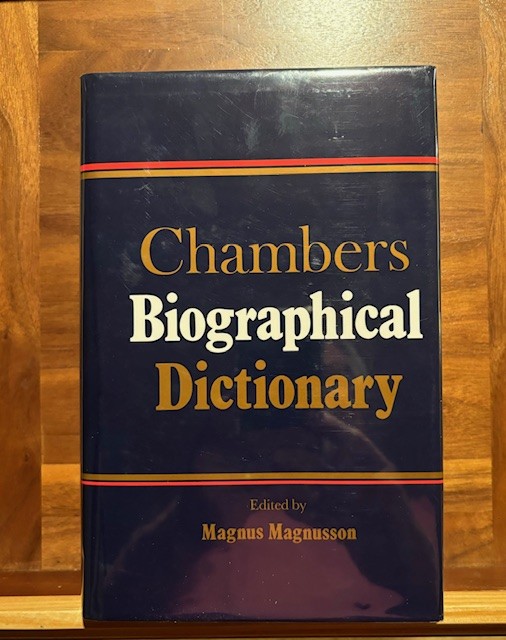
Benedict XIV was said to be one of the most learned popes, and continued his scholarly pursuits his whole life. He was a moderate pope, working with Protestants, and making better rules for treating non-Catholics in the new world, as they were trying to convert them. It was said that he frequently used profane language, what some biographers called “unfortunate phraseology”. It did not stop him from being a well revered pope. He was well spoken, and conversed with many famous people of the time, including Voltair.
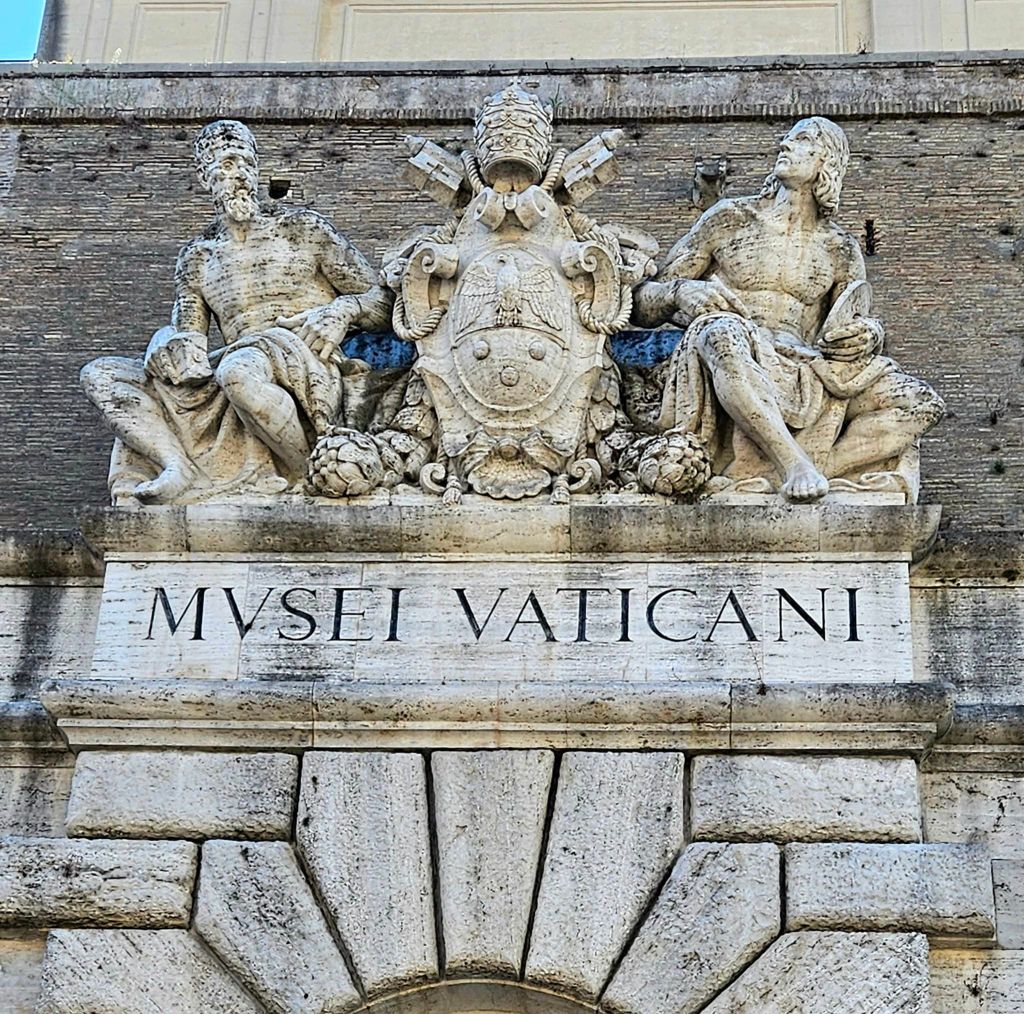
He laid the groundwork for developing the Sacred and Profane Museums at the Vatican, as well as aquiring and cataloging many new volumes of books, including an entire wing of Chinese. We were able to see much of what he started, when we went through the Vatican Museums. It now has nine miles of museum. (Thanks to my esteemed photographer friend, I have used several of her pictures.)
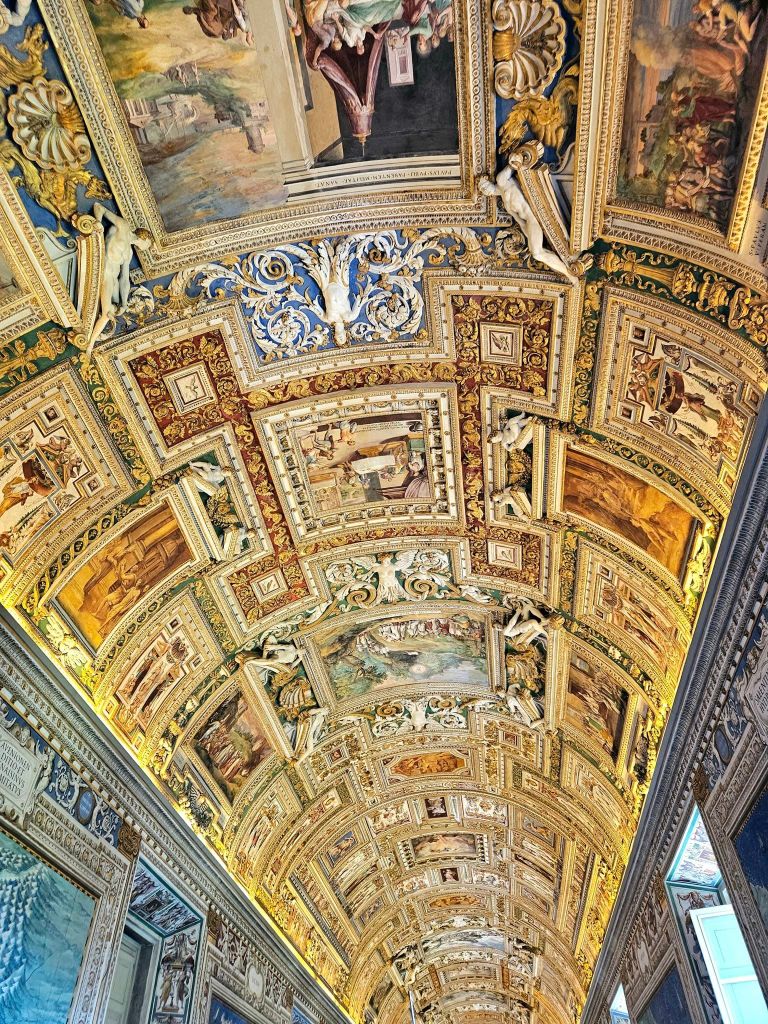
One long hallway in the Vatican Museum is called the Gallery of Maps. This one hallway is 120 meters long.
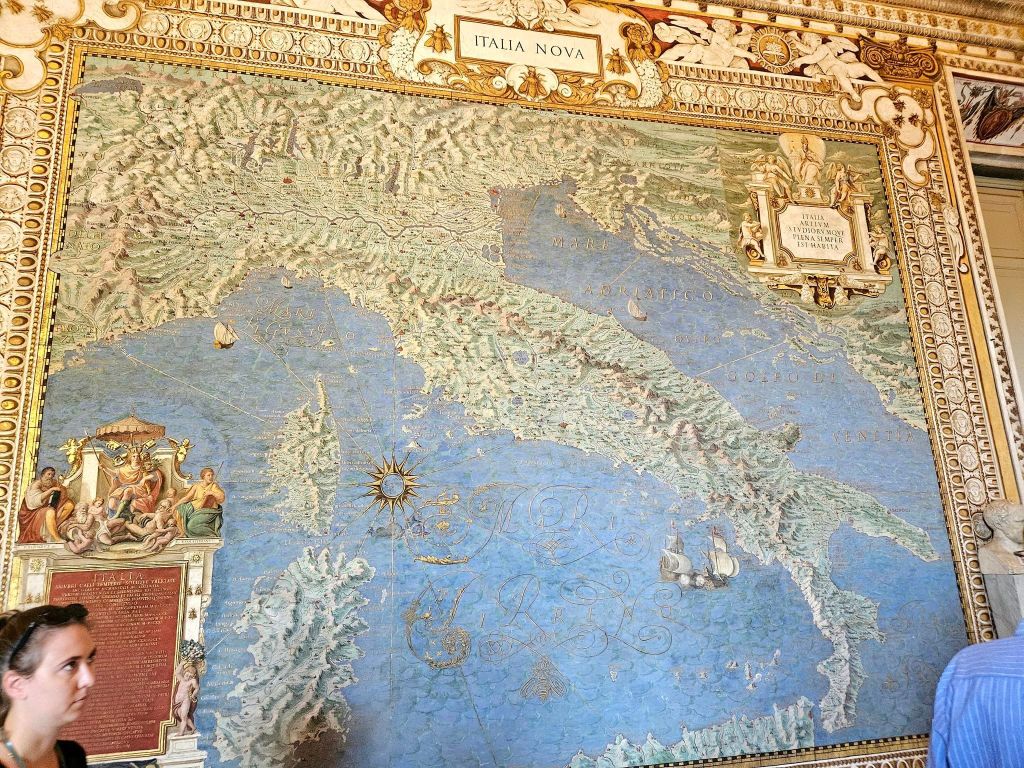
There are 40 large wall panels of maps in this gallery. The maps were painted by Friar and Geographer Ignazio Danti. He spent three years to paint them.
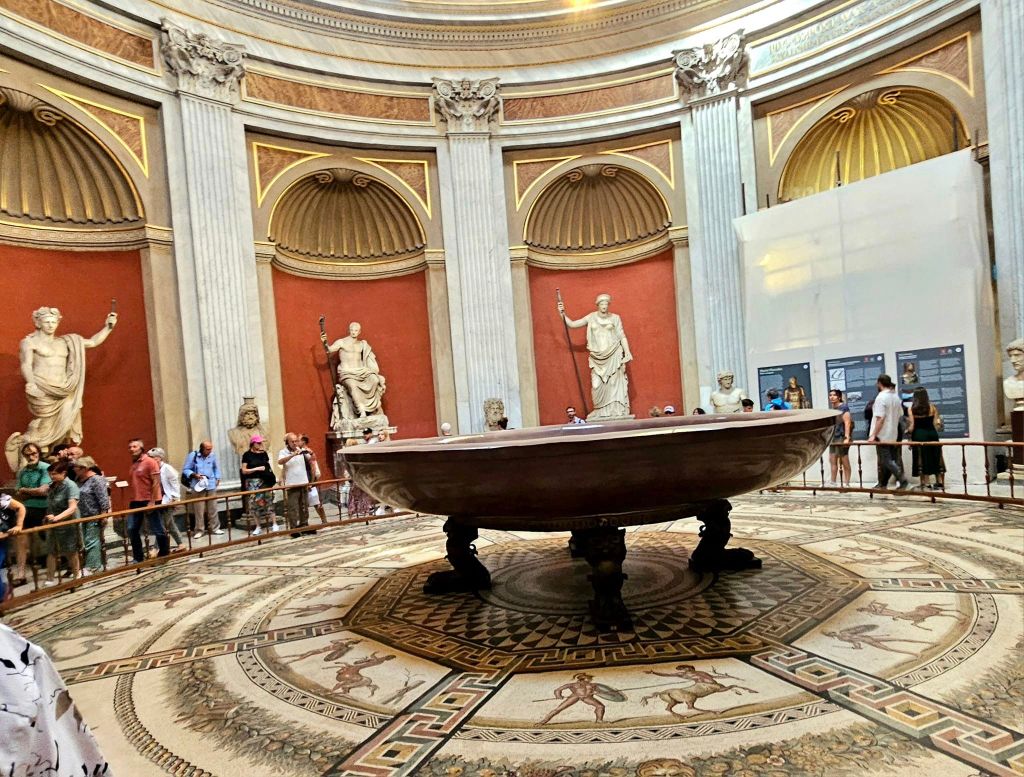
We also walked through the Round Room, or the Rotunda Hall. The ceiling is modeled after the Pantheon. The floor is a crazy mosaic from an ancient Roman bathhouse. There are statues of gods and emperors around the walls. And the centerpiece is a large bathtub. It is a ‘porphyry basin’ made for the Roman emperor Nero. It is the largest marble basin ever made, and it is an unusual purple marble, weighing over 1000 pounds. It is said to be worth $2,000,000,000 (two billion dollars).
Our guide telling us this information, was wonderful. She was a retired archeologist, had worked on parts of the forum ruins, and did the Vatican tours only one day a week (one other day she would give forum tours). She knew her business.
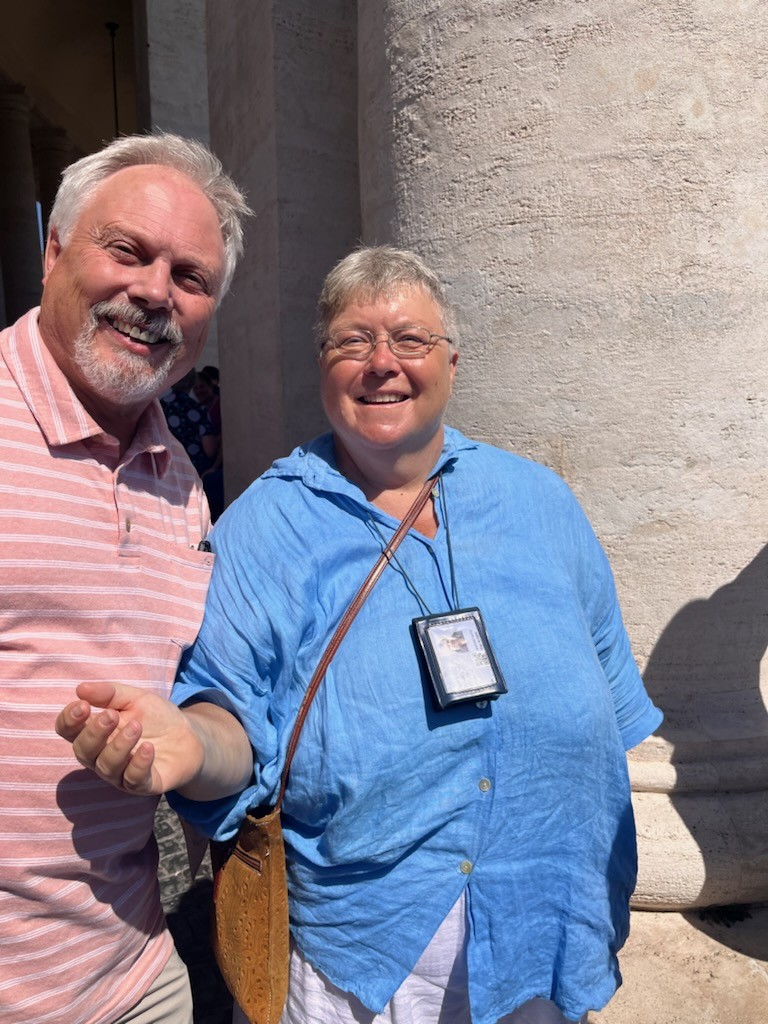
She was able to finesse us a passage around the Vatican police (the Swiss Guard) from the Sistine Chapel through some passageways to a shortcut into St Peter’s Basilica. While I don’t recall her name, my travel companions said we shall remember her as Margherita.
Once in St Peter’s Basilica, one of the first alters we saw was the one for Pope Benedict XIV. He is standing up with arm outstreached to give his blessing. On his right is the statue of Sacred Wisdom (or Knowledge) and on the other side is statue of Disinterestedness. The first figure holds a book in her hand, and has a gilded sun on her breast. She is looking at pope Benedict XIV in admiration of the culture of learning he brought. The other is flanked by an angel who is vainly trying to offer a cornucopia filled with jewels and money. She is spurning riches.
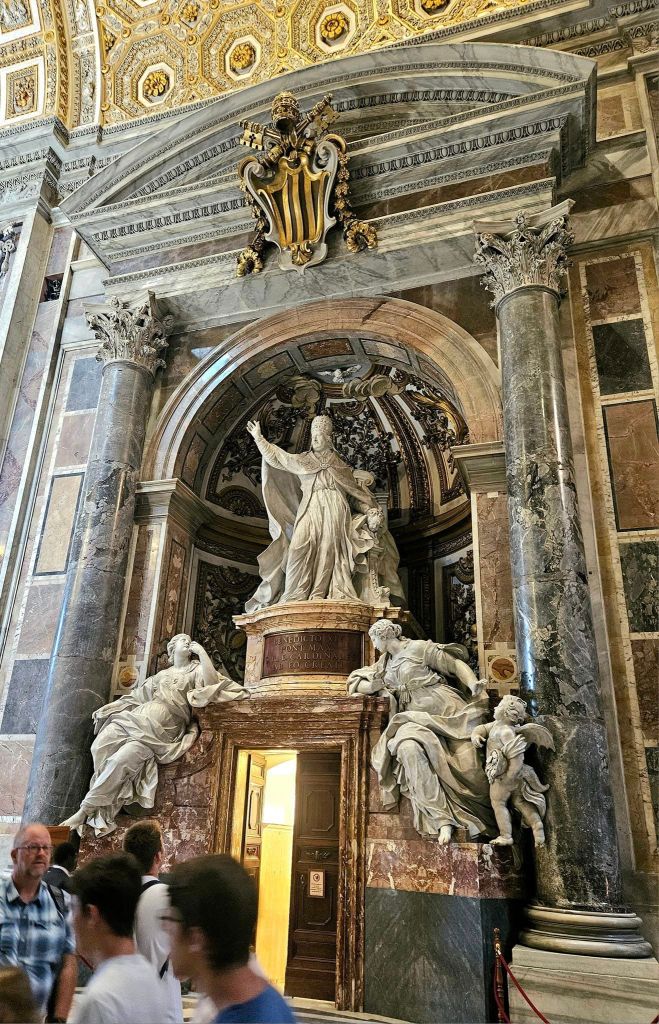
Pope Benedict XIV also admonished those in charge of drawing up the Index Librorum Prohibitorum (Index of Forbidden Books) to act with restraint. I am glad, because I may have one or two of those books, to use on a future day.
So we we have two learned men, not even a century apart. One promoted science and learning, even as a secular leader, the other developing mechanics that would promote the industrial revolution, and global trade, (along with American naval military strength.) They both improved our world.
Thanks for chugging along for the ride.
 Librarytomes