On August 6, at 8:15 in the morning, an atomic bomb was dropped on Hiroshima. I would like to talk about it a little, using a few books in the library.
My first book is “Hiroshima Under Atomic Bomb Attack” by Shogo Nagaoka, published in Hiroshima. Later editions will state published by the Peace Memorial Museum Press. This one does not, so is earlier, probably around 1954. This book has 17 pages of English text describing details of the aftermath of the bombing, 40 pages of pictures of the damage, and then 10 pages of Japanese text. The photos have both English and Japanese descriptions. There are several fold out maps and pictures, showing amount of damage in concentric circles away from ground zero. When you see the pictures, it is frightfully amazing of the amount of damage that this one bomb did.
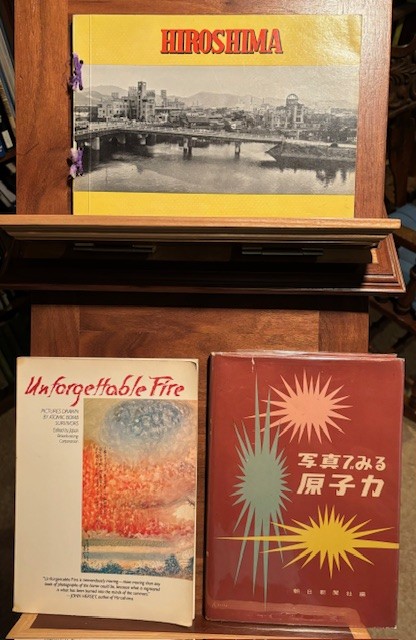
My next book is “Unforgettable Fire” 1977, edited by Japanese Broadcasting Corporation. The sub-title is “Pictures Drawn by Atomic Bomb Survivors”. This is an amazingly gut-wrenching book of pictures drawn, some colored some penciled, of survivor’s rememberences of people and places, and some of what the explosion looked like. There are then their ages, and stories of what pictures represented.
The next book I know very little about. I picked it up at an old bookstore to look, as it had Japanese lettering on the cover. It has no English. The pictures are in black and white, and it is written all in Japanese. The first pages are photographs of human damage and death from the bomb, and then physical damage to property. Following the pictures through the book, it looks like a history of the American discovery, then development, of atomic warfare and atomic power plants. The people are all American. Penciled in was the date 1954.
Twenty or so years ago, I visited Hiroshima. I have a few pictures from there. The first is at Ground Zero. The building behind me is the former Hiroshima Prefectural Commercial Exhibition Hall, now known as the Genbaku Dome. It is said to have survived because the blast was directly above it, and the concrete dome acted like an umbrella, directing much of the energy around it.
It is left like it was, blocked off, still somewhat radioactive. It is now part of the Hiroshima Peace Memorial Park and museum. Behind me is one of two rivers that join together there. The Aioi Bridge was a three way bridge that was used for the target of the bomb.

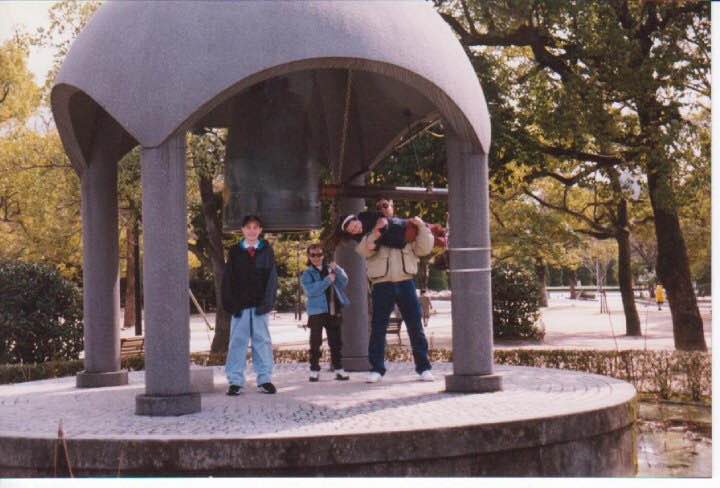
August 6th has also the Hiroshima Peace Memorial Ceremony, with events and speeches at the Memorial Park to pray for world peace. It is a important Japanese day. At one end of the park is the damaged dome, and at the other is the Children’s Peace Monument. There are several other memorials directly in line between them, including the Peace Bell that one can ring.
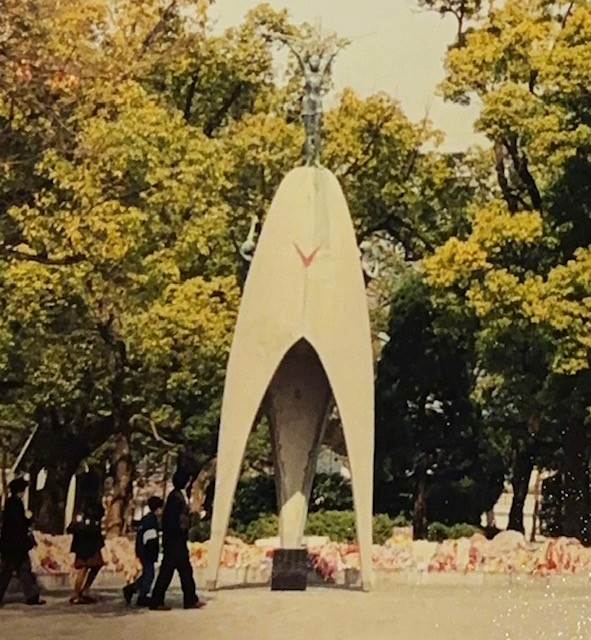
The Children’s Peace Monument is at the opposite end from the dome. It honors Sadako Sasaki, a young girl that died from radiation poisoning from the atomic bomb. It is her on top of the monument, holding a wire crane.
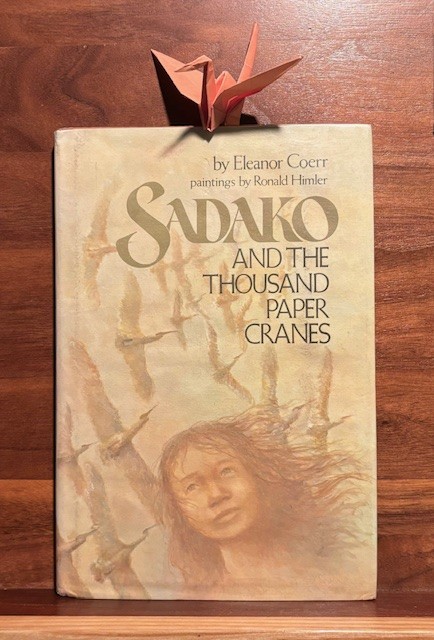
In the hospital, she tried to fold 1000 paper cranes. If she could, it was said that she would be granted a wish; she wanted to get better. I also have that story in the book “Saduko and the Thousand Paper Cranes” by Eleanor Coerr, 1977. It took me about twenty minutes, following an Origami book to just fold this one crane.
People still fold cranes, and string them together into crane garlands. We saw hundreds of such garlands, that were laid out here at the monument.

On August 6th, for the Hiroshima Peace Memorial Ceremony, there will be even more…from schools and children not just around Japan, but from around the world. There is a large plaque at the base of the monument that states:
“This is our cry, this is our prayer: for building peace in the world.”
,
 Librarytomes