On July 30, 1718, William Penn died. His story is another great example of the character of our founding fathers, the people who built this country. His story has actually brought some recent activity to life. But I shouldn’t get ahead of myself.
We will start with one more volume of my “Boomer Library”… histories from Landmark Books. I read so many of these books when in junior high at Westfield school-fifth through eighth grade. This is “William Penn-Quaker Hero” by Hildegarde Dolson,1961.
William Penn was born to a wealthy family. His father, Sir William Penn, an admiral for King Charles the Second, was given a large block of New World Land (much of modern Pennsylvania and New Jersey). Penn wanted his son to move up in into the royal courts. Instead, William Penn became a Quaker, and his life changed dramatically. The young William Penn always stood up for what he believed, even if Quakers were considered “enemies of the state”.
After getting out of prison (the tower of London), (which was a memorable time because he spoke so eloquently at his trial, that the jury voted him innocent three times, so the angry judge locked up the jury each time and told them to reconsider their verdict!), Penn then later went to America to manage and govern over the land in the New World with his views of proper ruling.

He wanted to call the land New Wales, but King Charles insisted on it being Pennsylvania to honor Sir William Penn. Penn then founded Philadelphia, plotting out the grids of roads, buildings, planting trees, designing the city. He developed the city which became the most influential city in the colonies. Penn remained a quiet yet forceful leader, that most people supported and believed in. As well as promoting religious freedoms, Penn ensured he would not exploit natives or immigrants. He negotiated with Indians on land sales. As well as getting Quakers to move there, he encouraged other religious minorities to also make their home in Pennsylvania.
Other Quakers, Penns cousins, Francis Daniel Pastorius and Abraham op den Graeff were among several that made the ‘1688 Germantown Quaker Petition Against Slavery.’ It became the first written protest over slavery.
Just today July 30, 2024, I made a planned stop (on the way to Hannibal, MO) to Barry, Illinois to see the newest site designated on the National Park Service-New Philadelphia National Historic Site (signed by President Biden on December 29, 2022.)
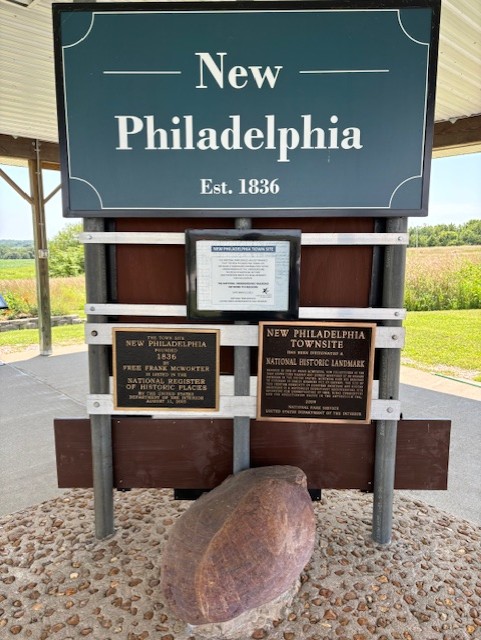
New Philadelphia was founded in 1836. It was the first town platted and registered by a free black man in the United States. Free Frank McWorter moved with his enslaver to Kentucky in 1795. He was able to do side work and keep some of his money, enough to buy his wife’s and his freedom.They moved to Illinois and bought property to make a town-New Philadelphia. Free Frank was able buy the freedom of 16 of his family members.
After visiting the site, we went to the local library in Barry, and took a tour of their museum. Actually the museum was closed, but the librarian asked us if we could wait a minute, and she called Mary Beth who runs the museum, to see if she could come down and give a tour. Five minutes later, doors were unlocked, and we were getting a history lesson. An hour and a half later as we were leaving, we decided it was a wonderful tour, by a wonderful guide, in a wonderful small town.
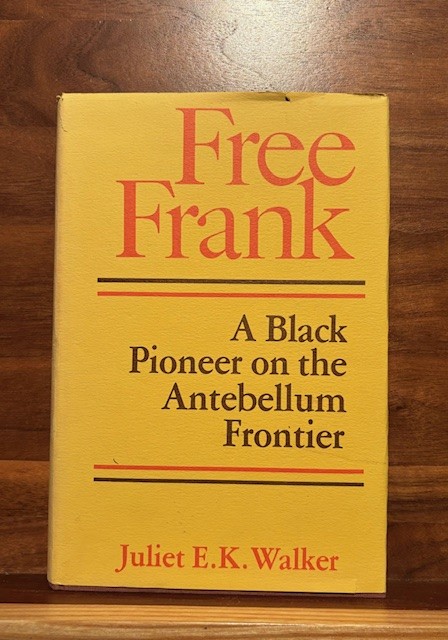
I also was able to buy several books there, on the New Pennsylvania story. The first is “Free Frank: A Black Pioneer on the Antebellum Frontier” by Juliet E.K.Walker, published 1983. (I was given a choice if I wanted the hardbound book with dust jacket, or the newer printed paperback. She said that most people seemed to like the new paperback. I chose the first edition hardback.)
The second book is “Finding Home: in New Philadelphia and Pike County, Illinois” by Carol McCartney, 2022.
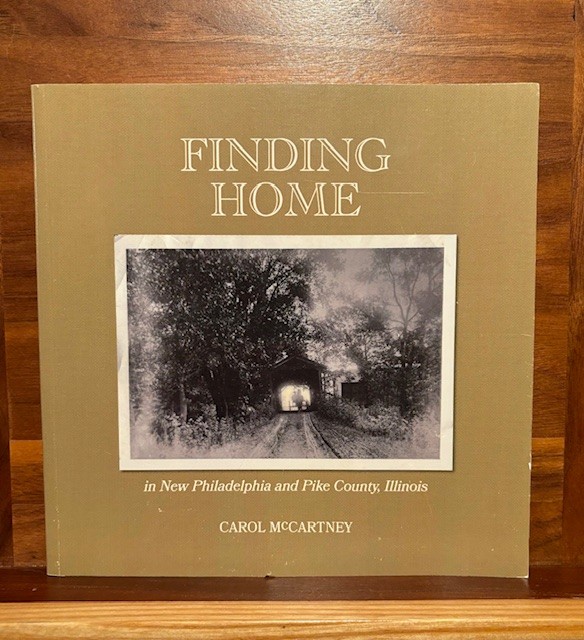
I wish I could tell you what all is in these two books, but I just bought them today. “Free Frank” looks like a detailed biography of Free Frank McWorter. “Finding Home” looks to be a story of New Philadelphia, with lots of pictures and illustrations added. After the visit to the site, and the museum in Barry, I am excited to reach into them both.
As for the rest of my visit, I continued on to Hannibal with my sister, and some grandkids. My sister and I, and the rest of our family had visited Hannibal in 1973. We took the following black and white picture. I was not enthused about the White Picket Fence and Samuel Clemen’s Boyhood Home.


I still look unenthused fifty years later. Several grandchildren are also following in my footsteps. I must be doing something right.
“Travel is fatal to prejudice, bigotry, and narrow-mindedness, and many of our people need it sorely on these accounts. Broad, wholesome, charitable views of men and things cannot be acquired by vegetating in one little corner of the earth all one’s lifetime.” – Mark Twain
 Librarytomes