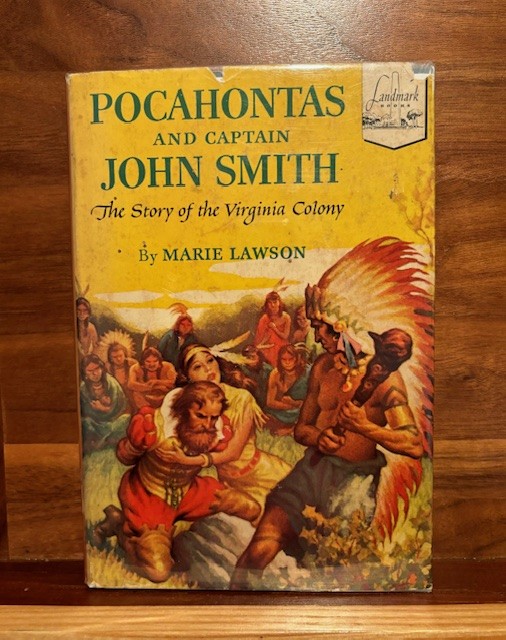
The Jamestown settlemant in Virginia was the first permanent English settlemant in America. I have a great book that tells of the Virginia colony’s beginnings. Once again, I lean on my collection of Landmark Books, for their American history and stories. This one is “Pocahontas and Captain John Smith: the Story of the Virginia Colony” by Marie Lawson, 1950.
This story starts when King James founded “the London Company” which made a charter to give land rights to one hundred and forty three colonists, to sail to the new world. Captain John Smith was picked to be one of the leaders of the new town. They called the new settlement Jamestown, after King James. Indians had attacted on the first day, shooting arrows in two men, so the first matter of business was to build a fort.
Many of the colonists died that first year. The next fall, John Smith went to trade with some Indians. His friends were all killed and he was taken to the Indian Chief-Powhatan. He noticed at his feet was the princess Pocahontas. After a long talk, John Smith was tied up and held over a tree trunk. He was to be executed. But at the last moment, Pocahontas jumped forward and grabbed John Smith’s head. He was spared because of her. He was then lead back to the Jamestown settlement.
This is the beginnings of the first white settlement in America. Though there were many troubles the first few years, especially in growing enough food, the settlement finally grew. And then, they opened additional profitable outposts and settlements around Jamestown. As the whole area kept getting larger, mostly by growing tobacco, the people wanted to have some local say in how things were run. The king’s appointed governor allowed them to have a voice in their own affairs.
So on July 30, 1619, there was the first legislative assembly in America. Two burgesses (representatives) from each settlement (there were 22 burgesses) picked by the settlements themselves, met with the picked governer, and counsell, and they chose John Pory to be the speaker.
As the book states “Thus was born the House of Burgesses-that tiny seed of self-government which, in the long years to come, was destined to grow and flourish; to become, in the end, the foundation of America’s freedom.”
This was a big deal. As well as making laws on drunkenness, idleness, and gambling, they made rules in protecting against Indians, baptizing Indians, and going to church. Lastly, they made rules concerning land. Each colonist who had been there before 1616, would be accorded many acres of land. Newer arrivals were also given land, but smaller plots.
Their next plan was to give the men a real home life. “The next ship brought a new cargo-possible wives. There were ninety women-some poor girls, some early widowed by England’s wars, but all had been chosen for life in the wilderness was hard…Wedding after wedding followed. Houses were becoming homes”
Things went well for a few years. In 1624, King James refused to give a new charter to the Virginia Company. He would rule everything himself-with his chosen people, and his taxes. Then he died, and King Charles the first took over..and then Charles the second..James the second, and William and Mary…and then queen Anne…and then George the first…and George the second…ending with George the third. It never really got better. They each added a few additional challenges to the colonists.
By then-it took that long-the colonists finally all revolutionized together to end this “taxation without representation.” It all started in Jamestown, and with that first assembly of representatives in 1619.
Thanks for reading.
 Librarytomes