July 29th is International Tiger Day.
I have the book “Man-eaters of Kumaon” by Jim Corbett, published 1946. Lieutenant-Colonel Corbet grew up in India. He was a big game hunter that would track down tigers, and a few leopards that were eating poor villagers in the mountains.
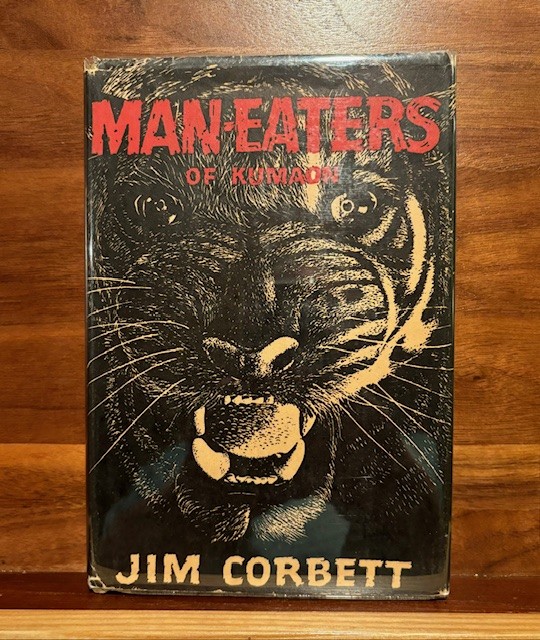
The book tells of seven true-life hunts Corbett took to track down these tigers in the wild jungles between 1900 and 1930. One Tiger in Champawat was responsible for killing over 400 people. These are interesting tales of tracking skills in a very secluded part of Northern India near the Nepal mountains. Corbett sometimes took over a month to track down a tiger through the jungles there. He said that usually a tiger became a man-eater because it had been wounded and could not attack other prey, or had been struck by a porcupine. One had over 50 quills in its paw and arm, and was severely infected.
Corbett usually travelled alone, but several times had a person following along with a camera. This book was very popular in the 1940’s, talking not only of his hunting skills but of his knowledge of jungle life and love of nature. He only hunted those sick tigers, ones killing unprotected people living in the jungle. He never hunted just for the thrill of killing big game. There is a subspecies of tiger named after him.
I have another book about killing tigers. That would be “Little Black Sambo”, this book by Whitman publishers in Racine Wisconson was published in 1959. The story was originally written in 1899, by Helen Bannerman. The story is that Sambo had bright new clothes, and had to give various articles of clothing to tigers that came up to him threatening to eat him. He told each tiger that he would look wonderful in the piece of clothing, and thus saved himself from being eaten. One tiger had his coat, another had his pants, another his umbrella, and a fourth had his shoes (put on his ears).

The tigers had come up to him at separate times, and they later all met back up, each thinking that he was the finest looking tiger. Sambo jumped up a tree, and the tigers madly chased after each other around the tree, faster and faster, until they turned into a circle of yellow butter. Sambo climbed down off the tree, put his clothes back on, and took the butter home to his family. His mother made a breakfast of pancakes with butter.
I have a second book with the “Little Black Sambo” story in it. This is “The Jolly Jump-ups: Favorite Nursery Stories” from 1942.

This is a nice old pop-up book over eighty-two years old.

It tells the same story, and reminds us that after Sambo’s exciting day, he ate one hundred and sixty-nine pancakes.
I last ate pancakes at a Sambo’s restaurant in DeKalb, Il while going to college. They had changed their name to Sammies, during the last year of my college days, while still keeping all of the book-inspired decor inside. It wasn’t long after the name change that the chain went bankrupt and closed.
The earliest books of little Black Sambo had extremely degrading racial illustrations. While later books had better illustrations, there has been much carry over feelings from earlier additions. The name alone can be troublesome. A more recent printed book is “The Boy and the Tigers” by Little Golden Books, 2004. While like my first book in which the boy is Indian, in this book he also has an Indian name, Little Rajani. I have actually ordered it, and will add a picture to this when I receive the book.
Thank you for prowling through this tiger narrative. While it’s not purr-fect, I hope it was a-mew-sing, and you felt it was a paws-itive story.
 Librarytomes