July 28th is World Nature Conservation Day. I conservatively have more than a few books about conservation.
July 28th is also National Tree Day. I have a forest’s worth of books on trees. I have a bookcase with probably 225 books on various topics of trees.
So today I will talk of those two days through some rather old books on the topics. I would like to mention that some of my books (especially todays) are rather dificult to find, and I have enjoyed reading. On old books of history and such, I have always tried to find the original, not some recent computer generated copy, or modern day advice. I really enjoy reading about issues and their solutions written at the time they happened. There is certainly a different perspective of such contemporary studies.
My first book is “Conservation of Our Natural Resources” by Loomis Havemeyer, published 1930. The author quotes in the beginning of this book:
“The average man has taken for granted that our resources were unlimited-at least if he ever gave them very much thought one way or another…”
“With the desire of presenting to the public the problems of conservation as they now confront us in 1930, I have put together experts in the four fields, namely the minerals, the waters, the forests and the lands. A section on conservation of wild life has also been added.”
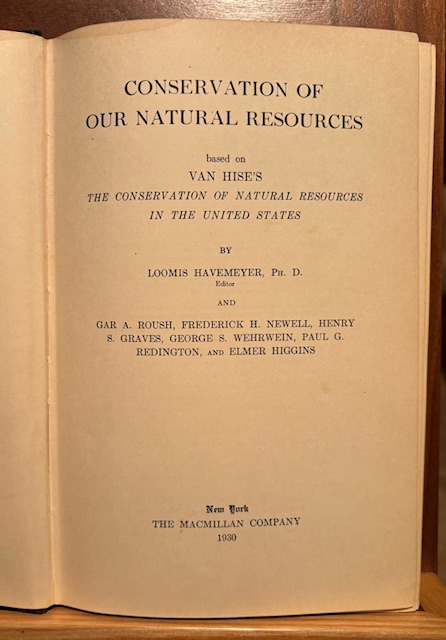
The author states “The real purpose of intelligent conservation is simply to guard against “willful waste” so that future generations need not be handicapped by “woeful want.” He mentions that forest fires caused loss of 38,500,000 acres in 1927, and half was result of human carelessness. And according to the Director of Forest Service of the Department of Agriculture, the 2,000,000,000 feet of timber destroyed every year by fire in the United States would build a five-room house every 100 feet on both sides of the road from Chicago to New York.
He also went into detail in the conservation of land is in soil erosion. “Soil erosion is the greatest single menace confronting the physical side of land utilization in this country. Between 40 and 50 per cent of the and now in tilled crops has suffered some degree from soil erosion and about one-quarter of this has suffered very materially.” It would only be a few years before the droughts and ‘Dust Bowl” would appear in our midwest.
My second book is Our Forests, a National Problem” by Ben. J. Rohan, published 1929. This is one of those hard to find books. This book was written to use in secondary schools, to help address the issues the author has written about: “America is facing a crisis. Her virgin forests are disappearing. She is threatened with a wood shortage. There is still a chance to avert a timber famine for us and those who follow. This little book is sent forth to inform you of the condition and importance of our forests. It is hoped that from its pages you will draw enough information and inspiration to help America solve her forest problem.”
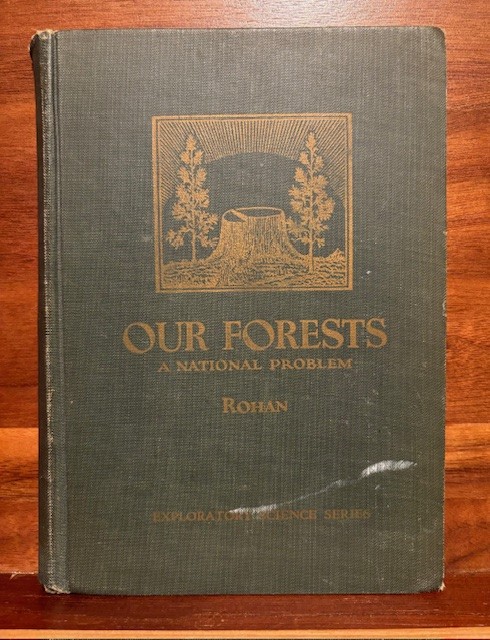
The rest of the book showed what wood is used for in various industries, and how we can help replant, along with other advice. An interesting statistic was that just for telephones, it took 5,000,000 trees a year to supply the nessessary poles to repair old lines and build new ones.
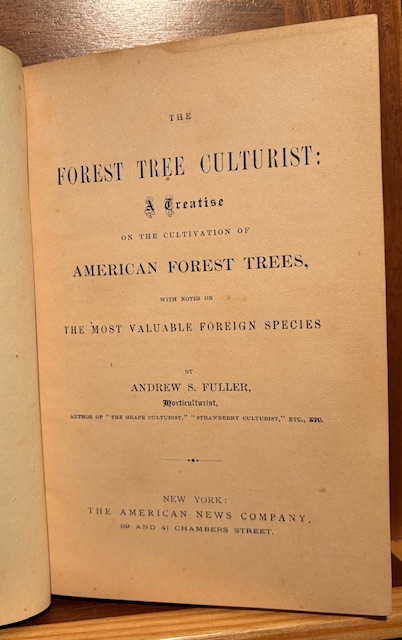
My next book is “The Forest Tree Culturist: A Treatice on the Cultivation of American Forest Trees” by Andrew Fuller, published 1866. He tells us that “Every civilized nation feels more or less the need of an abundant supply of forest trees. My book was written for the purpose of showing others how to benefit themselves and while doing it to conduce to the wealth of the nation. If it shall aid in awaking a more general interest in our noble forest trees, causing them to be more fully appreciated, not only for their intrinsic worth, but because they are of the many blessings bestowed by the creator upon this our country, then my object will be fully accomplished.”‘
My next book is “Trees and Tree-planting” by J.S. Brisbin, 1888. This is a tough book to find an original. It is also one interesting read. Back in 1888, he talks of the wasteful use of forest lands, and its serious consequences. The author states “I fear you will think I am becoming excited over this subject, and I do warm up a little when speaking or writing of the murder of the beautiful trees, which in atrocity is little short of human murder itself.” He then goes into the “voracious monster who threatens to devour all of our young timber in his insatiable maw are the railroad interests of the United States.” he figures 160,000,000 railroad ties are consumed yearly, and they have to be replaced every seven years.

He then put up that fences of the United States often cost more than the land, and shows figures of how many board feet are used around the country, just to fence farms. This is all in chapter one. Then we go into the effect of trees on humidity, evaporation, rainfall, and winds. There is another chapter on the influence of trees on climate (in 1888!), along with a chapter on warmth of trees in winter and coolness in summer. We end with a chapter on each of twenty or so types of trees, and the best way to plant and raise them.
I was amazed at the thoroughness in this book about the health of a country can relate to the health of trees and forests.
A more modern book on trees and the health of a country would be “Shelter Trees in War and Peace” by Ephraim Porter Felt, printed 1943. This book talks first about trees giving possible good protection from enemy flyers. Bombing was a war possibility so it was important to keep sheltering and shade trees in good condition. The author added that as we build military and navel centers, that we save the trees around them. There was then discussion about concealment of schools, homes, with trees, along with what trees for more urban areas that can stand smog and pollution but still offer shade and cover. Also when planting trees, think about what trees we could use for war production in timber.

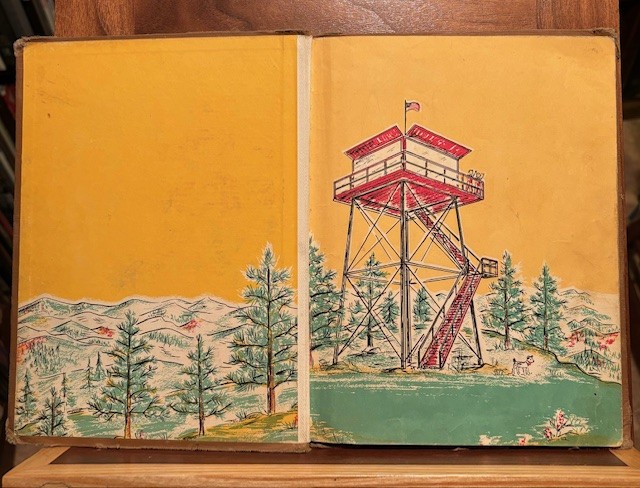
I want to move forward with a kids book, “The Little House on Stilts” by Lucia Patton, printed 1948. This is a book about a lookout tower and forest rangers.
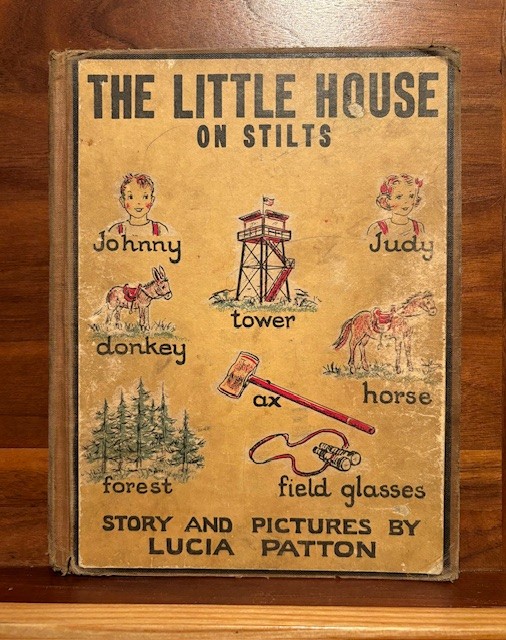
The story shows how rangers look for smoke and signs of fire before grows too large.
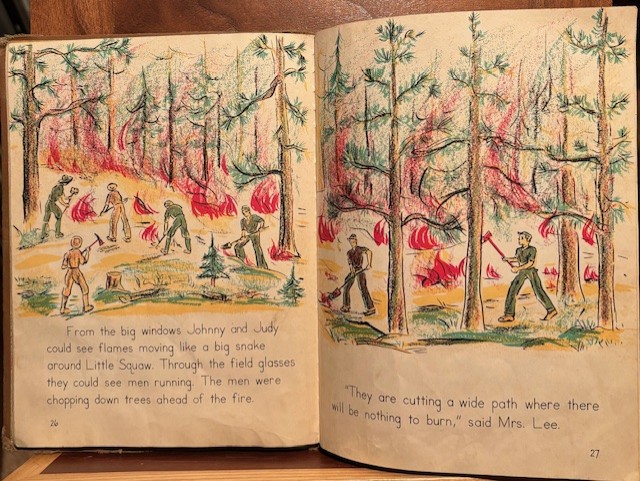
If a fire has started, then how they clear sections to have the fire burn out.
This is a great first look at the job of a forest ranger.
Why so many books on trees? I have the above books, along with all of the other tree books, because of a story my grandmother told me when my wife and I were her caregivers before she died at 96. She would tell me stories almost every night. We talked a lot about my father. He passed away at 41. I was just 19, and didn’t know about a lot of his hopes and dreams.
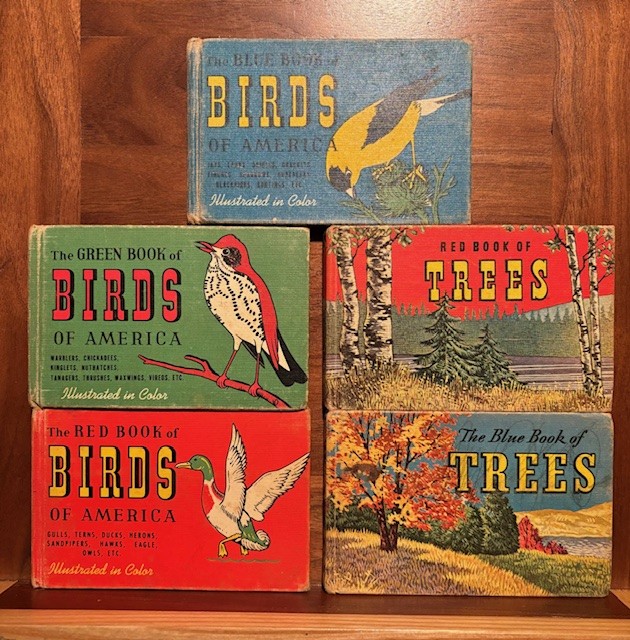
One night Grandma told me he always wanted to be a forest ranger. (These are his signed kids books on birds and trees when he was young.)
He spent several summers out West (either Colorado or Texas) with advanced Boy Scouts supervising (after his Eagle award), and then with the Explorers. While he got his degree at University of Illinois in Marketing, he also had taken classes in animals, insects, forestry and such. He then went to work at the family operation that my grandfather had built, selling supplies for businesses. She would then get rather quiet about it, but once added that she never understood forestry or the allure it may have had for him.
I decided then that I was going to put together a section of books, starting with older books of forest history and culture, and work my way up through timetable of my dad’s life, to see about what may have been a passion. I have bought all sorts of books about trees, nuts and fruits, and about forest culture, etc. I started with books that he may have had opportunity to read. Today, there are about 225 books of tree history, lore, growing, managing, pruning, and just a crazy selection about trees sitting in the library. There is even one on Creosoted Timber from 1900.
While I read them all, I didn’t discuss too much with my grandmother-I felt it was a sad topic for her, and wasn’t really sure of all her views. I did bring up I had found a few tree books about nuts and fruits, so I could talk with her about her Mango tree, or Florida oranges, or the black walnuts and hickories that I had hunted with my dad. But my collection of tree books has grown to be something very personal to me; interesting and important.
Thank you for letting me tree-t you to this story.
 Librarytomes