Aloha. July 5th is National Hawaii Day. I have a few unusual and wonderful books about Hawaii, Are they as interesting and diverse as the Islands of Hawaii are? You will have to decide.
First book begins with a beautiful cover. It is ‘Legends of Old Honolulu” by W.D. Westervelt, published 1915. Then inside, there are great stories, and photographs of the island. There is even a page of actual ‘Kapa’ sometimes known as ‘tapa’. There is a legend that a farmer named Maikoha became very sick. He told his daughters “when I die, bury my body close to the waters of our pleasant stream. A tree will grow there for kapa, from which you will make all things good for clothing as well as covering when you sleep or are ill. The bark of this tree is the part you will use.” They buried him as he requested, and a tree did grow. They called it the wauke-tree. They took some bark and pounded it very flat. After it dried, they could form it into cloth.
The next book is also by W.D. Westervelt “Hawaiian Legends of Volcanos” published 1916. This book also has some wonderful photographs, and even more legends of Hawaii. The author explains some of the geography of the Hawaiian islands, all being the tops of volcanos, and that they are alive with spirits. It is a very good read.

How about a third book by W.D. Westervelt, “Legends of Gods and Ghosts” published 1915. This is an expansive book on Hawaiian mythology. There are some beautiful illustrations, and the stories are intriguing nature-myths that make the islands come alive.
O.K., this is a fourth book by W.D. Westervelt, “Ma-ui: the Demi-God” published 1914. These legends are wonderful. The author reveals that there are three centers for these legends: “New Zealand in the south, Hawaii in the north and the Tahitian Islands in the East. In each of these groups of islands, separated by thousands of miles, there are the same legends, told almost the same way, and with very little variation in names.” It is an interesting book to read. (In writing this, I reviewed that Westervelt actually wrote five books, so I am researching for this last one, so I can have his complete works on Hawaiian legends.)
My next series of books are four Hawaiian novels written by Armine von Tempski. They are “Hula” 1927; “Dust” 1928; “Fire” 1929; and “Lava” 1930.
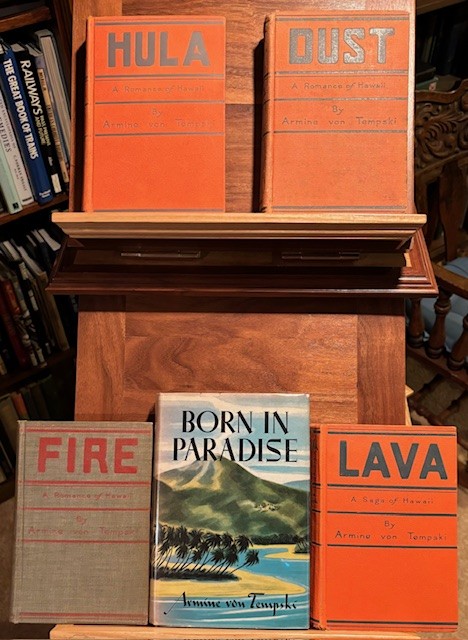
I also have “Born in Paradise” 1940, the autobiography of Armine von Tempski. This book is far more interesting than her novels. She was born on Haleakala Ranch (a sixty thousand acre ranch) in Maui. Her family had interesting lives. She always strove to bring out the excitement of living on the islands in her writings.
I have been once to Hawaii, but am always expecting to go back. It was heavenly there.
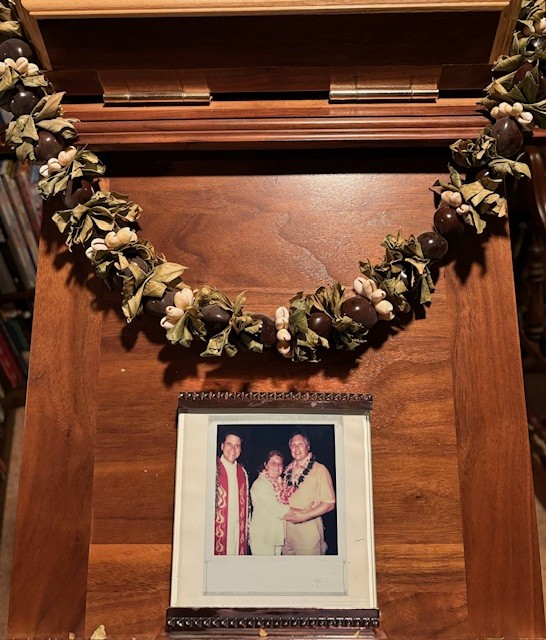
When my wife and I went to Hawaii, it was for our 25th anniversary. We renewed our vows. I have the picture, and lei of kukui nuts, shells, and leaves, that are dried and hanging in a cabinet. The kukui nut is also called the candlenut. Kukui leis were once worn by the chiefs of Hawaii. I didn’t tell my wife that, or she may have insisted that I give it to her to wear. (even though I like to think that I wear the nuts of the family.)
‘A hui hou’-until we meet again.
 Librarytomes