On June 30th 1882, Charles Julius Guiteau was hanged for the murder of James A. Garfield, president of the United States.
June 30th is National Log Cabin Day.
Shall we bill two stories with one book? My book is “From Log Cabin to White House: Life of Garfield” by William M Thayer, 1882.
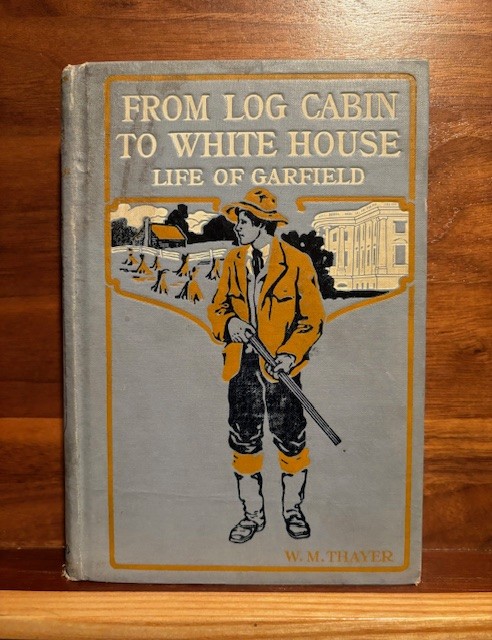
Our story begins that James Garfield was born in a log cabin. The author described the cabin as “twenty by thirty feet, made with unhewn logs, notched and laid upon one another, in what boys call the “cob-house” style of twelve feet or more in front, and eight feet or more on the back side. The spaces between the logs were filled with clay or mud, making a warm abode for winter and a cool one for summer.”
“The roof was covered with lab held in place by long weighted poles. The floor was made of split logs, there was a permanent loft above. The kids slept on the floor of the loft. There was one door and three windows. This briefly, was the pioneer home in which James A. Garfield was born.”
James Garfield was born in poverty. His father died when he was two. His older brother did not go to school, to work on their small farm. His older sister made sure he went to school. The book has many stories of how his poverty bothered him. He was a restless student “in perpetual motion” said his teacher; and he read every book he could get his hands on. He later became a very good student, and a wonder in the Debating Society of the Geauga Academy Seminary. He graduated from Williams University in Williamstown, Massachusettes. He worked as a janitor to pay for his tuition.
Quickly jumping to the end of his political career (leaving out most of his middle years, as we are just talking today of Garfield’s beginnings and end, though this book gives a wonderful full story of a most interesting president.), Garfield he was a state senator, then ran for House of representives for nine terms, was elected for the Senate, and then nominated for Republican presidential candidate (resigning his Senate seat), becoming president in 1881.
On July 2nd, 1881, Charles J. Guileau shot President Garfield at the Washington D.C. train depot leaving for New Jersey. The author states “But the assassin-how about him.? His name is Charles J. Guiteau, an ecentric, pettyfogging lawer, about forty years of age, of a weak, disordered mind, who had tried in vain to get an appointment to a foreign consulate. In his chagrin, poverty, and disappointment, as some suppose, reason was partially dethroned, and he committed the crime in his desperation.”
President Garfield took 11 weeks to die, with infection getting worse from the gunshot. Many looked back and said that had he not been constantly prodded around in the wound (by doctors trying to find the bullet), and the wound been kept sterile, he would have lived. The trial of Guileau was interesting. He acted eccentric, but also complained, and argued that he did not kill the president. He merely shot him, and the doctors killed him. Guileau was hanged on June 30, after he had completed reading a poem about Garfield he wrote.
James A. Garfield had a most interesting life, on his journey to become the 20th president. He surmounted terrible odds of poverty in his youth to even be educated, and had quite a drive to be successful. Charles Guileau also strugged most of his life with poverty, also had a drive, but most of his endeavors seemed irresponsible. Even with his assassinating of Garfield, he thought others would be excited, and revear him. This is but a quick one book synopsis of two very interesting people whose paths collided finally, on July 2, 1881.
Thanks for reading.
 Librarytomes