June 27th is National Onion Day. I thought I would bring out a good book on growing onions, from my collection of farming books printed by Orange Judd.
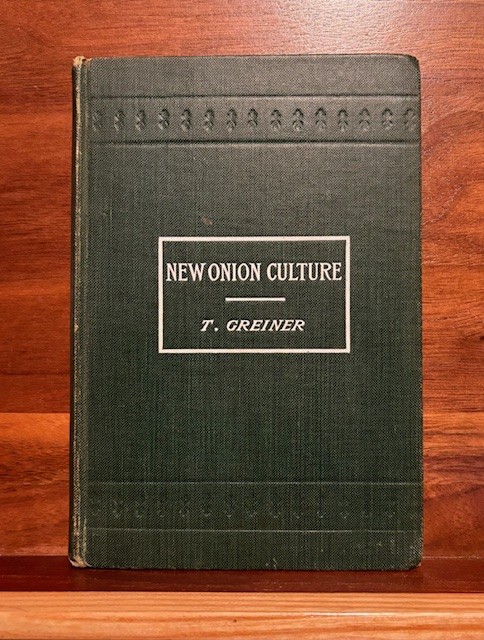
I have the book “New Onion Culture, A Complete Guide in Growing Onions for Profit” by T. Greiner, 1917. The author, was selling the program of starting onion seeds in a greenhouse, or barn, or various other areas, but getting them to sprout early so when put in ground in spring, they already had a good start. This was why the program was called “The New Onion Culture”. His motto was ‘Well begun-half done’. By planting those onion sets in the spring (same time as others planted seeds), one could then harvest larger onions from the ground, along with a better success rate of more onions growing to maturity. This was a more detailed program not yet accepted by many farmers, who just wanted to seed and grow; for them it was easier, quicker, and cheaper, even if the final product was smaller.
When the author started producing wonderful “Prizekeeper” Spanish onions, his work began to take off with other farmers. The Spanish onion was a sweeter onion, but one that was imported, long before Valdalia, or Walla Walla onions were grown. The author quoted “Americans may not think much of the Spaniards, as a nation; but they like the mild taste of their onions.” He was able to grow large sweet onions that would last a long time, thus helping change some imports. “I would like to see the imported bulb crowded out of our markets,” he challenged.
The book helped me understand more of how to plant onions, whether it be by seed or by plant. There is much to do, weeding, fertilizing, harvesting, and storing of onions. Also some of the insects that may attack onions. Who knew of onion maggots, thrips, or onion cutworms? This was an interesting farm book.
Another very interesting book about onions is lost…or loaned to a grandchild. Either way, I cannot find my copy of “Holes” by Louis Sachar. This is a great kids book that was made into a pretty good movie. One learns about Stanley Yelnats and his friend Zero when they meet in Camp Green Lake. They ended up surviving on Big Thumb mountain by eating onions from Sam’s old field. Later, the onions saved the two boys from highly venomous yellow-spotted lizards nearby, who don’t like the smell of onions. There is much more to find out between those two, and the flashback of a “no-good-dirty-rotten-pig-stealing-great-great-grandfather”. What a good story, one that connects many generations of the family. This book was a gift from my niece, because of when I was talking about the movie, and she cried “You haven’t read the book?!”
There is another holiday today. To find out, I go to my official Turtle Club Handbook.
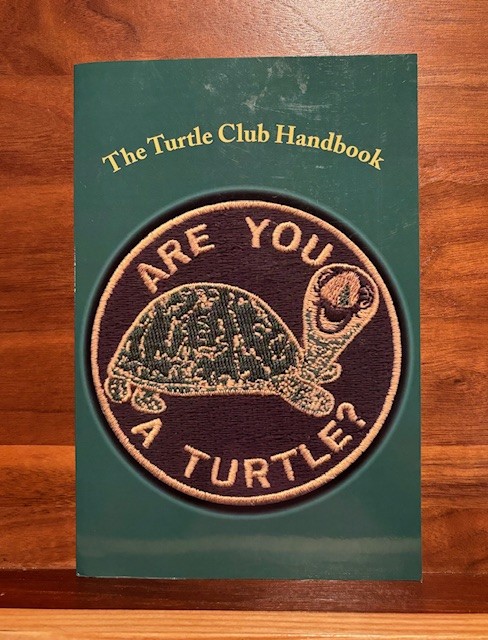
A Turtle Initiate needs to correctly answer four questions. One question is “What does a Man do standing up, a Women sitting down, and a Dog on three legs? Simple, if you knew that June 27th is National Handshake Day. (the last Thursday in June).
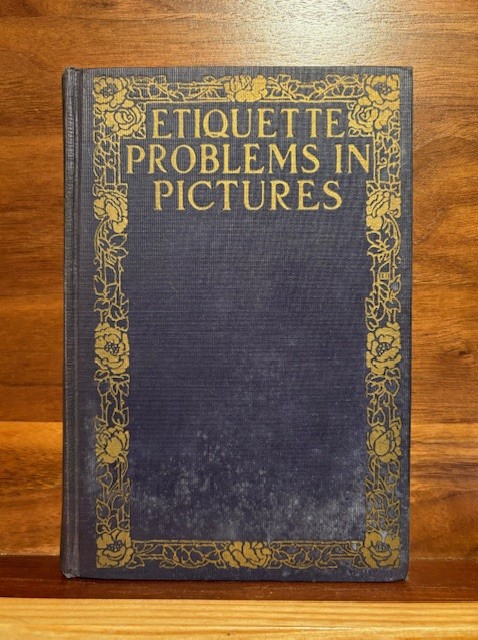

In the book “Etiquette Problems in Pictures” by Lillian Eichler, 1922, there is a breach of etiquette in the picture, or as the author says “A warning of what not to do when you meet for the second time, a woman to whom you have been introduced. Etiquette gives the woman the privilege of continuing or discontinuing aquaintanceships, and consequently it is she who must make the first sign of recognition.”
“Instead of extending his hand as he is, the man opposite should wait for the women to extend her hand-and when she does, it is time for him to remove his hat and proffer his hand. If she does not extend her hand, but merely smiles and nods, he should simply lift his hat and walk on without stopping her.”
Hands out, or hands in, what to do if your hand smells like onions? Try lemon juice, vinegar, salt, baking soda, or rub your hands on a stainless steel utensil.
What do you call an onion pun? A tear-able joke. ( I nailed that joke-hands down!)
 Librarytomes