The Battle of Bunker Hill was fought on June 17th, 1775. It was the first major battle of the Revolutionary War, actually fought mostly on a lower hill called Breed’s Hill, nearer the town of Charlestown. After two failed attacks, the British finally beat the colonists back. The battle gave the colonists hope though, over 1000 British soldiers died to the about 450 colonists.

I have the book “The Battle of Bunker Hill, or The Temple of Liberty; an Historic Poem in Four Cantos.” by Col. William Emmons, 1865 (tenth edition-first written in 1839). The author took a lot of articles of the actual battle, and worked the history in to a 120 page epic poem. It is complete with many actual soldiers names, and personal stories.
While there is not the saying “Don’t shoot till you see the whites of their eyes” rumoured that General Israel Putnam told Colonal William Prescott to tell the troops, (That was supposedly invented by Mason Weems, who wrote the first biography of George Washington in 1808.) there is something close. The colonists are waiting for a signal to begin shooting, as the British are racing up the hill:
“By this, so near the summit are the foe, That their flush’d countenance begins to show ; Where scorn is mingled with imperious pride. While the rude works they tauntingly deride. Still they in blazing depths hold progress on, Thinking already was th’ achievement won. Still Putnam keeps his sword suspended high — They now so close, he looks them in the eye ! — They caught the rising vengeance of his soul, Which shock’d them, as keen lightning from the pole. They paused — so terrible the veteran’s ire. His glance appear’d an arrow tipp’d with fire. His sword the instant like a meteor fell ! — A shriek of agony convulsed the hill!“
“Confusion reigns — the squadron is no more — The fugitives bewilder’d seek the shore. They drop their arms — on board the barges leap. Intent to find a rescue on the deep. The dead in gashful attitudes are seen. While some yet gasp with death’s contracting mien. So suddenly th’ embodied cohorts fell, It seem’d th’ effect of some bewildering spell.“
The British were repelled twice, and only on the third attack, when the colonists were nearly out of ammunition, did they retreat. It is actually a great poem to read.
I have one more interest in Bunker Hill. In researching my family history, on my mom’s side, years ago, I found a bunch of information near Galesburg, Illinois. I could trace back with certainty to my great, great, great, grandfather Nathan Bunker.
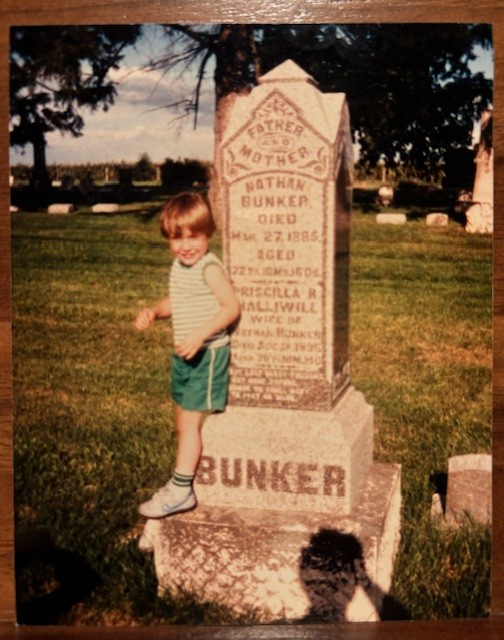
I have a photograph of the tombstone (with my son-now 42). In a small library near there, in the book “The Past & Present of Warren County, Ill.” published 1877, I found a paragraph biography of Nathan Bunker:
“…He was a farmer, born in Armstrong Co Penn. May 11, 1812. Lived in Medina Co.; lumbering in Jefferson and Knox Cos. Ill., each ten years; came to this county in 1865. Mr. Bunker is of Welch desent; his grandfather was a soldier in the Revolution; he owned the hill where the battle of that name was fought and the Monument erected. wife was Priscilla Halliwell, born in Stark Co. Ohio, Nov. 7, 1816; married at Richfield, Medina Co., Ohio, March 23, 1837; four children, two girls living.”
I have not yet been able to find Nathan Bunker’s father or grandfather’s name to complete that story-at least I haven’t tried for some years now. It is just another item on my list of things to research…
“squirrel”
(On a side note, for two hours after I wrote the above line, I have been scrolling through the internet instead of this blog, and may have found his parents to be William B. Bunker (47), and Elizabeth Monks (25). HIS father Jacob Michael Brinker (?) 1727-1798, mother Susannah Hinkle 1727-1798. HIS father Andreas Brinker 1699-1764 and mother Regula Hester Herter 1695-1757, married 26 Apr 1720.)
(And yet another find said that Bunker Hill in Charlestrown, MA, was named as land assigned in 1634 to George Bunker of Charlestown, who had emigrated from Odell in Bedfordshire, England. That means something is not correct somewhere (if Nathan’s family owned the land). Don’t know yet to validate either, but this is from FamilySearch with Church of Jesus Christ of Latter-Day Saints. Do I want to go down this rabbit hole…)
It is because of situations like this, that I cannot seem to focus very well. Anyway, I hope you enjoyed these Adventures in Bunkerland.
Thanks for reading.
 Librarytomes