June 15th 1844, Charles Goodyear receives a patent for vulcanization, a process to strengthen rubber. I found an interesting pamphlet on rubber, read it, enjoyed it, then looked for more. The more I looked, the more I found about the early years of rubber: plantations, harvesting, preparing, testing, and so on. I would like to give a quick recap on them.
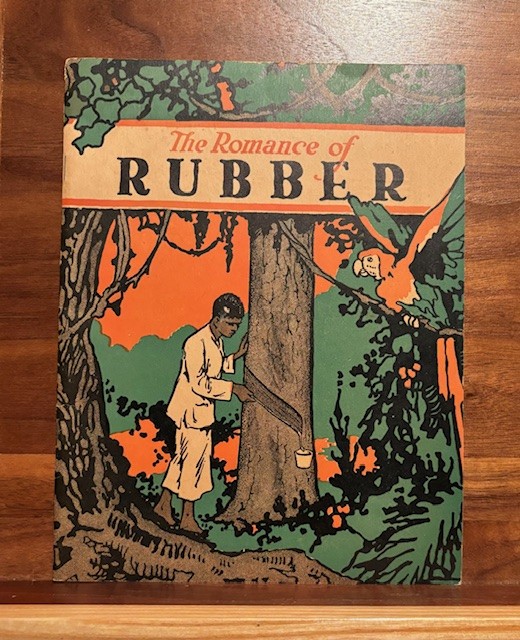
The first is a thin pamphlet produced by the United States Rubber Company “The Romance of Rubber” by John Martin, 1925. This book goes into the origin in South and Central America. Rubber was harvested in jungles. It was a monopoly. There was a ban to grow anywhere else in world, until once there were some seeds smuggled out to start plantations in India, Sri Lanka, Dutch East Indies, Singapore, and British Malaya.
Trees are tapped, to get a white sticky sap-latex. The sap is processed into rubber. Later it was ‘volcanized’, where rubber is heated and sulfer added. This would harden the rubber to make it more durable, for things like car tires.

The last page of the booklet was an advertizement for Keds tennis shoes-made by United States Rubber Company rubber. Teachers were asked to give these booklets to their students after class, I’m sure to increase Keds sales.
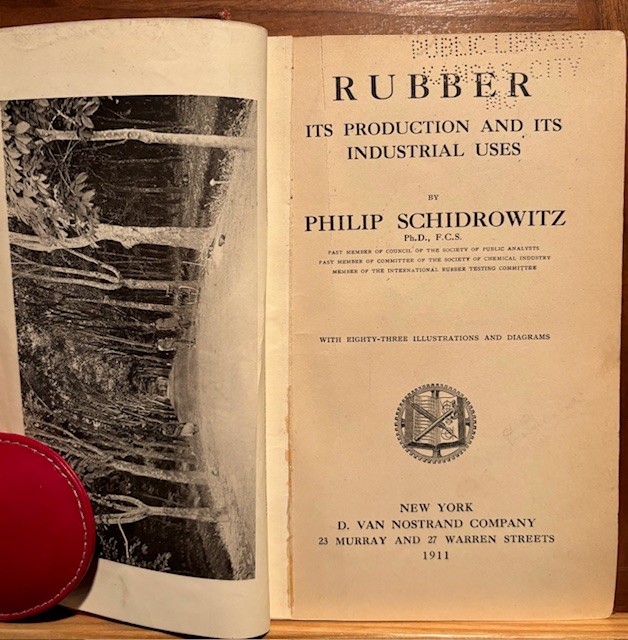
The whole subject was interesting so I began looking for more books. I then found “Rubber, Its Production and Its Industrial Uses” by Philip Schidrowitz, 1911. It gave even more details of how harvested in the jungles of South America, and how to process it for uses.
I then found “The Manufacture of Rubber Goods: A Practical Handbook for the Use of Manufacturers, Chemists, and Others” by Adolf Heil and Edward W. Lewis, 1909. This was a rather technical book about transporting rubber to factories, the machinery to work and volcanize, and then process the rubber. It also shows ways to ensure purity, and different ways to use rubber in manufacturing.
And then I found another book! “The Preparation of Rubber” By Sidney Morgan, 1922. This book talks how to begin working the ground, and planting for rubber trees in plantations. Now more rubber is grown and harvested in Malaya then anywhere else. This is the change from harvesting in jungles in Brazil to harvesting on rubber plantations in South Asia. Production was easier and much more profitable.
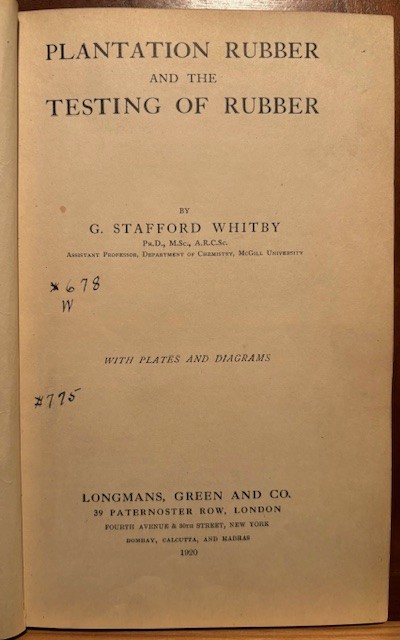
Then I found another book “Plantation rubber and the Testing of Rubber” by G. Stafford Whitby, 1920. The first third of the book was more plantation ideas for better rubber, and then the rest was much chemical processes to test and purify rubber. I thought I was done buying books on rubber. I had high hopes that I knew just about all there could be known about rubber trees.
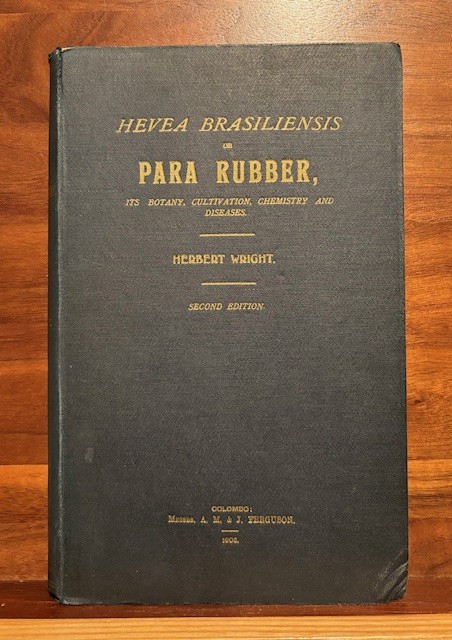
Then…whoops, here comes another Rubber Tree Book. I found “Hevea Brasiliensis or Para Rubber, Its Botony, Cultivation, Chemistry and Diseases” by Herbert Wright, 1906. This was now my oldest book on rubber, and the most focused on the tree itself. This went into the most detail about the tree, and growing, cultivating, and protecting the tree from diseases from bugs and improper harvesting methods.
I enjoyed this book immensely. They developed dozens of ways to cut slanted grooves into the tree for harvesting latex. There were all types of designs and different cutters, and then they would measure the volume of latex from each type of cut. There were plenty of photographs and profit charts. This was a book for starting plantation owners on how to maxify their investments.
I am rather ‘tired’ talking about rubber. Well, perhaps one rubber joke:
Guy: Doctor, my girlfriend is pregnant but we always use protection and the rubber never broke. How is it possible?
Doctor: Let me tell you a story: “There was once a hunter who always carried a gun wherever he went.
One day he took out his umbrella instead of his gun and went out. A lion suddenly jumped in front of him. In order to scare the lion, the hunter used the umbrella like a gun, and shot the lion… then it died!”
Guy : Nonsense! Someone else must have shot the lion…
Doctor : Good! You understood the story. Next patient please.
Thanks for reading.
 Librarytomes