June 11th is National Corn on the Cob Day. As well as eating corn on the cob (Illinois has the best corn in the country), I happen to have an interesting book on the very subject of corn on the cob.

Here is an unusual book by Orange Judd. It is “Manual of Corn Judging” by Archibald Dixon Shamel, 1903. This shows some of the criteria judges used when inspecting corn for fairs and Farmer’s institutes. BTW, it is dedicated to the Illinois Corn growers’ and Seed Corn Breeders’ Associations. (I say this because I recently went to my niece’s wedding, and I had a lengthy discussion with the groom’s aunt about the quality of Iowa corn versus Illinois sweet corn. As if…She was just “Iowa Stubborn” [from The Music Man]).
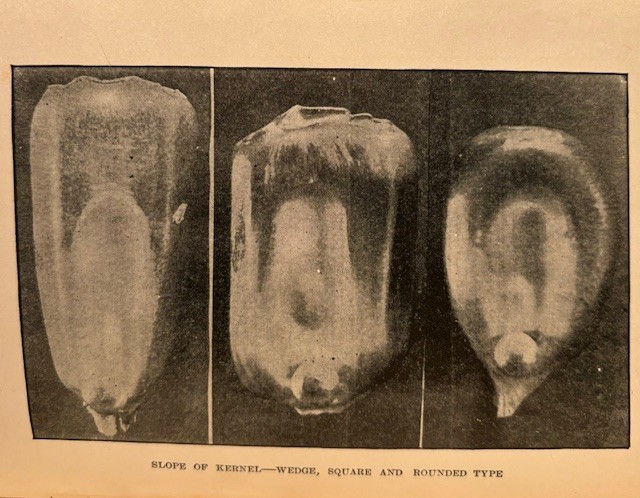
In this book are many photos and much information about what to look for in Blue Ribbon worthy ears of corn.
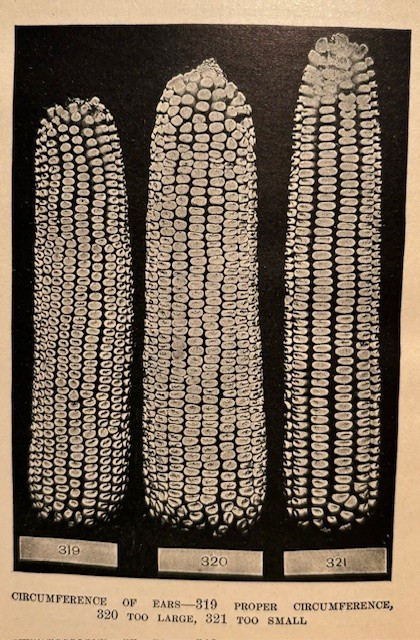
There is much to look for in quality corn. And to show corn in fairs and exibitions, usually there are ten ears to constitute a sample. Sometimes at corn institutes, they use a sample of 100 ears, and the judges take ten out of that sample for a better average ear of corn.
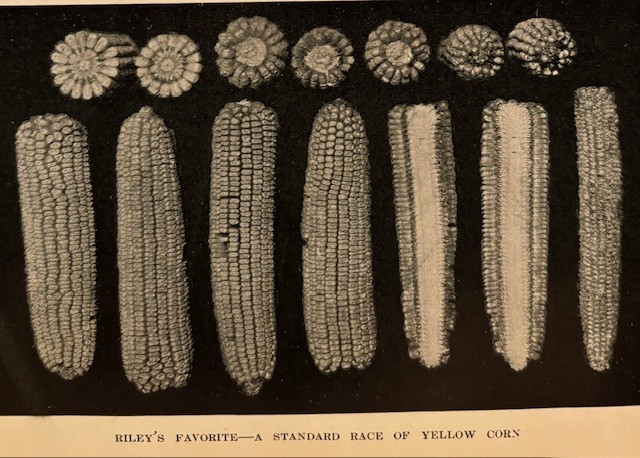
It turns out that there are variations on corn judging from Iowa, Nebraska, Illinois, and Kansas. They each have their own scorecards, and reasonings. And there were various different things to look for based on the top varieties of corn. There were seven types of corn: Reide’s Yellow Dent, Golden Eagle, Riley’s Favorite, Leaming, Boone County White, Silvermine, and White Superior. it could get confusing.
In all, there was much to look for in judging corn on the cob. This was a very interesting book from 1903, that really went into the details of specific items to judge, and the explanations why. It was shuckinly, an a-maizing read.
Back in college, I worked a summer job at Del Monte. I have talked earlier about working with sweet peas (check out the post on February 1st). I did such a good job (in spite of the frog), that after the pea season, when the plant moved to canning sweet corn, they promoted me to manage the creamed corn machinery on day shift. First, let me tell you about the assembly line for corn.
Corn would be dumped outside the plant by the truckload. A bulldozer would push the corn into a trough with a conveyor belt to move the corn into the building. There it would be dumped between several rubberized rollers that would twist the husks off of the corn. Then the corn would go through washers to clean the ears, before being dropped singularly on another belt with lips to hold the corn. There they would be driven into a circular bladed spinning knives machine, that would rip the corn off of the cob. There were perhaps 10 or 12 of these machines in a row.
The corn was driven into the knives. Sometimes they missed going into the center of the blades and would get stuck. At each set of blades, there was a migrant worker holding a plastic dowel, about 16 inches long. If an ear of corn was stuck, they would have to poke the corn into the spinning knifes with the stick. It was dangerous, and the sticks slowly would get worn down. Every couple of weeks, maybe once a month, a migrant would shout out, if they lost part of a finger. The line would shut down for cleaning, and to find the finger part.
Even with finger safety, there was always corn pieces and juice flying around the cutters. All of the corn “pokers” would be covered in corn. That was a terrible job-messy and dangerous. After being cut, the corn would be washed again, and then put on a conveyor to go upstairs to the canning dept.
As I mentioned earlier, I got to work with cream corn. Sitting behind a control panel, I would press buttons that put preset measurements of fresh cut corn, then some fresh corn that had gone through a grinder (finely cut), some water, and some corn starch (mixed from 50 pound bags into a slurry) into a 1000 gallon stainless steel container. I would then press a button that then heated the container with internal steam piping, as it mixed the ingredients, to a certain temperature. Then another button would direct the contents into a second stainless steel container to heat it up to another higher temperature. After reaching that temperature, I would take a sample to test for viscosity, log it, and a button push would pipe the remainder up to the cannery.
It may sound complicated, but it was not at all. I pressed a few buttons to fill, then a button to heat. 20 minutes later, I would transfer and heat again. 20 minutes later, test and send to cannery. I did this with two sets of mixers. The best part was that I could take a book and read while I was working. I read perhaps two books a week, and was paid for it.
Then one fateful day, I got really engrossed with a book. I heard a buzzer that the corn in the mixer was ready to transfer into the next tank. Without thinking or looking, I hit the button to start filling the tank again before transfering out the old. Almost immediately, a seal blew open on top, corn flying out. I hit the kill switches for the whole line and shouted out to my foreman, (after hiding my book), and started messing with switches, saying something about the controls and pumps not working, but that I luckily got everything turned off before it all blew sky high.
Since I had turned it all off, they couldn’t tell if I had just made a mistake. They brought out a mechanic, to check all of the motors, switches, and such. They were happy that I had turned off the machine before it could have blown up (it did blow the seals). To check everything out, they told me to hit the valve at the bottom of the tank, to drain 1000 gallons of cream corn into the drainage system. 1000 gallons! If that was the day that they were making the tiny 8 oz. cans of cream corn, I just poured 16,000 cans down the drain. If it was day for the larger 14.5 regular size of corn, I only poured down about 8,800 cans down the drain.
I worked the rest of the day with the remaining mixer machine, talking a lot with the mechanic. It took them till the next day to finish cleaning and replacing seals, and to not find anything else wrong, but by that time, I had talked myself out of anyone thinking it was my fault. Until my admission now, of what I may or may not have done, Illinois statute of limitations I think, has cleared me of damages to those 16,000 cans of cream corn. Whew! and now at about $1.29 a can…
Thanks for reading; There is more than a kernel of truth in this story.
 Librarytomes