June 1st is National Cork Oak Day and National Cork Day in Portugal. As I have a large collection of tree books, the Cork Oak comes up several times. Let me show you a few books in the library. You will find out about the tree, and the uses of cork. The main use is still for bottling wine.
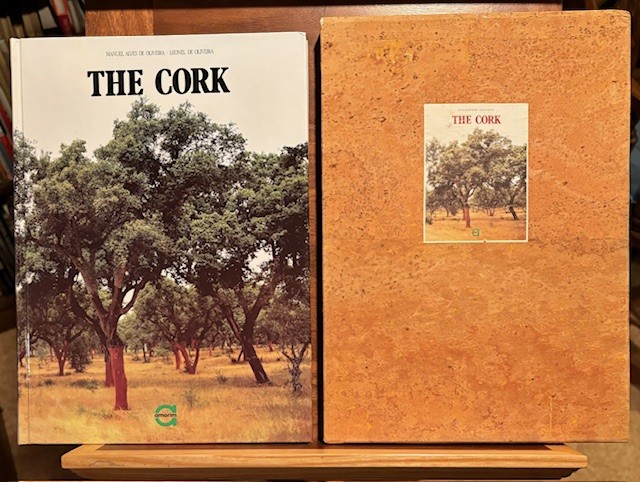
First up is “The Cork” by Mamuel Alves De Oliveira and Leonel De Oliveira, 1999. It was first published in Portugese, and then into English. Most cork comes from Portugal. I have the English version, and it is a nice general book to begin a tour of Cork Oak trees. Not only are there beautiful photographs, it has a good basic history of cork, and how harvested. They peel the bark off of the tree (much like shearing a sheep), and then can re-peel on average nine years later. I also like that this book has a slipcase that is made from cork. This would be a great book for anyone’s the library, beautiful inside and out. I however, keep looking for more books, older and with more details.
The next book is “Cork and the Cork Tree” by Giles B. Cooke, 1961. This goes into more substance, not only in the history, but of the uses of cork such as insulation, flooring, shoe soles, and flotation items. We read about Robert Hooke, who in 1665 discovered the cells of the cork, using a homemade microscope, coining the word cells.
There are many maps and photographs (one cool fold-out map showing the locations of cork tree forests around the Mediterranean), and much of the science involved with uses of cork, and why cork is what it is.
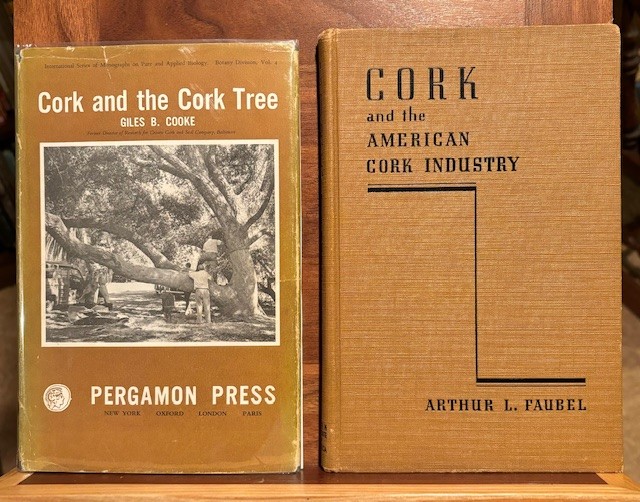
Another interesting book is “Cork and the American Cork Industry” by Arthur L. Faubel, 1938. It was published by the Cork Institute of America. This book goes into greater details on various uses of cork. There is a whole chapter on how corks are made and used, after stamped out of the bark, including photographs of the machinery used.

The next book is “Cork Insulation” by Pearl Edwin Thomas, 1928. This is a detailed scientific book on using cork for insulation for both heat and cold. It explains in detail why cork works the way it does in insulation; and how to use it effectively.

My last book on cork is also the oldest, “Cork: Its Origin and Industrial Uses”, by Gibert E. Stecher, 1914. It was published by D. Van Nostand Company. At the back of the book are 16 pages of other scientific books that they printed. This book goes over the history and the uses of cork, but long before the other books did. An interesting statistic was that in 1909, Spain produced 11,960,760 pounds of corks, a value of $4,870,948. In 1910, 14,924,052 pounds of corks valued at $6,105,294; and in 1911, 17,817,037 pounds of corks worth $7,288,787. That is a lot of corks!
If anyone tells me to “put a cork in it’ I have an answer…

I will put it in a cork, with “Screwpull: Creation & History of a High-tech Corkscrew” by Dnald Minzenmayer, 2013. This large book talks about the Screwpull corkscrew, and the history of how it was built and patented in the 1970’s. It is considered one of the easiest corkscrews to use.
Thanks for reading. Is it true that corks are for quitters?
 Librarytomes