Happy birthday to John Alexander Dowie (born May 25, 1847), founder of Zion. I have a bunch of books and history about Dowie and the history of Zion, Illinois, and thought to show a few unusual ones.

First, I have an illustration from a bound copy of the Century Magazine, October of 1902. Dowie was giving a sermon. There are several articles about Dowie and his “Utopia north of Chicago.” He was a faith healer, and called himself Elijah the Restorer.
Dowie had bought 6000 acres and planned out an entire city-Zion City, including the factories and business. He wanted Zion to be home to 50,000 Christian souls. He bought a Lace factory from England, moved it to Zion, and had Zionites trained to manufacture lace. It was the first lace factory in the United States. He also built a large bakery, a printing business, everything to be self-reliant.
Interestingly, all of the streets going East and West were numerical, starting at the Wisconsin border. All of the North South streets were alphabetical begining at Lake Michigan, and were biblical names and places, starting with Antioch, Aquila… After the industrial section, the residential names continued with Edin, Edina, Eli, and more. Sheridan road was actually Elijah street. I have a pamphlet that explains 30 or so of the names meanings. Dowie personally named all of the streets. In the center was the tabernacle, with a few diagonal streets, as well.
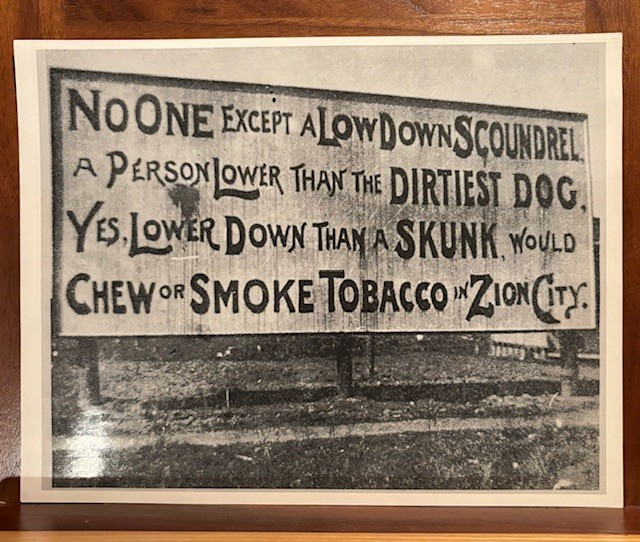
This was one of several signs in Zion. It was a very strict religious town: no gambling, smoking, or drinking; no swine products, oysters, or scavenger foods; no doctors, dance halls, or drug stores. Dowie would give many sermons for the faithful, in a 6000 person auditorium, the Shiloh Tabernacle. Trains from Chicago would constantly drop people off, the tabernacle was often full. The walls of the tabernacle were covered with braces and crutches from those healed.
Dowie once chartered trains and took a group of thousands of believers (called The Seventies) into New York to preach and hand out pamphlets against drinking, smoking, and other vices. He spoke at Madison Square Garden. His speechs and sermons had worked in Chicago, so he tried to expand his words to the world. He also took a group to Europe. His long term plan was to make Zion Cities all over, and then take the profits, and buy/build a Zion in Jerusalem.
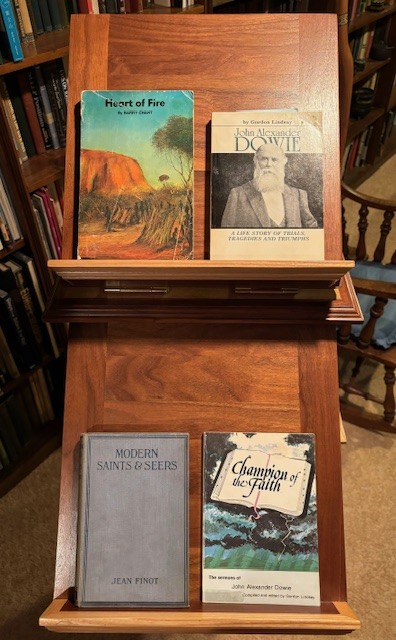
I would like to showcase a few of my books about John Alexander Dowie. First is a rare original paperback from Australia “Heart of Fire” by Barry Chant, 1977. This tells of Dowie’s early days preaching in Australia.
Then there is “John Alexander Dowie. A Life Story of Trials, Tragedies, and Triumphs” by Gordon Lindsey. This is a very good biography of Dowie. He competently explains Dowie’s strengths and weaknesses. Who knows where Zion would have gone, if Dowie hadn’t died from a stroke in 1905. Zion took a different direction when Wilber Glenn Voliva took over Zion, after Dowie’s death. My family eventually grew disillusioned with the new changes, and left the church, but not the city.
Next is “Modern Saints & Seers” by Jean Finot, 1920. There is a chapter about Dowie, said of him “…with remarkable wisdom, (he) seized the moment to appear in the United States as a Barnum and a Pierpont Morgan of religion combined. He had extraordinary knowledge of stocks and shares, along with the value of souls.”
Lastly is “Champion of the Faith-sermons of John Alexander Dowie”, also by Gordon Lindsey. These are copies of many of his actual sermons.
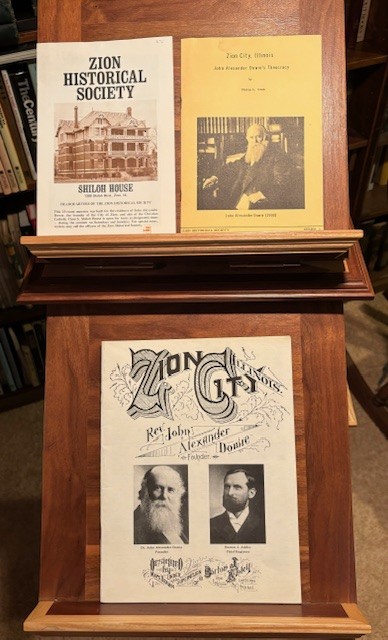
Here are a just a few pamphlets about Dowie and Zion. Shiloh House was Dowie’s home. It is now a museum, and headquarters for the historical society.
Dowie was in Chicago preaching in the 1890’s. He had a tabernacle right outside of the 1893 Columbian World’s Fair. From there, he moved his tabernacle to the Chicago Auditorium for six months, and then to St Pauls on Michigan Ave. My great-great grandmother was one cured by Dowie’s faith healing in Chicago, and thus a believer in Dowie. From then on, our family was part of the move to build Zion, both with financial money, and building skills. My great, great grandfather, and my great grandfather had a large plaster and lathing business in Oak Park-was told 150 employees, and they did interiors (plaster and woodworking) of many large residential buildings in North Shore area. They moved to Zion in 1901 when it was first open for followers to build homes.
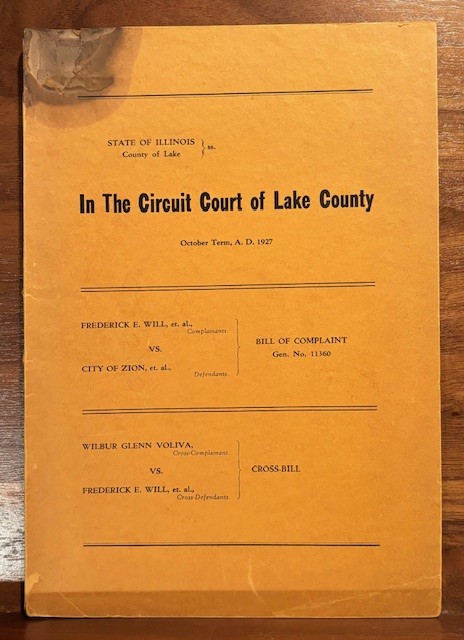
A few years later (1927) my great grandfather would be suing Zion and Dowie’s successor Wilber Glenn Voliva, in a class action suit, for the right to use the city parks when no longer a member of the city church. They won finally in Illinois Supreme Court, and my young grandfather and his brother could then continue to play tennis in the parks of Zion.
My great, great grandparents are buried only a dozen yards from John Alexander Dowie in Zion’s downtown Lake Mound Cemetery. Zion has had an interesting history, and I have many other stories, having so many generations growing up in the town. Will later relate a few more, as I promote other dates, and books with Librarytomes.
Thanks for reading.
 Librarytomes