May 17th 1958, National Walnut Day was recognised and signed into law by President Dwight D. Eisenhower. There are two types of walnuts; English or Persian Walnuts, and Black Walnuts. I happen to have a section of my library devoted to trees, and then also to various nuts. I would like to showcase several interesting walnut books.
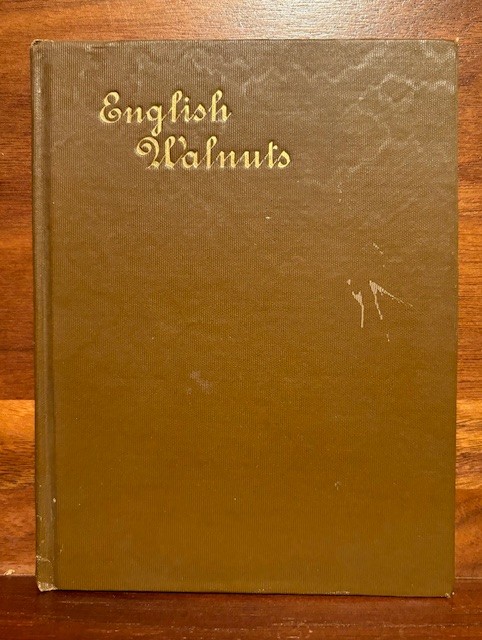
We will start with “English Walnuts” by Walter Fox Allen, 1912. I have an original hardbound book, printed and signed by him. This is an interesting book not only of the history of the Walnut from Persia, but also how to raise the trees for a good shade tree, and for the thin-shell walnuts. It is quite the little book.
The next book is “A Journey To The Walnut Sections of Europe and Asia” by Carlyle Thorpe, 1923. This is a much more in-depth book about the history of the English Walnut. The author journeys to find not only the history, but also information of the industries of walnut farming in both Europe and China. For a detailed book, it is very readable. It is also an easy used book to find.
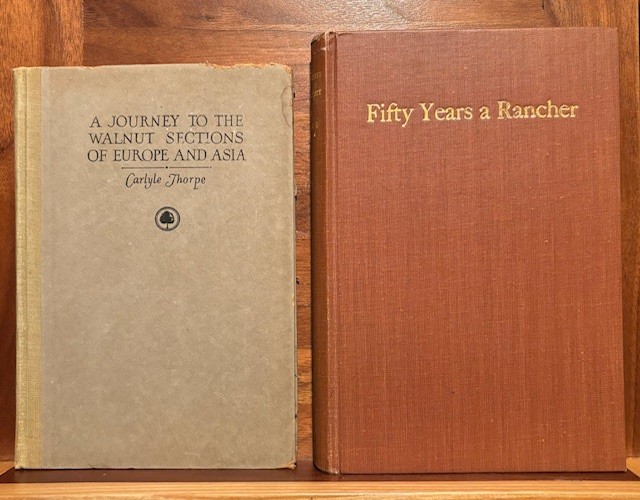
My third book on English walnuts is “Fifty Years A Rancher. The recollections of half a Century Devoted to the Citris and Walnut Industries of California and to Furthering the Cooperative Movement in Agriculture” by Charles Collins Teague, 1944. This book is also signed by the author. Not just an autobiography, this book is the history of how the walnut (and also the orange) business grew in California. It suppliments the previous book with walnut growing, harvesting, and selling, so one can see and compare how the world reacts to walnuts.
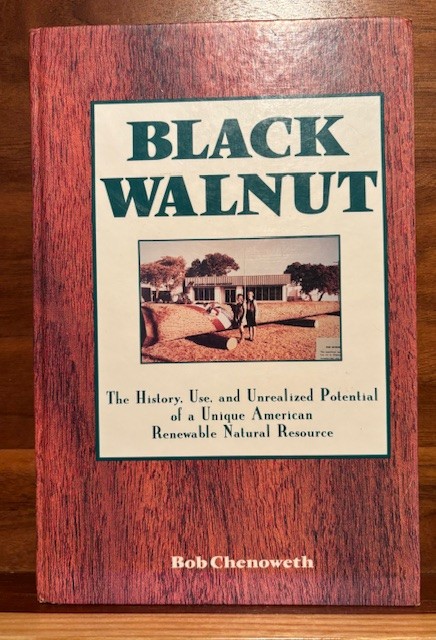
Moving to black walnuts, I have the book “Black Walnut. The History, Use, and Unrealized Potential of a Unique American Renewable Natural Resource” by Bob Chenoweth, 1995. This is an interesting book because not only do black walnuts produce nuts, but they also have a much desired wood. Black walnuts can be, and are, grown also for harvesting the trees themselves. This book is an easy to read textbook of sorts, about black walnut trees.

I will end with “Cooking With Black Walnuts” by Carole Bough, 1995. This book has wonderful recipes for using black walnuts. It is quite an extensive cookbook for the nut.
Everyone has had English walnuts. The taste is mild, and the nuts are easy to crack, being an art to be able to crack two halves evenly. But black walnuts are more devisive for people. The taste is loved by many (myself included), while others hate the flavor, reminding some of tasting like dirt. The shells are also much harder to crack. One must need specific heavy duty crackers for leverage, or use a trustworthy hammer.
It is also more challenging to harvest the black walnut. While they are also picked up off of the ground, black walnuts are messier. The husk is green, and when first turns black, there is a gooey mess that can really stain ones clothes and hands. When I would go black walnut hunting with my dad over fifty-five years ago, we would of course, use cotton gloves and big galvanized buckets. We would try to remain clean and productive. That would not stop my brother and I from throwing an occasional “juicy’ walnut to each other’s head.
We would put the walnuts in our gutters to dry the outer husk, then later put the nuts on the driveway to roll over them with the car to clean the husks off. After cleaning, we would have to use the workshop vice or a hammer to break open the nuts, and pick out the pieces. While it was a chore, the resulting bits of nut meat would be made into a black walnut cake that was divine. I still go out every year to hunt several five-gallon buckets worth of black walnuts. Childhood memories come back strong from the smell of those outer husks, and the taste of that cake.
Knock, knock. Who’s there? Cash. Cash who? No thanks, I prefer walnuts.
Knock, knock. Who’s there? Walnut. Walnut who? I walnut tell you. It’s a secret.
Man, that is nut funny. Thanks for reading.
 Librarytomes