April 26th is National Arbor Day, this year. It falls on the last Friday of April. Arbor Day was the brainchild of Julius Sterling Morton. It is a great holiday because it is a forward looking holiday. Most holidays we remember or look back on. Arbor Day we prepare for the future. We plant trees for what will be. I remember in grade school for Arbor day at Westfield school, we planted bushes. All around the border of the fields-there were several baseball fields, we planted wild rose bushes. There were hundreds perhaps a thousand. I even was able to take some home. We planted on the back side of our home.
I have several books to discuss this event. I am picking from many books. I have a large collection of books on trees. Many specialized tree books. My father always wanted to be a Forest Ranger, and live in a forest. Then life came along, and he began work in the family business. There he remained.
My first book is “Trees and Tree-planting” by J.S. Brisbin, published 1888. The first part of this book is the effect of forest distruction on a country. It looks back on Europe and Asia. It The author then discusses the consequences of de-forestation, and how to remedy it. Later he discusses the benefits of various families of trees, and then individual trees that are good to plant, and why. Lastly, he explains the best times and methods to plant trees.
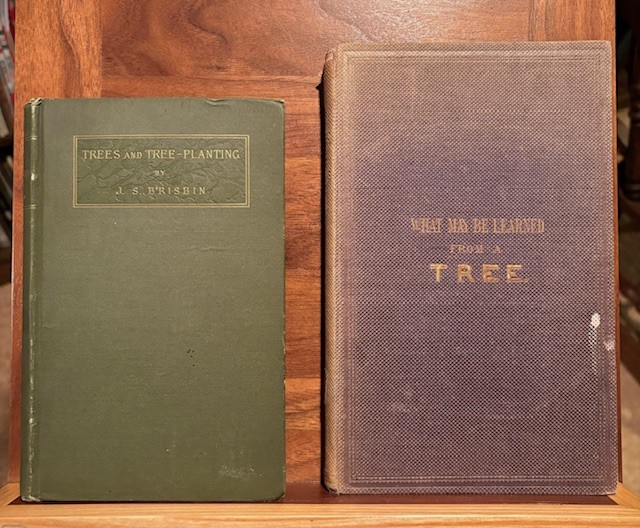
My second book is “What May Be Learned from a Tree” by Harland Coultas, published 1860. The author states “We are about to write its life-history. The tree is a picture of the whole of Nature, and the way that Nature works. We shall trace it from the first manifestations of vitality in the germinating seed until the period of puberty, when it puts forth flowers and fruit. We shall consider its phenomena after it has passed its prime, and show that it has its limits in consequence of the development of its organism, equally with that of the lowly plant which grows beneath its shade. Reader, whoever you are, may this book prove to you a friend. May you be induced by its pages to look at the tree with a new interest.”
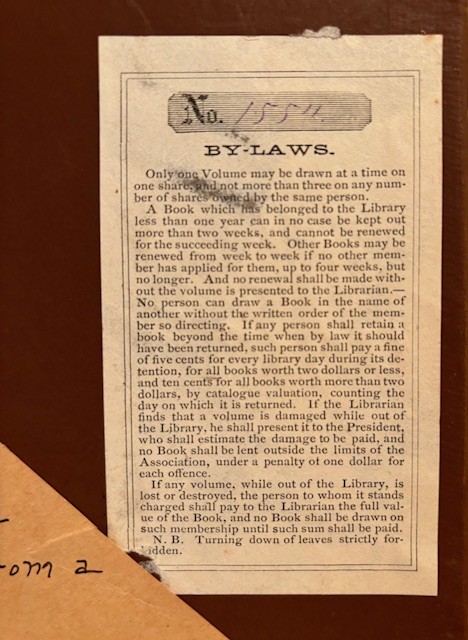
This book was a very good read. It was a library book last checked out Feb 8, 1941. It had a book plate giving the library rules about books that I also thought interesting, so printed it for you.
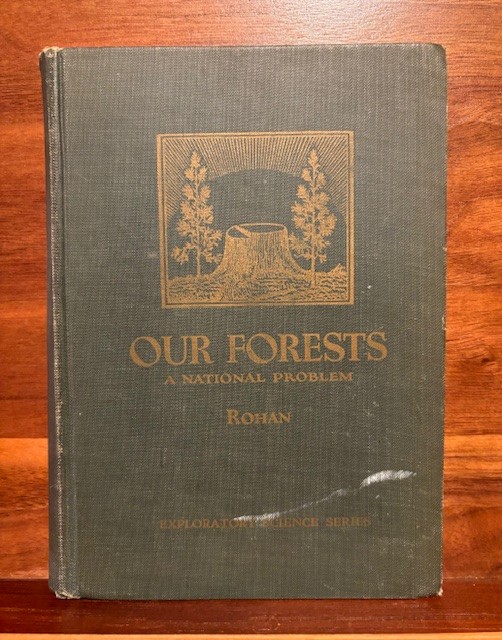
My third book for Arbor Day is “Our Forests, A National Problem” by Ben Rohan, published 1929. The author writes “The story of our dependance on the forests is one that cannot be too often told. Abundance breeds neglect. We find it hard to realize either the extent to which they enter into our American civilization or the possiblility that the supply may not last forever. Lack of Forests means much more than merely a shortage of wood, important though that is. It means also undesireable changes in climate, streamflow, and erosion; marked decrease in game, fish, and other forms of wildlife, and far less opportunity for healthy outdoor recreation.”
All three of these books are well-written warnings in looking at the importance of forests and trees to the health of nature and our country. They were all very interesting books.
April 26th is John James Audubon’s birthday, 1785. Audubon is famous for being a naturalist and trying to paint all the Birds of America, a popular series of lifesize prints. He traveled the country painting in the wild.
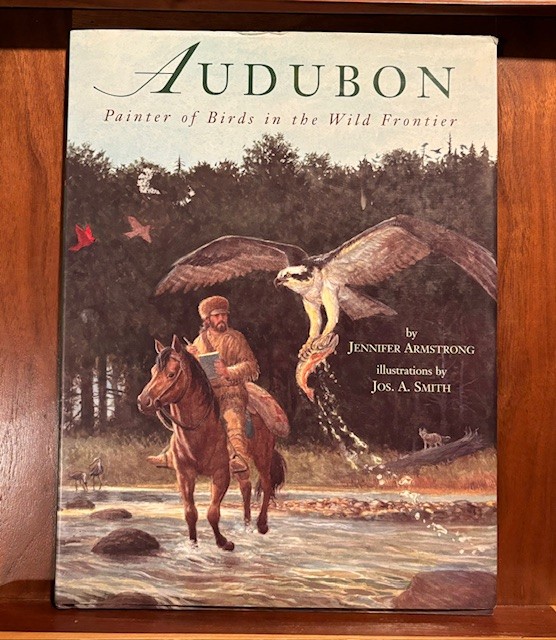
My first book “Audubon, Painter of Birds in the Wild Frontier” by Jennifer Armstrong, 2003 is a wonderful kids book that I have read to my children and grandchildren. There are great moments in Audubon’s bird hunting and painting. He remembers floating down the Ohio river when Passenger Pigeons flew over the boat. For hours and hours, huge flocks so large they darkened the sky, flew over head. The deck of the barge was covered in bird droppings. Audubon could hardly walk, it was so thick. Sadly, a hundred years later, because of so much indescriminate hunting of the birds, they became extinct when Martha, the last remaining Passenger Pidgeon died in 1914, at the Cincinnati zoo.
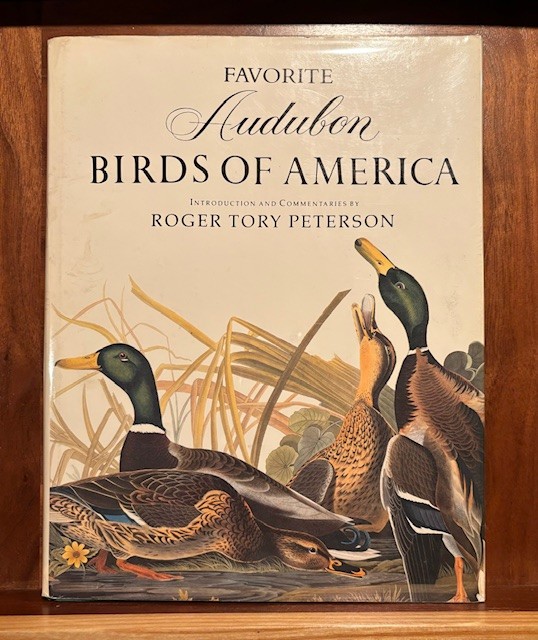
The book “Favorite Audubon Birds of America” published 1978, has 50 Audubon prints, along with great commentary with each bird.
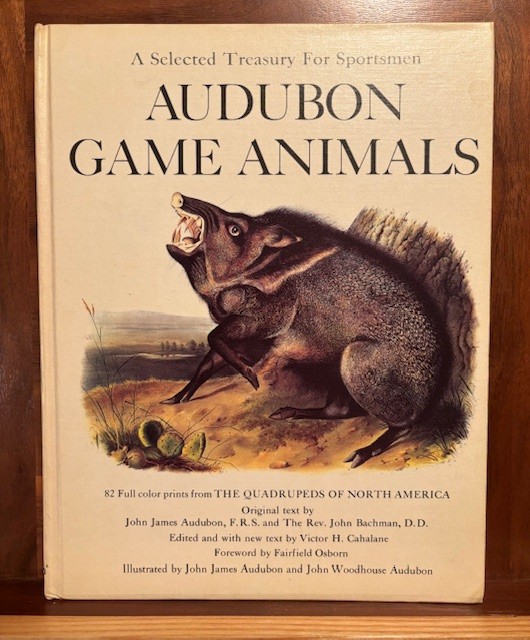
After Audubon finished his Bird paintings, he began a new task. The book “Audubon Game Animals” published 1968 has 82 of Audubon’s attempt to paint all of ‘The quadrupeds of North America. This book has great illustrations and descriptions of the animals.
Between trees, and birds, and four-legged animals, one can a read a lot about nature, and learn how to protect our lands and animals. As in the message of Arbor Day, we need to ‘play it forward”, use the philosophy to make our world a better place. Thanks for reading.
 Librarytomes