I love Landmark books. So does Rev. Dr. Leo J. McCormick, Supt. of Schools, Archdiocese of Baltimore. His quote from the back cover of one of the books says, “The outstanding children’s books of this half-century, Landmark Books are the source of an intellectual curiosity which prompts me to read the stories immediately after they are delivered.”
I have four events to talk about today, and each one is represented by a Landmark Book. I had read many in junior high. Picked them out of the school library. I still remember the corner where these history books were located. The first is “The Fall of Constantinople” by Bernadine Kielty, 1957. On April 6, 1453, Mohammed II, (Mehmed II) began the siege on Constantinople, bringing down the city just over a month later. This book does a wonderful job highlighting how great of a city Constantinople was, why everyone in the world wanted to own it, and how it came to be re-named Istanbul.
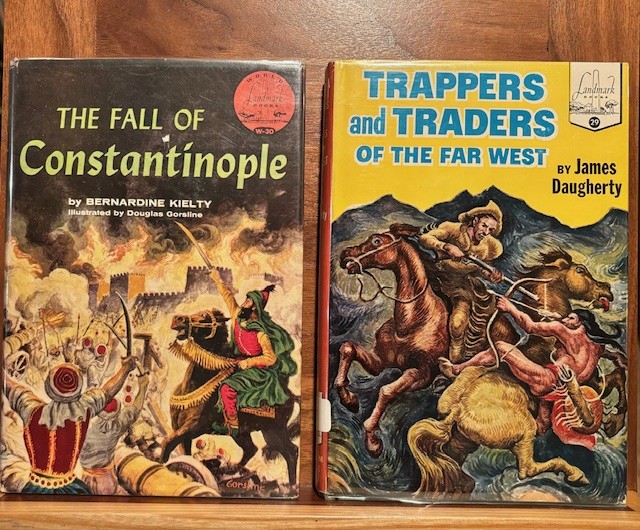
Then “Trappers and Traders of the Far West” by James Daugherty, 1952. On April 6, 1808, John Jacob Aster incorporated the American Fur Company. This Landmark book goes into the details of Aster’s plan, and the hardships and triumphs of the actual trappers that hunted beaver skins for fashion and hats.
Now there is “The Conquest of the North and South Poles: Adventures of the Peary and Byrd Expedition” by Russell Owen, 1952. April 6, 1909, Robert E. Peary was the first person to reach the North Pole. This book tells the amazing story of trying to get to the north pole. From one attempt after another, Peary had to overcome incredible hardships. We are right there with him, fighting snow blindness and ships caught in the ice for months. And the quest to the south pole was even colder-with penguins the only friends around.
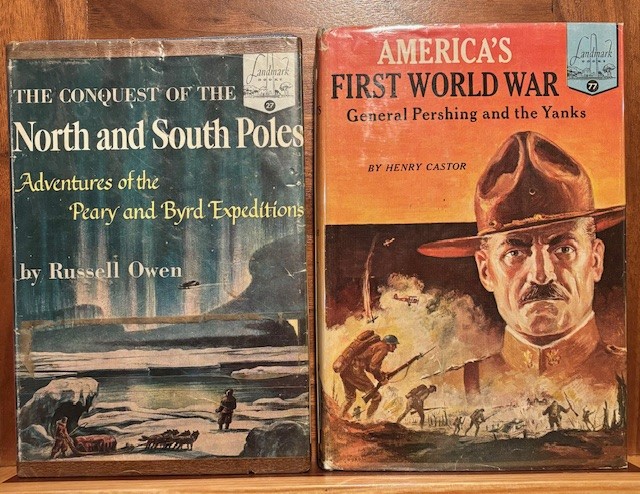
And lastly, “America’s First World War: General Pershing and the Yanks” by Henry Caster, 1957. On April 6, 1917, Congress declared war between United States and Germany. Major-General John J. Pershing and the American Expeditionary Forces, would soon fight alongside allied soldiers, but under their own command. This is his remarkable story, and a vivid American one, as well.
I have my collection of Landmark books in an open bookcase in my guest bedroom. If a visitor wishes, they can easily browse through them. The book jackets alone are great to look over. In the course of an evening, one can read about (and finish) a great event, or a great person. Each Landmark book plot moves quickly, and is good history as well as a good read. I believe there can be no better way to wind down the day, than by reading something. It is said that reading can lower blood pressure (excepting my wife’s when reading my book bill), reduce stress, and improve sleep quality. All drug free! Fifteen minutes a night can do a world of good, and if carried on till midnight-even better.
Dr. Scott’s prescription is to “keep reading.”
 Librarytomes