April 1st, the day of pranks and hoaxes. In 1894, Pierre Louÿs published “Les Chansons de Bilitis” or in English “The Songs of Bilitis”. He claimed that he had translated 143 poems written by a courtesan from ancient Greece, that had been recently unearthed. To complete his tale, he had printed a biography of her, and had several poems still in Greek, that were as of yet, untranslated. It was found later that Louÿs had invented the whole story, but with his actual knowledge of ancient history (which made it all plausible), and the overall theme of the story, the book became very popular.
The book was considered risqué in America, and various artists made scandalous illustrations. I have several Bilitis books with immodest illustrations. The illustrations and their artists have made some of these books very collectable.

Shown are two copies of “the Songs of Bilitis” by Pierre Louÿs. The first is illustrated by
Jean de Bosschere, printed in 1933 by William Godwin; The second illustrated by Willy Pogany (signed) 1926 by Macy-Masius.
Other copies in my collection are illustrated by: James Fagen, English 1904; Joseph Kuhn-Regnier, French 1930; Bantzinger, French 1930; Marietta Lydis, French 1934, and Dignimont, French 1947.
Another celebration on April 1st is National One Cent Day. It honors the American penny. Ben Franklin designed the first penny in 1787-the Fugio Cent, that was privately minted. The US mint began minting pennies in 1793.
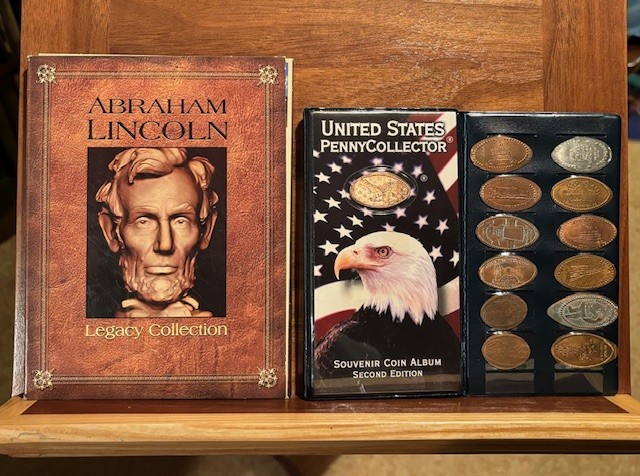
I have “Abraham Lincoln Legacy Collection” which tells of the history of Lincoln pennies, complete with actual pennies of each Lincoln style. The pennies, and a Lincoln commemorative $1 coin are mounted in plastic so can see both sides of each coin. I bought this at the Lincoln Museum in Springfield. In 1909, Lincoln appeared on the penny. The back side was sheaves of wheat until 1959, when the backside became the Lincoln Monument. In 2009, there were four different backsides to honor Lincoln’s 200th birthday. In 2010, the backside was permanently changed to the ‘Union Shield.’ In 1943, pennies were made from steel because of copper shortage. In 1982, pennies were made with a zinc center. Before that, they were solid copper.
I also have this little album of smashed pennies, or elongated pennies. There are 42 pennies held inside. These pennies are made from little machines around tourist areas in America. Put in a penny, and either 50¢ or $1 in quarters, and out comes a smashed penny with logo or emblem from the tourist area you are in.

Here is my collection of smashed pennies. There are probably 500 pennies from around the country. Actually, even more places. There is a penny from Australia, one from Canadian-side Niagara Falls, and one from Rome, outside St Peter’s Cathedral. I still collect them, and have a little leather coin purse with pennies (I use only 1981 or earlier because of pure copper-they last better) and quarters, just in case I stumble on a new machine. The box is an Honduran carved, wooden box my sister bought for me when she lived in Honduras.
I try not to think “A penny saved is a penny earned,” but rather “See a penny pick it up (buy it!). All day long you’ll have good luck.”
For those “penny for your thoughts” fans, here is a modest song (poem) from Bilitis:
“When he came back, I hid my face within my hands. He said: “Fear nothing. Who has seen our kiss?” “Who saw us? The night and the moon.”
“And the stars and the first flush of dawn. The moon has seen its visage in the lake, and told it to the water ‘neath the willows. The water told it to the rower’s oar.
“And the oar has told it to the boat, and the boat has passed the secret to the fisher. Alas! alas! if that were only all! But the fisher told the secret to a woman.
“The fisher told the secret to a woman: my father and my mother and my sisters, and all of Hellas now shall know the tale.”
-Pierre Louÿs, ‘The Songs of Bilitis’
Thanks for reading. And if I had a penny for every book in my library…
 Librarytomes