Today is March 2. The birthday of Theodor Seuss Geisel, better known as Dr. Seuss. With a sing-songy writing, and colorful illustrations, Dr. Seuss encouraged kids to read. His books have been a big part of Read Across America week.
This day, Seuss day,
Fun day, truce day.
Rhyme day, use Day.
What day? Deuce day.
Can we have a little chat?
While we wear a big stripe hat.
Is it hard to rhyme and scat?
As we imitate that cat?
Today is Seuss Day-here’s the hook,
Everyone must read a book.
Not an e-screen, not a nook,
Just pick one up, and take a look.
Read to a child…daughter, son,
Niece or nephew, find someone.
Some of us are reading champs,
Those lucky kids with “super gramps.”
And grownups too, he wrote for you!
Not just once…I’ll list a few:
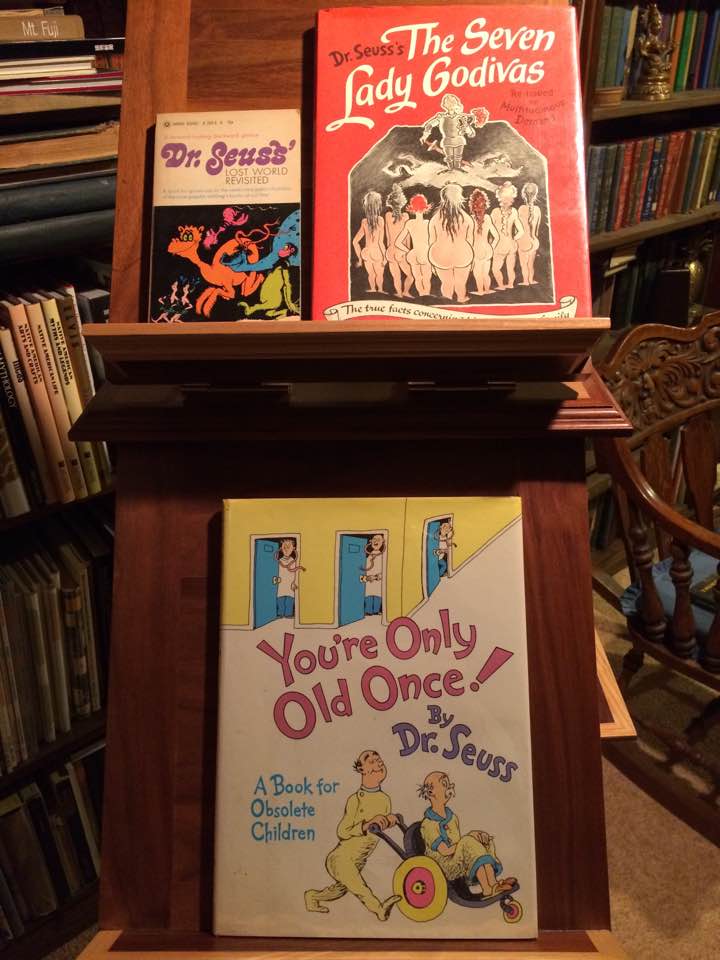
As well as the dozen or so of childrens Dr Seuss books in the kids section of my library, these are a few other interesting books I have. Dr Seuss’ “Lost World Revisited”, paperback 1967; “The Seven Lady Godivas”, an interesting take on the Lady Godiva tale; and “You’re Only Old Once”, where Dr Seuss ensures you are “properly pilled” and “properly billed”.
In the last few years interesting events have been happening:
Dr. Seuss Enterprises decided to cease publication of six Dr. Seuss books, that they “portray people in ways that are hurtful and wrong.”
Learning for Justice (educator’s group) put out a study several years ago surveying 50 Dr. Seuss books and stated “of 2240 human characters, there are 45 characters of color, representing 2% of total characters. Of the 45, 43 exhibited behaviors and appearances that align with harmful and stereotypical Orientalist tropes. The remaining two are identified in the text as ‘African’ and both align with the theme of anti-Blackness.”
Loudoun County Public Schools in Virginia were given ‘guidance’ by the school district to “not connect Read Across America Day with Dr. Seuss’ birthday.” They were one of the first.
President Biden gives no mention of Dr. Seuss in his speeches for National Reading Day/Week.
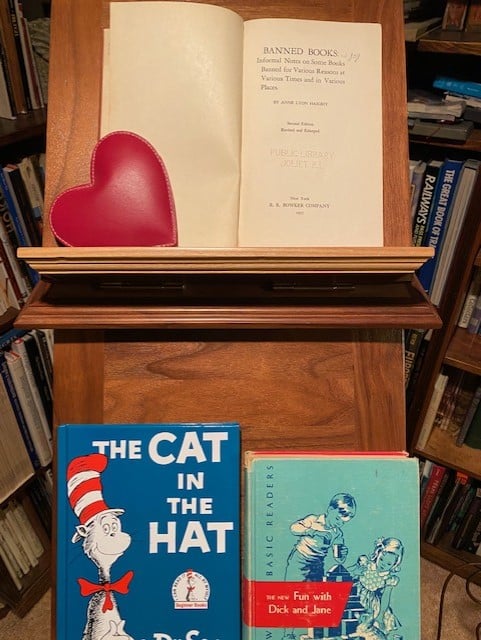
The first thought could be that “One who lives by the pen, will die by the pen.” After all in 1954, the director of Houghton Mifflin, William Spaulding, approached Theodor Geisel to see if he could write a book for first graders, to take away from the Dick and Jane reading primer books from a different publisher. It had to be more interesting, and use only 200 different words. The book ‘The Cat in the Hat’ contained 136 different words, and was a great success.
Geisel later said that ‘The Cat in the Hat’ was his best book because “I have great pride in taking Dick and Jane out of most school libraries. That is my greatest satisfaction.” He also said that ‘The Cat in the Hat’ was about “rebelling against authority, ameliorated by a cat picking everything up.” (I had to look that word up-SW.) So I suppose that someone who unseated a nation’s reading program, could also be unceremoniously de-throned.
But yet…I quote from “Banned Books; Informal Notes on Some Books Banned for Various Reasons and Various Times and in Various Places” by Ann Lyon Haight, second edition 1955.
“In ‘The Freedom to Read’ a joint declaration of the American Library Association, and the American Book Publishers Council…”The freedom to read is essential to our democracy. It is under attack. Present groups and public authorities in various parts of the country are working to remove books from sale, to censor textbooks, to label ‘controversial’ books, to distribute lists of ‘objectionable’ books or authors, and to purge libraries. These actions apparently rise from a view that our national tradition of free expression is no longer valid, that censorship and suppression are needed to avoid the subversion of politics and the corruption of morals.”
Not just in 1955, but even today, I believe our politics ARE subversive, by cancel culture censorship. Please keep reading, banned or not. Then continue a healthy debate. Are there books by Dr Seuss that have some illustrations that can be considered racist, or at least improper? Yes, a few. Should that force out from schools, one of the most influential writers to actively encourage children to read? No, it shouldn’t. We need our children to want to read, to engage in learning. We can help with what is good, what will get more readings, what we can show is better. We can compliment, not ban.
Dr Seuss improved on Dick and Jane. If there is something better, then let’s improve. We didn’t ban Dick and Jane. There are books that perhaps can perhaps be noted, or tagged, that has vulgar language or sexual content (or ‘depicts ethnic and racial prejudices’ like “Gone with the Wind” was recently tagged). We can warn kids, and parents, perhaps debate on an age appropriate level-or reading level (if that doesn’t create more discussion shutdown). When I grew up at the library, we had the children’s section, and the adult section. Perhaps even more libraries should have that ‘Young adult” section (with caveats), and restricted areas. We still need Mark Twain, Harper Lee, Judy Blume, J.D. Salinger, Maya Angelou, J.K. Rawlings, Maurice Sendak, and many others to have some place on library shelves.
We need to keep reading…and to encourage our children to read. I still believe in the Harry S. Truman quote “Not all readers are leaders, but all leaders are readers.” Reading helps us see other perspectives than our own.
P.S.
I have a few controversial topic children’s books that I thought I would drop in because of the topic.

“The House That Crack Built” by Clark Taylor and Jan Thompson Dicks, 1992. This is a well written book about the dangers of drugs without being preachy. It tells-using the “house that Jack built” rhyming and repeating, the story how drugs travel before they end up poisoning people. I liked it more than I thought I would, not just to say no to drugs, but to have a conversation (or several) to help make good choices.
“Sometimes My Mom Drinks Too Much”, by Kevin Kenny and Helen Krull, 1980. This story is how a young girl copes with a parent with alcoholism. It gives a chance to better understand the illness, and has avenues for others to assist in coping with. It too is well written, and helps to understand family dynamics, and that a child is not alone.
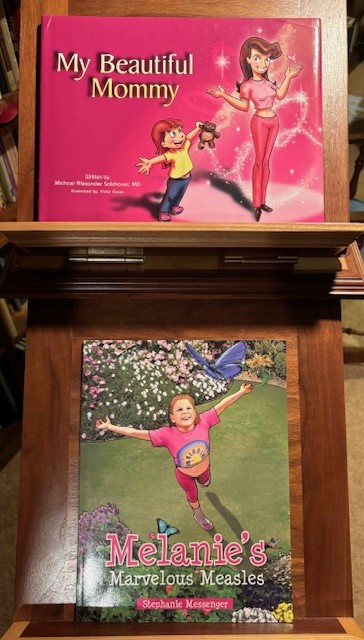
“My Beautiful Mommy” by Michael Alexander Salzhauer, MD, 2007, is a book about a young girl, and her mother explaining about having some cosmetic surgery: nose job and tummy tuck. Mmmm, not sure about this one. Is it important enough? There is a note on back cover that “a portion of the proceeds will be donated to charities dedicated to repairing facial deformities in third world nations.”
Last is “Melanie’s Marvelous Measles”, by Stephanie Messenger, 2012. This is a privately published book that tells the story of a girl who gets measles. The author is an anti-vaccination activist, and encouraged her family to get measles and chickenpox, stating that diseases such as these are “quite benign, and according to natural health sources, beneficial to the body.” The book received tremendous backlash to the dangers she proposed by not vaccinating children. The book has been banned from Amazon. The author became an anti-vaccination activist after her son died-she claimed because of vaccinations.
There were also concerns that the book was a dig to Roald Dahl’s book “George’s Marvelous Medicine” because he actively supported vaccinations after his daughter died from measles. Curious side-note is that that 10 of his books have been re-released in 2023 (including that one) with changes to make them “less offensive and more inclusive,” according to his estate.
Where do we go with re-editing and banning of books. Is it better to put government ratings on them, or have them cancelled, or perhaps just caveat lector-let the reader beware.
P.P.S.
My daughter-who has always been a wonderful counselor for my melodramatic ruminating-just informed me that her school this year will indeed have Dr Seuss and Reading Week. She keeps me grounded, and with hope for the future. So back to paraphrasing Dr. Seuss:
“When tweetle beetles fight, it’s called
A tweetle beetle battle.”
But if in this battle, they discuss how to get along with books, it’s called a:
tweetle beetle battle to hassle fragile prattle, that’ll unravel psycho-babble.
 Librarytomes