Today is Clean Out Your Bookcase Day. It is true, books and their cases need to be dusted, cleaned, sometimes repaired. Some also say to get rid of old, unused-gaaaaa-can’t do it-books. I can clean up my library, but I will not clean out and remove (well I have painfully removed some, but it is like abandoning a child. I bring these books home to give them a new life.) Operations like this can be boring to talk about, but let me try. There are some interesting and unusual books on these topic.
First is “The Enemies of Books” by William Blades, 1902. This old book has chapters on various issues that can damage or destroy a library. Things like fire, water, gas and heat, dust and neglect, bigotry, bookworms and vermin, servants and children.

“The Teacher-Librarian’s Handbook” by American Library Association, 1949. There is a chapter on the Care of the Library and of the books. Also, they have a form for using in the organization of a library that I am actually using, to then transfer to computer.
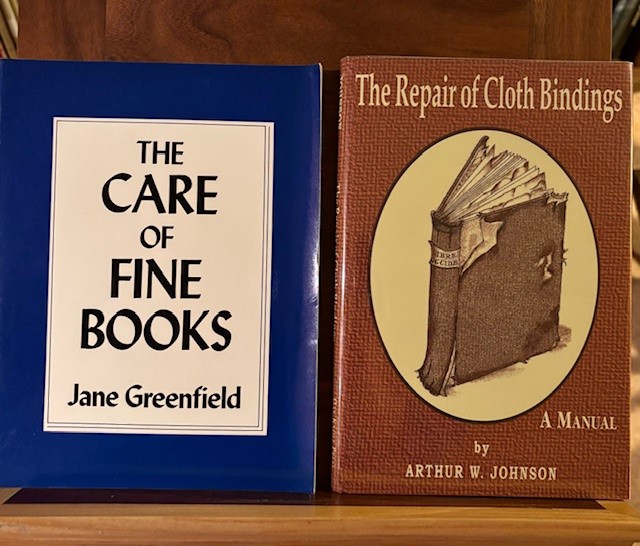
“The Care of Fine books” by Jane Greenfield, 1988.; and “The Repair of Cloth Bindings” By Arthur W. Johnson, 2002.
These were several of the books I used when I attended an adult class on Book Repair and Used Book Store Management at Michigan State University, while opening Target store in Okemos, Michigan.
“Double Fold, Libraries and the Assault on Paper” by Nicholson Baker, 2001. This is an interesting book about putting records on microfiche, and film, and destroying hard copies of paper, especially newspapers in libraries, due to space and decomposition of paper. Nicholson is very passionate about the conspiracy throughout libraries. It is a riveting book.
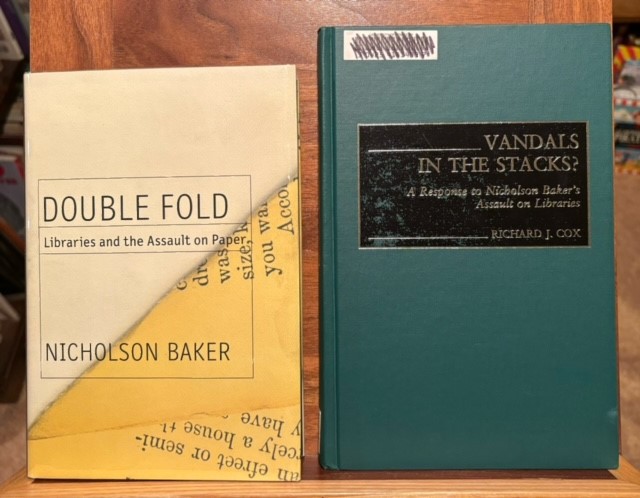
Vandals in the Stacks? A response on Nicholson Baker’s Assault on Libraries” by Richard J. Cox, 2002. Due to the media success of Baker’s book, librarians and archivists were looked down upon as simply getting rid of paper records, indiscriminately. Baker was painted as a whisleblower and saviour, while everyone else were bad guys. This interesting book fights back, showing limitations and distortions of Baker’s book, and questioned research and assumptions drawn.
In the end, Cox explains that there are good points with Baker’s book, and that those parts should be answerable to librarians and archivists alike. However, other parts are written by an author for book sales, and fanciful assertions, not for saving library original documents and books. This is a well done book debating issues and helping understand librarian issues of preservation, storage, and the roles that current libraries serve.
When Swiffer dusters came out in 1999, I was soon pointed out to them while at a book convention. Swiffers were not invented for libraries, and book collectors, but they are perfect. They can clean tops of books, without removing them, and are safe to use with old or new volumes. Sadly, according to my wife, I keep my library much more dust freer than the rest of the house. Now she has to work on me for the piles of books I have scattered about, as I research and plan stories about books and connections.
I don’t have a stack of books for another National Day today, that of the Toothpick. I do have a book of toothpick holders, “A Collectors Book on Toothpick Holders” by Florence Mighell, 1973. It is a book listing types of glass and ceramic toothpick holders, by design and by maker. There are detailed pictures to assist for the collector. I also have the book “The Toothpick, Technology and Culture” by Henry Petroski, 2007. This signed book tells us of the history and the manufacture of toothpicks. Most toothpicks were made from birch. Very interesting to see how small wood logs were peeled into veneer and then cut with automatic blade to size of toothpicks. This is an interesting story of the toothpick. In the stacks, I have another book by Petroski, “The Pencil”.

Turns out they are not going to make toothpicks any longer. They are long enough as they are. Keep reading.
 Librarytomes