Today is National Cabbage Day. To learn about cabbage culture, I first turn to “Cabbages, Cauliflower, and Allied Vegetables. From Seed to Harvest” by C.L. Allen, 1907. This is a book by Orange Judd publishing. They famously printed books for farmers. I have 1 1/2 bookshelves devoted to Orange Judd books. For cabbages, I found some interesting history. At the time of this books writing, all of New York and Brooklyn bought their cabbage from Long Island and New Jersey (within a span of 15 miles from the city hall of New York).
One farmer spend his cabbage career, working strains of cabbage so he could have the earliest harvesting one. Came up with ‘All Head’ the best Early Flat Dutch cabbage to date. It matured over 5 days before others. He had a weeks advantage for selling cabbage, and was the envy of all other farmers. His cabbage seeds were only made available to other farmers after he died.

There was a big market for cabbage, and there was an early and a late planting season. the book gives details on whether to seed, or in some cases transplant seedlings. Also learned about the bugs and funguses that can attack cabbages. Also discusses pros and cons of all types of varieties of cabbages, and how to store them through the winter. This is a farmer’s guide.
The next book is “The Orange Judd Cookbook” by Adeline O. Goessling, 1914. This is a great handbook for a farmer’s wife. There is everything for baking, cooking, canning, butchering, pickling, if it came from the farm, there would be a recipe or instructions on it. I looked up for cabbage. There were recipes for pickling cabbage and beets, pickled red cabbage, pickled white cabbage, and cauliflower pickle (I hadn’t discussed cauliflower growing from earlier book, they were more fickle to grow). Of course, there was a large entry on how to make sauerkraut. I have helped some old friends make sauerkraut with this recipe. They used a 35 gallon crock, with wooden lid to ferment it. The crock, and cabbage cutter were over 75 years old.
Rumor has it that cabbages can slow hair loss (and speed digestion).
Today also markes the death of Geronimo, June 16, 1829 to Feb 17, 1909. The book “Geronimo, Wolf of the Warpath” by Ralph Moody, 1958, is another Landmark Book. While I don’t have the entire set, I have most. These books were extremely popular for Baby Boomers, when going to the school library. That is why I like them, I remember those weekly trips to the library. The series is still popular with homeschoolers, because of the topics, both american, and world. Each book would be a focused topic, and under 200 pages.
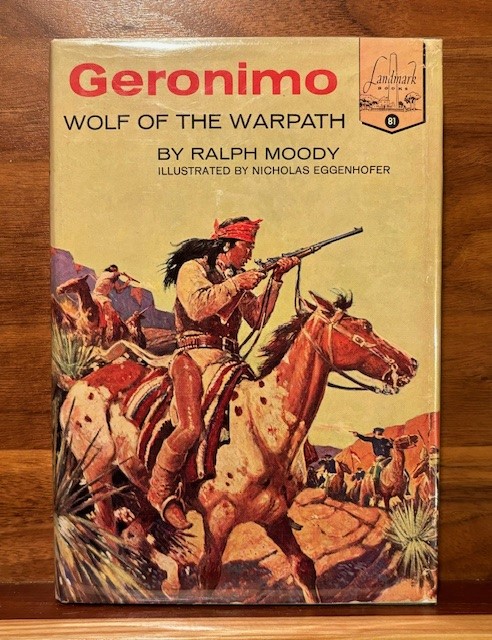
Geronimo was an interesting person. This is a good account, and written for young adults. Geronimo was a fearless fighter, one of the most dangerous Indians. He could ambush quickly, and escape just as quickly. He hated the Mexicans first and foremost because they killed his family, he always held that grudge.
He was captured three times to be put on reservations, and escaped each time to continue fighting raids against United States. He had made enemies with other Indians because he would not embrace working with the government, and living on a reservation. There were thousands of US soldiers, along with Apaches, and Mexican soldiers tracking Geronimo for months, before he finally surrendered. Geronimo, in the book, “would be remembered as the last Indian leader that tried, through warfare, to turn back the tide of white civilization.”
I keep my bookcase of Landmark books in our spare bedroom. There, if a guest would like to browse through, they are certainly going to find an interesting, easy to read, book. There are probably 150 books within. One of the endorsements printed on the back cover of this book is: “They catch the imagination; few students will read only one of these landmark books. If one is read, the rest will be devoured.”
I will add that they will be devoured much more readily than any cooked cabbage recipe. Keep eating.
 Librarytomes