National G.I.Joe Day and the beginning of National Can Food Month. They both fit together. I hope. Let’s figure out why.
February 1st is National Can Food Day. This is to celebrate canned fruits and vegetables, and how we can now use these foods all year long. The process began during Napoleon’s reign. He wanted a way to keep food safe and edible for his troops. ”The Canned Food Reference Manual”, 1949, by The American Can Company, is a good start for canning. It gives us a brief history of canning, along with using tin to keep everything sanitary. The book also shows basic steps for different parts of the canning process. Then there is much detail on nutrition values, along with the regulatory programs for the US government.
The second book is “Practical Canning” by Arthur Lock, 1949. This book is more centered on the cannery itself. How one receives the fruits or vegetables from the field, and then the processes needed to clean, blanch, sort, fill, seal, and cook (sterilize/pasteurize) the products.
For example, in fresh peas, a dump truck drops off a load of peas from the field. The pods are mostly removed from harvesting at the field. The peas go by conveigher into a blower, and sorter, that seperates most of the rest of anything that is not an actual pea. It is then moved down a long trough with water, that has ridges along the bottom (riffles) that allow the peas to float along, and most rocks to stay caught in those riffles. The peas are dumped into a pea cleaner called an Olney. Peas are again sorted by size, along with being washed in a vat with mixture of soap and oil. Soap cleans the peas, oil clings to non-pea or broken pea roughage, and floats; stones and bad peas sink to bottom. The Olney then suctions the center part (with only good peas), and sends that to the Blancher. The Blancher machine then flash heats the peas, before sending (again via water) to quality control section, and then be actually canned and sealed. The sealed cans are sent to steamer to be cooked thoroughly, then to be cooled and labeled. There is a specific chain of events for all vegetables and fruits that have to be canned. There is a separate cannery, or at least line of machines for each vegetable.
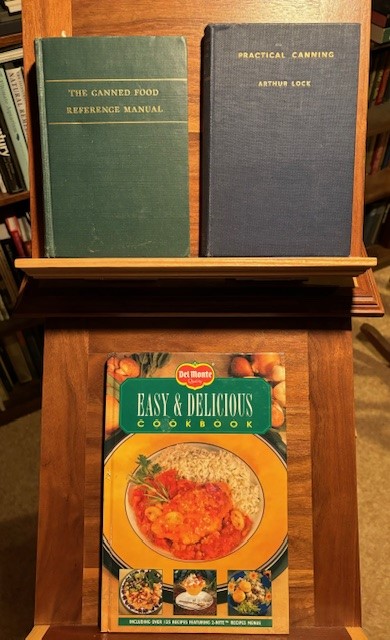
The third book is a cookbook from Del Monte, “Easy and Delicious Cookbook”, 1996. Del Monte has been canning since 1886. This cook book was made to suggest new ways of using canned vegetables and fruits into everyday recipes.
My personal connection to all of this happened in college. I signed on for a summer job at a local Del Monte canning company. There were three levels of workers at the cannery: a small crew of full timers; migrants (put up in mobile homes behind the factory); and college students. I was hired as a quality control for peas. That meant that I was an actual pea counter-taking samples, and checking quality at the beginning, middle, and end of each truck of peas that came from a farmer’s field. They got paid on how good the quality was for each truckload.
I quickly moved up to work inside. scraping the conveyor as peas went through the pea blower, before dropping into trough of water and going to the riffles, on the way to the Olney cleaner. I was also backup to the the Olney operator, who had to constantly add oil and soap to the machine so it would sort properly and efficiently. I could see then where the peas got piped out of the Olney, to the upstairs blancher (all automated, no workers), and then back downstairs to some shaker tables, that had migrant women visually looking at the shaker tables for any rocks or bad looking peas still in the mix. There would be four tables, each with four women reviewing peas. As the peas passes through the shaker tables, they would be dropped back into a tube to be sent to the cannery.
One day the Olney operator called in, his wife had heart attack. Del Monte put me in charge of the Olney machine. I regularly measured the quantity of oils and soap that went into the machine (the older guy had after 15 years, just ‘eyeballed’ it). Very quickly, I was receiving praise as the quality of peas improved dramatically. They supervised me less as I was doing such a great job.
Then one day, I went outside where the trucks were dumping peas on the conveyor, just for a breath of air. There were several frogs hopping around. (if one made it inside on the conveyor belt, it would have been sorted out from the blower at the beginning of the line). I quickly grabbed one and snuck it inside. I then, when clear of supervisors, ran upstairs to the blancher. I threw the frog in the pea pipeline after the blancher had flash-cooked the peas. I ran back to my post at the Olney machine, and waited for excitement at the shaker tables. Sure enough screams shortly rang out. This poor frog was trying to hop away on the shaker table, but it was shaking too much. All the women were frightened, and screaming. I grinned to myself. Good joke.
Then the alarms went off, and the entire line shut down. I hadn’t realized that the IDA (Illinois Department of Agriculture) was doing an inspection. In a few moments, they were by my machines questioning me. I set down my measuring cans of oil and soap that I conveniently was holding and walked them along-as I now was the senior person operating. I denied seeing anything in system. As I had not told, or shown anyone else what I was doing, no one could contradict me. And my quality control record was great. At the end, the IDA closed down the line for the rest of the day, and had the cleaning/sterilizing team come in early. As my record was still great, at the end of pea season, and beginning of corn season, I was promoted to operate the corn mixers and steamers, for blending and cooking cream-style corn to be canned. I may, or may not have been involved with an incident there. Perhaps a story for another day…
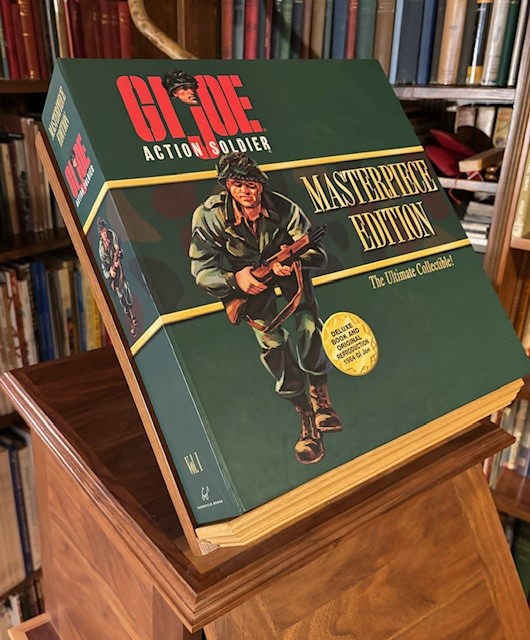
February 1st is also National G.I. Joe day. In February of 1964, Hasbro released the first G.I.Joe doll. I am showing the book and doll edition that was released in 1996. It has a replica 12 in doll, along with a book that discusses the making of GI Joe, along with prototypes of the figure, and advertising campaign. This is the book to read for everything GI Joe.

I remember before Christmas on year, growing up, discovering where Mom hid our Christmas presents. I found wrapped presents, in the back of my sister’s bedroom closet. I planned that on the first day I was alone, to sneak in and unwrap some presents to see what I was getting. I started with the big presents. Being crafty, I could rewrap presents so they looks as good as new. I am still a master present wrapper (and unwrapper, if needed). When I saw that I was to get the GI Joe action jeep, and my brother was getting the helicopter, I was mad. I wanted the helicopter. The next two weeks had me torn from switching the labels, to just feeling miserable. I accepted my fate, and played with GI Joe and his jeep. Turned out to love jeeps. My wife gifted me a real jeep (1998 Jeep wrangler) on my 60th birthday.
It seems that I have found myself doing things that I probably should have not done. In both of these events, I came out OK. Please keep reading. If not books, at least of my escapades.
 Librarytomes