Today is World Neglected Tropical Diseases Day. The World Health Organization would like to keep focus, and raise the profile of diseases in vulnerable areas around the world. I have a huge two volume set of books called Insects, Ticks, Mites, and Venomous Animals, of Medical and Veterinary Importance”, by Walter Scott Patton and Alwen M. Evans, 1929 and 1930. Volume One is Medical information, 786 pages. Volume two is Public Health information, 740 pages.
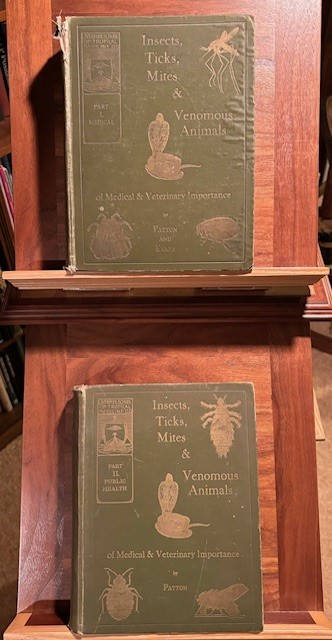
These are textbook training for tropical medicine. Volume one gives us training of “medically important insects and Acari”. There are plenty of illustrations and photographs, along with descriptions. The first book was to be taught in twenty-eight one hour sessions, followed by demonstrations and labwork.
Volume two on involvement with Public Health, has equally impressive and detailed illustrations, and photographs. It was to be trained with nine meetings of two hours each. The author acknowledges that it is almost impossible in that short time to cover the whole ground of teaching tropical medicine, so he writes important summaries for the training of each session (at the end of each written meeting-or chapters/sections- along with what to teach if there were more meetings allowed.) The students were recommended to read the chapters beforehand, then go to the meeting (for either volume), to facilitate learning of such broad topics.

There is a dedication at the front of each book to the memory of the following “well-known medical Men and Scientists, along with other Workers of all Nationalities who have died while investigating the Etiology of those Diseases the causal Organisms of which are transmitted by Insects and Acari.” It then lists twelve Drs. names and what they died of, diseases that ranged from Yellow Fever, Tick Fever, Sleeping Sickness, Amoebic Dysentery, and Typhus.
The dedication ends with the quote: “Sic vos non vobis”, latin for ‘You work but not for yourselves.”
These diseases, and the creatures that spread them, are still in the world today, along with others more recently discovered. It is unfortunate that while these texts are very interesting old books for those who have a thirst of knowledge on such topics, people today continue to die, in spite of the information that has been described to help cure and treat those who are afflicted. Politics plays no small part in this matter. Learning of, and then talking about (with healthy debates), will help keep the awareness of these issues alive. Keep reading.
 Librarytomes