Today is Thomas Crapper Day. Crapper had a plumbing Company in England, with many patents on the workings of a toilet. While he did not invent the toilet, he made many improvements with it. I happen to have quite a few books on plumbing and water sanitation to celebrate today.
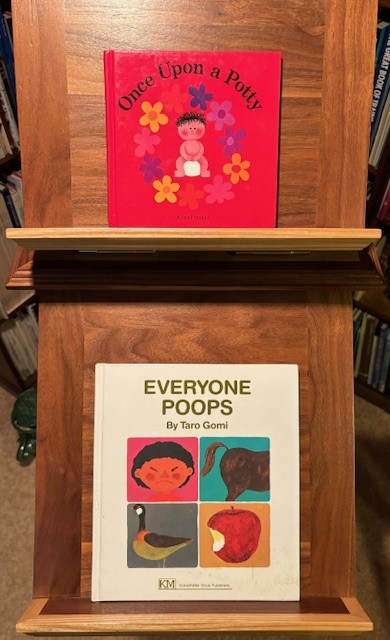
I cannot pass on first showing several kids books on the subject(?!). Let me show you several. Number One “Once Upon a Potty” by Alona Frankel, 1980. It is a cute book to help kids use the toilet. And Number Two “Everyone Poops” by Taro Gomi, 1993. It is a funny book about bunches of different animals, and something they all do…poop.
Much like the process of cleaning waste-water, one must first screen out a few of the books I have on this subject. I will show a few of the more interesting and unusual ones. First is “Sewer Gas and How to Keep it Out of Houses, a Handbook on House Drainage” by Osborne Reynolds, 1872. Reynolds states “my chief objective in writing on this subject was to suggest a plan for preventing the evil which is causing so much alarm—vis. the back-flow of gas into our houses.”
Next is “Municipal Sanitation” by W.A. Hardenbergh, 1932. The book is in three parts: Purification of Water; Sewage Treatment; Municipal Refuse.” The book shows how to clean water, with steps methods, reasons, even softening hard water. Then there are chapters about sewage, filtering, processing, and machinery involved. There are wonderful fold-out pages on some of the processes. The last section is about rubbish, food wastes, and other refuse. How to deal with trash, ashes from heating homes, dead animals. Ways to collect, types of containers, street sweeping are other topics. Finally goes into how to dispose, using open dumps, bury, incinerate, or feeding to pigs, are some of the solutions. Another interesting book.

Next I have “Farm Sewage” by Ellis Santee, Orange Judd publisher, 1912. This book discusses home sewage, home piping with indoor plumbing and a great deal about septic tanks. Some farmers would use open cesspools, or empty into streams. This book was to combat those other dangerous and illegal ways of sanitation. I have a good collection of ‘Orange Judd’ published books. They were a company that printed books for farmers, on all sorts of subjects. Farm folk, it turns out were pretty literate, and there were loads of government publications, and books printed on everything. There are perhaps 50 Orange Judd books on all subjects farming in my library. One might need a book on Asparagus culture, or Peas, or Rhubarb, or Celery, or Potatoes, or Sweet Potatoes, Strawberrys, Pigs, Cows, Chickens, Bees, Irrigation Methods, Drainage Tiles for fields, types of Manure, etc. Several are from the 1860s and 1870’s. I will later have a full story of Orange Judd books and the farmer.
Last book on today’s topic is “Military Hygiene” by Frank Keefer, 1918. This book has the basics for personal hygiene but then goes into much more. With WW1 just ending, there are chapters on trench warfare, rather hygiene in trenches. How to make and where to use latrines, in camps and posts, and while on marches and battlefields. And even though written in 1918, it would not be a training book for soldiers, if there was no discussion on alcohol, narcotics, and Venereal Disease. Another sidenote to this book is the stone holding open the page. (go look!) It is really fossilized coprolite (dinosaur poop).
This is a lot of reading thanks to Thomas Crapper. On a personal note, I have notes including my grandparents, with this subject. My grandmother was one of the last homes, at least in her area of town to have an outhouse. She was terribly embarrassed. When she got her first job (at John Manville as a copier), she took her first paycheck to neighbor, who bought a used toilet from Great Lakes naval base when they were remodeling a barracks. He installed it for the family. She was 17. Much later, my grandfather was on board of trustees, and later President of North Shore Sanitary District. The NSSD would treat water for all of Lake County, as well as supervising and safeguarding Lake Michigan and various rivers in the county. I have a picture of him and I towing an outhouse, in Zion parade.


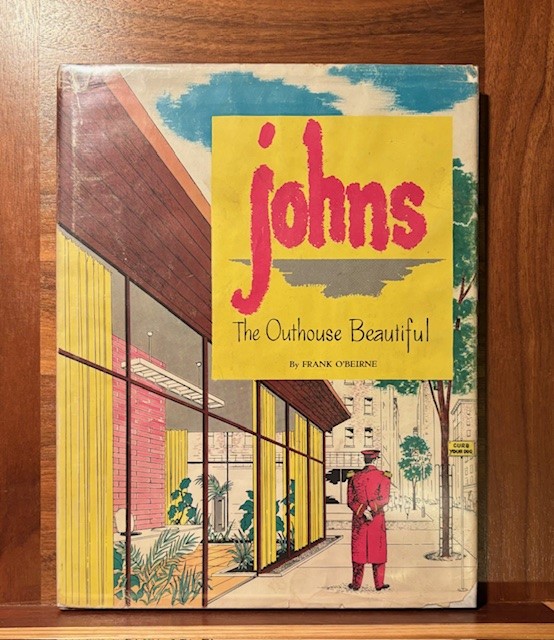
While I will not end now with the book “Jokes for the John”, I would rather show an interesting book about outhouses, using different humorous architectural styles. This is “Johns, the Outhouse Beautiful”, by Frank O’Beirne, 1952. I have included ‘The Fortress” and “The Rumble Seat”


So without passing judgement, keep reading…even if only in the bathroom.
 Librarytomes