Today we have several books that will pull together two different Events. We have National Hot Tea Day, and National Marzipan day.

We will start with The “Candy Book” edited by Ruth Berolzheimer, 1941. This Culinary Arts Institute book has ” everything you need to know about making… Marzipans.” It says that marzipan translated literally, means almond bread…a foundation of ground almonds are used. There is a simple recipe for making almond paste for marzipan. The basic ingredient are almonds, though I am reminded in “Hard to Crack: Nut Trees” by Meredith Sayles Hughes, 2001, that nut confectioners consider true marzipan to also have a small amount of Bitter Almonds, however those almonds are banned in America because of the cyanide content.
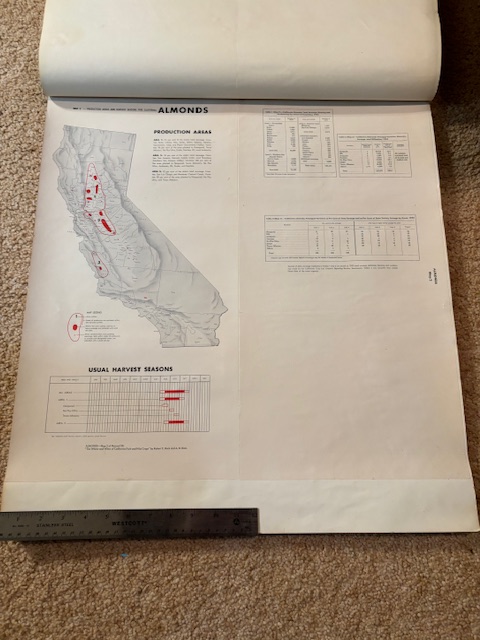
The Largest book in library (22 1/2″ by 24″) is “the Where and When of California Fruit and Nut Crops, by Robert Rock 1955 by The University of California, College of Agriculture. The page I have open, shows where the main areas of almond growing are, and when harvesting times are by month.
The book “Encyclopedia of Cookery: over 1300 pages” published in 1949, has another, slightly more intricate recipe for Marzipan, and explains about making them into small potatoes, or other fruits and vegetables shapes. Those candies ae used in both my Swedish and German heritages during the holiday season. We will get back to this book later.
The book “A World of Nut Recipes” by Morton Gill Clark, 1967, also reminds us about bitter almonds having cyanide, but that Europe can use several individual bitter almond nuts in a batch of marzipan. It also has a basic recipe for marzipan (without bitter almonds). After going through 11 pages of almond recipes, the last one is an almond tea, made with almond paste and water, strained then heated.
That brings us to National Hot Tea day today. One can combine the two holidays into one with Almond tea, or we can go back to “The Encyclopedia of Cookery” and review tea making. There are several pages about the history and cultivation of tea. There are also three type of tea, Black, Oolong, and Green. We are reminded when making tea to measure exactly for strength, and do not just brew longer or shorter. There are specific times for steeping, based on type of tea, and hardness of water. When making a pot, we do not use a spoon for each person, and a spoon for pot, rather just proper spoonfuls. Then there are several pages of other recipes for using tea.
The last book is “The encyclopedia of Fortune-telling by Francis X. King, 1988. There is a chapter in telling one’s fortune using the tea leaves in the bottom of one’s cup. They do recommend using the pot recipe of one spoon per person, and one for the pot when making tea.
So take a tea break, and then even a snack break, but don’t forget to go back to the library and dig into a full meal of reading.
 Librarytomes